

Carsten Rossi
Managing Director · Kammann Rossi
LinkedInThe digital front door for your company
News, tools, and tasks in employees’ pockets
Internal newsletters at enterprise scale
Create once, publish everywhere
Trusted answers and actions for every employee
One source of truth for internal comms
Connect your tools and AI agents via MCP and A2A
Teams, SharePoint, Outlook, Copilot, and Viva Engage
Get IT help and submit requests in Staffbase
Works with the Google tools your teams already use
Request leave, check balances, and get HR answers
Assigned learning that reaches the frontline
Carsten Rossi and Frank Wolf make the case that unlocking AI's full potential means comms has to become an orchestrator — and that only works with a super app behind it.
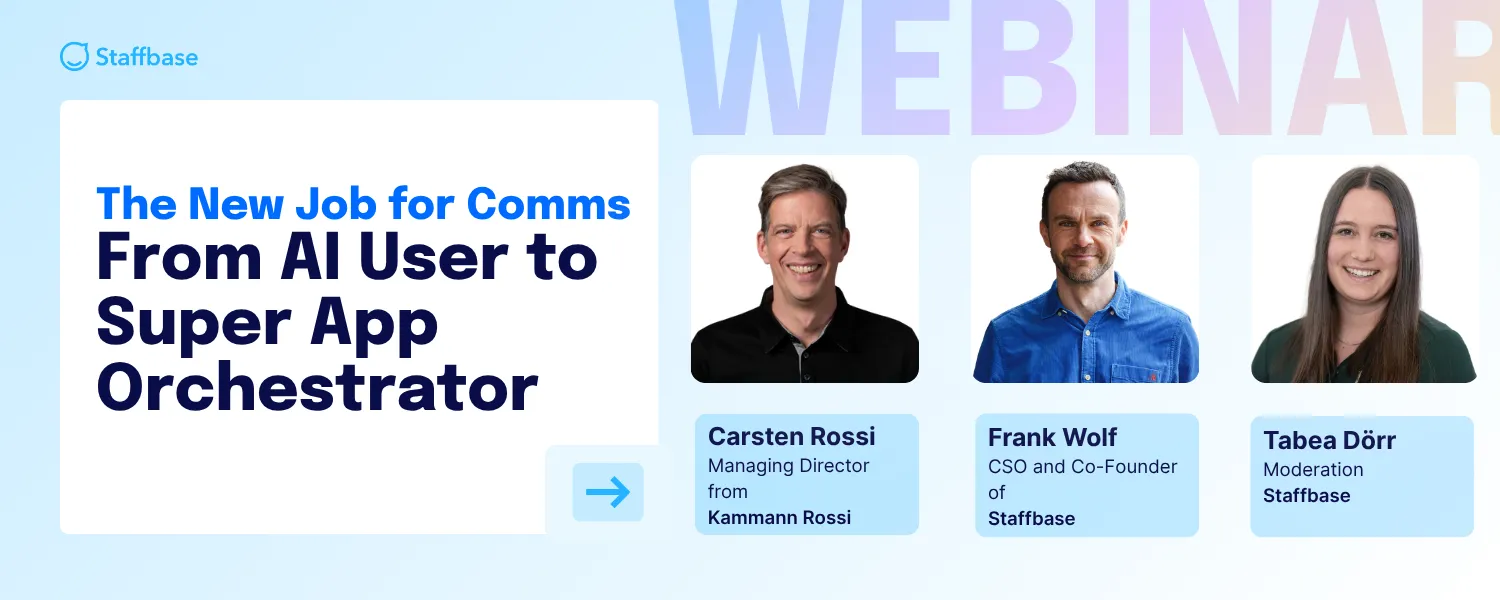
Most companies have already rolled out AI for employees — a chatbot here, a smarter search there. But rolling something out isn't the same as using its full potential, and that gap is exactly where comms comes in. In this talk, Carsten Rossi and Frank Wolf make the case that AI is reshaping what comms actually does: not just writing updates, but deciding what employees see, when, and through which channel — in other words, becoming orchestrators. Carsten brings data from a survey of roughly 6,000 employees at a German industrial company: those who use AI at least weekly rate the relevance of company information 18 to 23 percentage points higher than those who don't. Frank walks through a real case from Brussels Airlines, where a chatbot now handles employees' annual leave questions directly, taking the load off HR and middle management. Together, they argue that neither AI nor comms can pull this off alone — it takes a super app to bring both together. And nobody needs to overhaul everything on day one: by the end, you'll have a starting point for your own first use case.
Real survey data on how weekly AI use changes whether employees find company information actually relevant to them.
A concrete case — Brussels Airlines' leave-request chatbot — showing what AI-as-orchestrator looks like outside a slide deck.
A framework for the new comms role: from writing content to curating and orchestrating information and functions
A realistic way to start: picking one use case instead of trying to rebuild your whole tool landscape at once.
