
How Staffbase and ServiceNow create a unified employee experience
See how Staffbase and ServiceNow bring workflows and communication together to reach frontline teams and deliver a unified employee experience.

Felicia Flemming in About Staffbase
ServiceNow has become a strategic pillar of the digital workplace, powering workflows, standardizing processes, and helping teams deliver services at scale. As an official ServiceNow partner, Staffbase shares this vision and works closely to complement it. However, as organizations push to use ServiceNow for employee communication and engagement, a critical gap becomes clear.
A workflow platform built for complex, tech-driven processes naturally isn’t optimized for the everyday communication needs of a diverse — and especially partially deskless — workforce.
This blog looks at why and how an increasing number of organizations are bringing ServiceNow and Staffbase together to unite workflows with communication and deliver a seamless and personalized employee experience.
Where ServiceNow is a game changer — and where it isn’t
ServiceNow has evolved from an IT Service Management (ITSM) tool into one of the most powerful workflow engines in the enterprise ecosystem. IT, HR, and operations teams rely on it to automate processes, standardize service delivery, and bring order to complex workflows across the business. For these process-heavy functions, ServiceNow delivers exactly what it promises: efficiency, consistency, and control at scale.
But as organizations expand their ServiceNow footprint, many are now relying on it as the central gateway to the employee experience — the place employees rely on not just for tasks, but for the communication that guides their work.
This raises a critical question:
Is a workflow-based portal really enough to support a great employee experience — especially for frontline teams?
ServiceNow was built to power extremely complex workflows and automations — not to deliver a simple, intuitive employee experience. It's a platform catering to tech-savvy users who live in systems, understand configuration logic, and work inside structured digital environments.
The platform includes hundreds of modules, deep configuration layers, and specialized roles, all built to manage large volumes of data. This inherent complexity is why a broad technical partner network emerged over time to support large-scale ServiceNow deployments.
But this architecture poses major challenges when the goal is to deliver an employee experience based on ease of access, clear orientation, context, personalization, engagement, and inclusivity for every worker. Unlike knowledge workers, frontline employees — including shift teams, field technicians, drivers, retail staff, caregivers, and factory workers — do not operate in workflow-centric environments.
ServiceNow was never designed for this reality. These employees need information delivered to them proactively and clearly, through channels that match their mobile, distributed, and time-sensitive work patterns. And communicators, editors, HR teams, and local managers need a publishing system built for clarity, speed, and scale.
Those limits show up in two predictable and costly ways:
It creates an admin and publisher bottleneck.
It fails to reach frontline and non-desk employees.
Here’s what this means for organizations in practice.
The first major gap: A complex backend leads to admin and publisher bottlenecks
ServiceNow is engineered for process owners, power users, and technical administrators. That’s its strength — but it’s also why it becomes a bottleneck when organizations attempt to use it for comms.
For communicators, HR teams, and local, onsite contributors, ServiceNow’s powerful workflow capabilities come with a level of complexity that makes simple publishing difficult. Editing content feels technical, page creation requires specialized skills, and organizations often need ongoing training and additional admin support — all of which increases costs.
These challenges are only amplified when companies want to decentralize their comms through part-time editors who are essential for local, employee-facing communication. The result is predictable:
Communication slows down, business teams lose autonomy, and the reliance on IT drives up costs and effort.
Gartner echoes this reality. In its analysis of ServiceNow as an intranet and portal solution, Gartner notes that ServiceNow’s content and communication capabilities are “a side use case,” emphasizing that:
“ServiceNow has the foundation for building an intranet, but it wasn’t designed with communicators in mind. Without a true CMS or intuitive delivery tools, even simple content updates require extensive training and technical expertise. It’s a powerful workflow platform, just not an employee engagement platform.” – Large Enterprise Staffbase and ServiceNow customer, North America
A modern workforce requires fast, decentralized publishing. Regional managers need to keep shift teams updated. HR needs to roll out policy changes. Leadership needs to communicate at scale. And none of that should require workflow configuration skills. This is why many enterprises pair ServiceNow with a lower complexity, frontline-ready platform.
The second major gap: The portal’s not fit for frontline and non-desk workers
The frontline worker’s reality: they’re constantly on the move, distributed across locations, and operating on shift schedules. They only have fleeting moments to absorb the communications, tasks, and information they need to do their job and stay connected to their company culture and strategy.
Because ServiceNow is built for workflow execution — not workforce communication — it isn’t optimized for frontline employees. It excels for power users, process owners, and desk-based employees in structured, system-driven environments; it doesn’t meet frontline needs.
But the majority of the workforce — including frontline employees, shift teams, field technicians, drivers, retail staff, caregivers, factory workers — do not operate in a workflow-centric environment. They aren’t navigating dashboards. They aren’t scanning portals between tasks. And they aren’t logging into IT request systems during a shift.
They need critical information to come to them — proactively, clearly, and through channels built for mobile, distributed, and time-sensitive work patterns.
Gartner reinforces this mismatch, noting that ServiceNow “may not meet the needs of organizations with more flexible or distributed channel requirements.” In other words: if employees aren’t already living inside ServiceNow, they will not suddenly start — no matter how much content is placed there.
This creates two critical business problems:
Frontline employees miss essential updates. HR policies, safety updates, operational changes, and leadership messages never reach the people who need them most.
Critical ServiceNow resources don’t reach all audiences. Knowledge articles, ticketing workflows, and other essential resources often never reach frontline teams, causing low adoption and reducing the impact of IT’s digital workplace investments.
This isn’t just a communication problem. It’s an architectural one.
Frontline and non-desk workers require a different model: information delivered proactively, in formats and channels that match the realities of their workday. That’s why companies are most successful when they combine ServiceNow with a dedicated frontline experience hub.
The solution: a frontline experience hub that completes your ServiceNow strategy
 The answer to ServiceNow’s communication gaps isn’t to stretch the platform further. Robust configuration of the platform, a heavy time, and resource investment will ultimately not address the challenges ServiceNow presents as the primary communication channel for hybrid and frontline-heavy workforces.
Organizations need to pair it with a purpose-built layer designed for reach, clarity, and rapid publishing — a Frontline Experience Hub.
This is a critical need for organizations with large frontline or mobile workforces, where portal-based systems simply cannot achieve high adoption. There are three key benefits to this approach:
1. It empowers business teams and leaders to communicate instantly and autonomously — without IT or complexity.
Communicators, HR, operations, and local managers can publish timely, relevant updates without technical training or workflow configuration. This is especially crucial for comms teams, as they are expected to do more with fewer people. It enables true proximity communication by empowering local teams to share timely, relevant updates directly with the people who need them.
2. A frontline experience hub works seamlessly alongside your productivity portals and delivers essential updates to every employee, not just those at a desk.
Frontline workers often miss HR policies, safety alerts, operational changes, and leadership messages because they don’t regularly access productivity portals. Staffbase proactively delivers information through the channels they already use — their branded company app, push notifications, email, digital signage, kiosk screens, SMS — ensuring critical updates actually reach the people who need them most.
3. It turns IT’s digital workplace investments into real adoption and measurable ROI.
World-class workflows and services don’t matter if employees never see them. Staffbase closes the “last mile” by surfacing ServiceNow services, HR resources, and operational updates in context, driving awareness, usage, and measurable return on the systems you already own.
How Staffbase integrates with ServiceNow
Solving the communication and frontline gaps doesn’t require reorganizing or replacing ServiceNow — just extending it.
Staffbase delivers out-of-the-box integrations that unify Staffbase and ServiceNow into one seamless, easy, and personalized digital employee experience.
These integrations support IT governance while keeping the experience simple and intuitive for the workforce, closing the last-mile gap without custom development.
Here’s how:
Bring ServiceNow assets into Staffbase
Staffbase extends the power of ServiceNow by bringing its workflows and resources directly to where employees already work — especially frontline and on-the-go users who rarely visit the portal. Instead of navigating complex interfaces, employees can access key ServiceNow actions and services through a simple, mobile-first experience. This makes assets easier to find, easier to complete, and far more likely to be used.
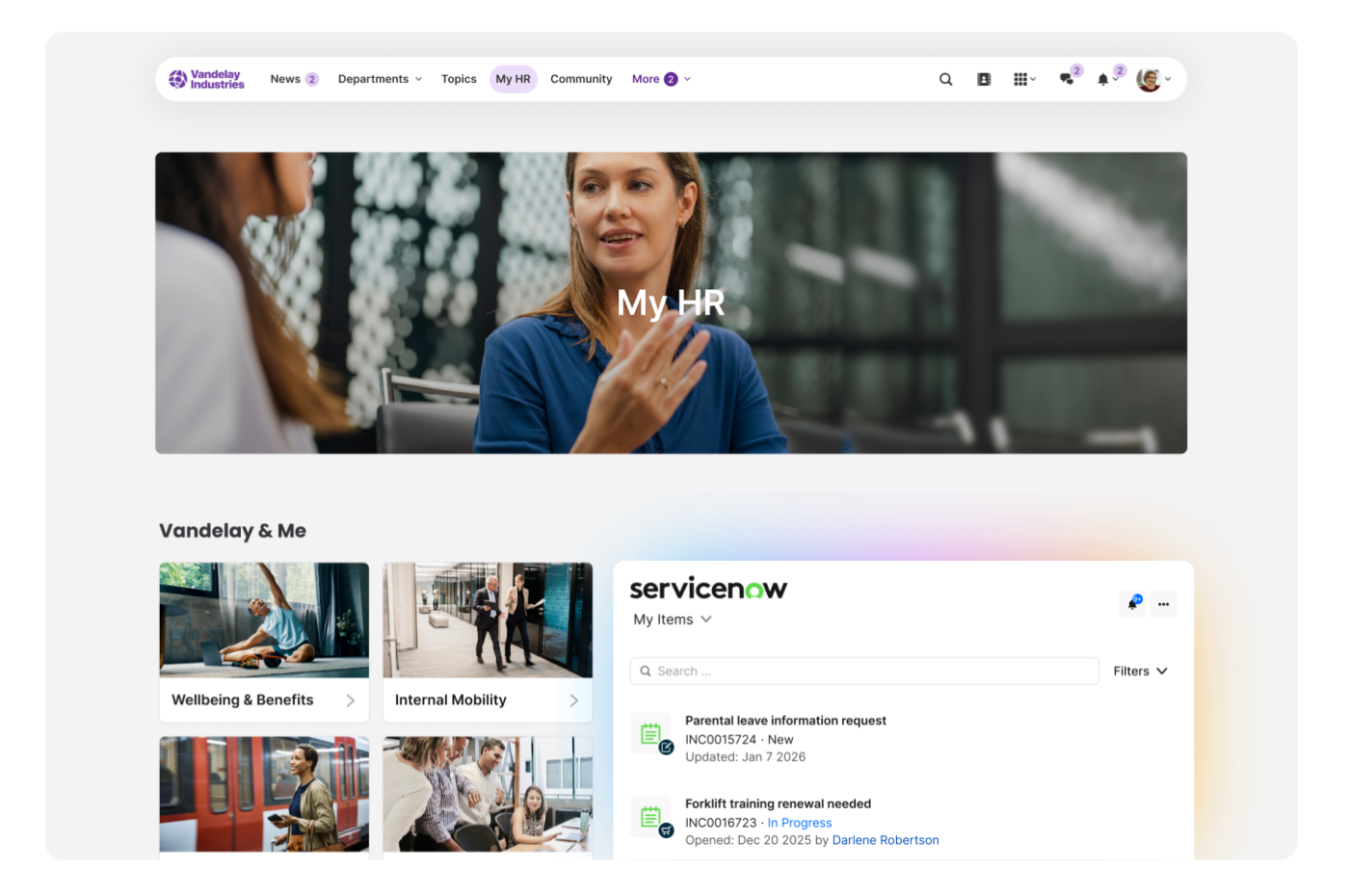 How Staffbase increases ServiceNow adoption:
Surface personal ServiceNow tickets — such as IT or HR requests — through a widget within a Staffbase homepage or a dedicated, contextualized landing page, such as an IT or HR services hub
Allow employees to receive notifications about active requests or launch new requests
Enable employees to search through the ServiceNow knowledge base right from within Staffbase
By meeting employees where they are, Staffbase closes the last-mile gap and boosts the ROI of an organization’s ServiceNow investment.
Publish Staffbase communications inside ServiceNow
Critical updates, news, and HR information created in Staffbase can be automatically displayed inside ServiceNow alongside other channels such as digital signage, email, and employee app — meeting power users where they are.
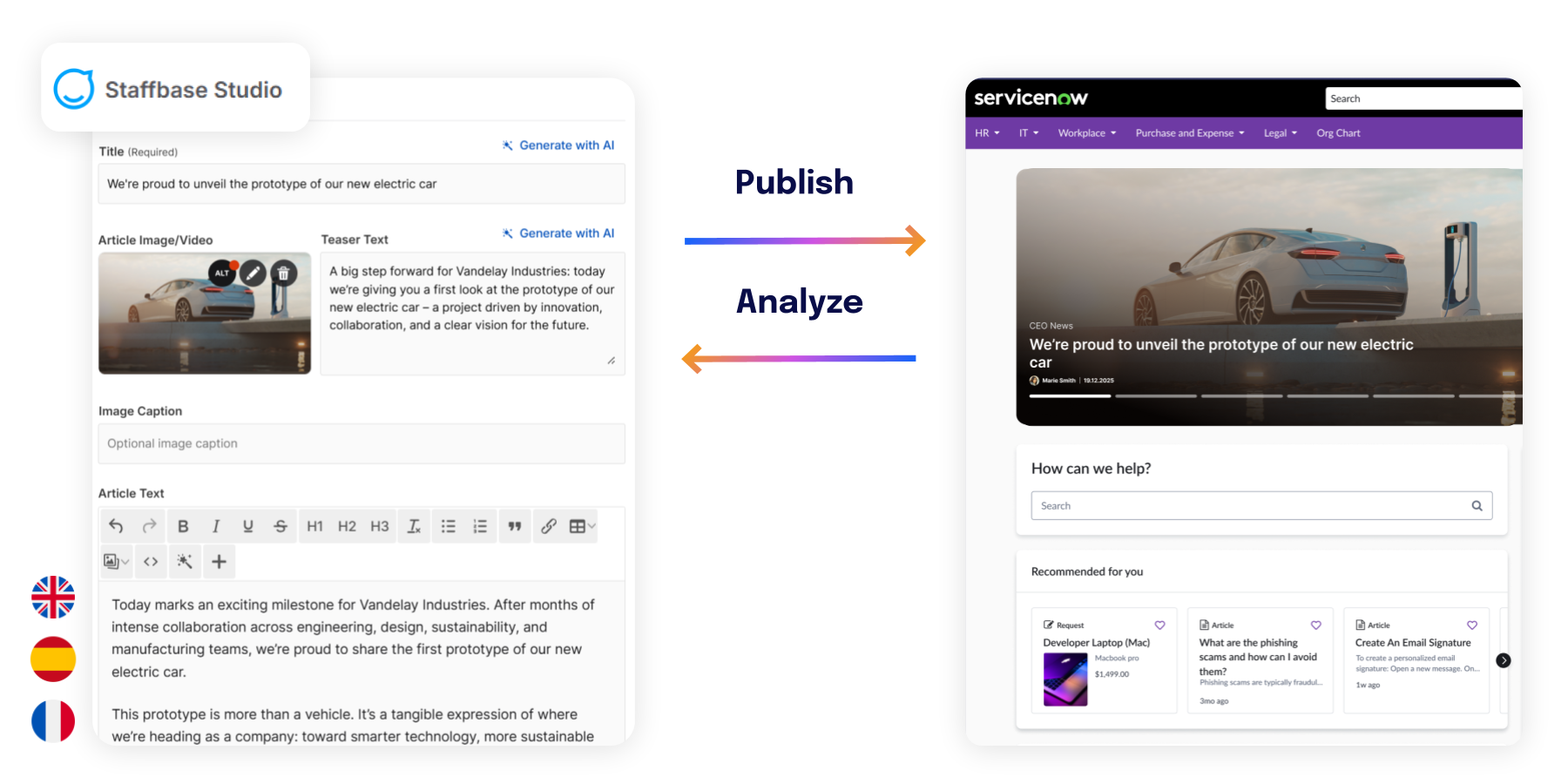 Here’s how Staffbase makes multi-channel orchestration to ServiceNow simple:
Publish company news from one place into ServiceNow and other channels, and measure success centrally in Staffbase
Enable employees to access news relevant to their role and location — and accessible in their language — anywhere they are, including in ServiceNow
Ensure all employees have one place to interact with your news and each other across all channels, avoiding audience silos
This enables a unified end-to-end workflow for communicators and HR managers, while ensuring employees have a cohesive experience across all company touchpoints.
The future: a complete employee experience that works for the whole workforce
 The future of the digital workplace won’t be defined by a single system. It will be defined by how well organizations combine different tools, create meaningful integrations, and establish clear governance structures to provide the best possible digital employee experience for their workforce.
ServiceNow will continue to run the operational core of many businesses: requests, approvals, knowledge bases, and automated processes.
But its design focuses on workflow excellence rather than the reach, clarity, and multi-channel communication needed to inform and activate the entire workforce for complex organizations.
That’s where the frontline experience hub comes in.
By pairing ServiceNow with Staffbase, organizations create a digital workplace that finally addresses the full employee experience:
The workflow engine that standardizes how work gets done
The experience layer that ensures employees see, understand, and act on what matters
This combination solves the two persistent challenges of ServiceNow-led strategies: administrative bottlenecks and frontline disconnect.
And it turns your existing digital workplace investments — ServiceNow, Microsoft 365, your HR systems — into a connected, high-adoption environment that drives real business impact.
Learn how Staffbase integrates with ServiceNow, explore real-world use cases, or book a demo to see what a complete, frontline-ready experience looks like in practice.