


The ultimate guide to AI prompts for internal communications
Stop staring at the blinking cursor. This guide gives you proven AI prompts to write faster, stay on-brand, and boost engagement — without losing the human touch.


If you’ve ever stared at a blinking cursor while trying to find the right words for an internal announcement, you’re not alone. For many internal communications (IC) teams, writing and rewriting content can feel like running an endless marathon with no water station in sight. Enter AI prompts for internal communications — the digital hydration your comms workflow didn’t know it needed.
This isn’t just another “AI will save us all” article (we’ve read those, too). Think of this piece as a practical AI‑powered internal communication guide built to spark creativity, streamline workflows, and empower communicators to use artificial intelligence intentionally and not blindly.
In today’s world, internal communications professionals balance constant demands: delivering clarity, motivating employees, maintaining tone consistency, and proving strategic value. Often under tight deadlines. That’s where internal communications AI becomes a genuine ally. By turning carefully crafted prompts into everyday tools, communicators can produce impactful updates, leadership messages, and culture stories faster and with greater confidence.
At its best, AI doesn’t dilute the human touch; it amplifies it (think electric guitar vs. acoustic guitar). Prompts act as bridges between intention and expression, enabling the translation of complex corporate priorities into messages people actually want to read. The following article shows how innovative teams and communications solutions like Staffbase Employee AI are transforming that simple blinking cursor into a spark for engagement, alignment, and connection across the entire organization.
How AI prompts are permanently changing internal communications
A few short years ago, internal communications AI sounded like an experimental phrase you’d only hear at a tech summit or read about in fantastical books like The Da Vinci Code. Now it’s a daily reality for content creators, HR leads, and comms strategists everywhere. The magic lies not in the AI tools themselves but in how communicators instruct them through precise, well‑crafted prompts that have changed the way we look at work.
A recent Gallagher study found that nearly 7 out of 10 internal communication professionals expect AI to play a significant role in how they work over the next 5 years. Many teams have already started exploring what that could mean for their daily routines and strategies.
They’re part of a much larger movement. Research from McKinsey shows that more than 9 in 10 organizations plan to expand their AI investments over the next three years, signaling that this shift isn’t limited to communications; it’s happening across every corner of business.
For internal communicators, this surge in AI adoption is an opportunity to shift from content producers to strategic enablers — using automation, prompting, and data insights to connect people, inspire action, and shape company culture.
A great AI prompt for internal comms is the difference between a robot reciting bullet points and a human‑sounding colleague helping craft your next CEO announcement. Prompts turn AI tools for internal communication — like Staffbase Employee AI — from generic assistants into tone‑perfect writing partners that understand context, compliance, and voice.
How AI prompts improve internal comms workflows
Every communicator knows the pain points: repetitive tasks, fragmented channels, inconsistent messaging, and the eternal question: “Does this sound too corporate?” Here’s where thoughtfully written prompts make real‑world impact:
Speed: Smart prompting helps generate polished drafts in seconds, giving teams more time for strategy and feedback.
Consistency: Repeatable prompt templates ensure brand voice is maintained across multiple regions or departments.
Creativity: With the proper instructions, AI provides phrasing, summaries, or metaphors you’d never consider alone.
Data‑driven insights: Some AI‑powered internal communication tools can analyze engagement or summarize feedback to refine messaging.
Scalability: Global companies can produce multilingual internal updates using AI translation and AI‑assisted messaging instantly across formats, including email, app, and intranet.
Put simply, great prompts make great communicators even better.
The art (and science) of writing AI prompts
 Before diving into examples, let’s set the foundation.
1. Always define the audience 🔬
Prompt templates should specify who the message targets, such as executives, frontline employees, or entire departments. The AI will then adjust tone and vocabulary accordingly.
Example:
“Write a motivational Monday post for frontline logistics staff in a friendly tone, highlighting the week’s key safety priorities.”
2. Include purpose and desired outcome 🎨
Ambiguous prompts yield generic output. Tell the AI exactly what the message should achieve.
Example:
“Create a concise announcement that informs staff about the new remote‑work policy and encourages feedback in a positive, inclusive tone.”
3. Specify style or brand voice 🔬
Provide context about voice. Is it casual, clear, empathetic, or authoritative? Or even better: teach it your organization’s tone through examples stored in your AI‑assisted communication workflow (like those governed by Staffbase Employee AI).
4. Use role‑playing language for better context 🎨
You can assign the AI a role in your prompt to sharpen tone (so brush up your Shakespeare!)
Example:
“Act as an experienced internal communications manager writing to an international workforce. Draft a short all‑hands update about Q4 sales results.”
5. Refine and iterate 🔬
AI prompts aren’t set in stone. The beauty of generative AI for internal comms is that it learns and improves as you experiment.
10 types of AI prompts for every internal communication scenario
Internal communicators wear many hats: writer, strategist, therapist, and occasional magician. Move over, Houdini! Below are the most practical prompt categories to make each hat fit better.
1. Leadership messages and executive announcements
Your executives are brilliant at leading but often short on time to sound inspiring. Use these AI prompts examples for workplace communication to give their announcements clarity and human warmth:
“Write a 250‑word CEO letter celebrating a revenue milestone. Strike a proud but humble tone and include a short quote about teamwork.”
“Draft a leadership email summarizing this quarter’s results in three key highlights and two improvement areas. Blend positivity with transparency.”
🎩 Pro Tip: Ask AI tools for internal communication to rephrase messages for different audiences, including frontline staff vs. office employees, to match real needs.
2. Crisis or change management messages
No one loves change comms. But with empathy‑driven AI prompting, you can soothe nerves and reduce rumor mills.
“Craft a message explaining an internal reorganization to employees. Maintain transparency while emphasizing future opportunities and support systems.”
“Write a short intranet post addressing system downtime in a calm, apologetic, informative tone. Include next‑step instructions.”
🎩 Pro Tip: Best used with AI content creation internal communications tools that flag emotional sentiment or phrasing for sensitivity.
3. HR & policy updates
Sometimes HR updates feel like legal documents disguised as emails. Fix that with prompts focusing on clarity and warmth.
“Summarize the updated parental‑leave policy in three bullet points with a friendly tone, highlighting employee benefits.”
“Turn this 2‑page HR policy PDF into a short, conversational overview for the intranet homepage.”
🎩 Pro Tip: Staffbase’s Employee AI can automate exactly this by creating short summaries, FAQs, or push notifications from long corporate texts.
4. Employee recognition & engagement
Boosting morale is easier when AI helps write authentic appreciation posts.
“Write a short recognition post for the internal newsfeed, celebrating the customer‑support team for surpassing service ratings. Keep the tone upbeat and personal.”
“Compose five different thank‑you messages leaders can personalize for employee appreciation week.”
🎩 Pro Tip: Tying these to AI for employee engagement metrics, you can even generate prompts that align kudos messages with top‑performing teams.
5. Event promotion & wrap‑ups
We’ve all opened emails about “upcoming town halls” that spark as much excitement as a tax seminar. Better prompts solve that.
“Create a fun invitation for the upcoming hybrid town hall focusing on innovation. Include RSVP call‑to‑action, agenda summary, and playful tone.”
“Generate a social‑style recap message summarizing the employee innovation fair with two employee quotes.”
🎩 Pro Tip: AI can ensure consistent tone across regional internal campaigns, especially when those campaigns feed directly into the Staffbase intranet or employee app.
6. Diversity, equity, and inclusion (DEI) communications
DEI messages demand cultural sensitivity and authenticity. AI prompting helps navigate wording carefully.
“Draft a message celebrating Lunar New Year that balances educational insight with inclusivity and warmth.”
“Create a gender‑neutral announcement inviting staff to participate in a new DEI mentorship program. Include inclusive language per our tone guide.”
🎩 Pro Tip: Communicators can integrate DEI best practices into custom prompt templates for ongoing use.
7. Onboarding and training
Turn mundane manuals into engaging moments.
“Write a welcome message for new sales hires summarizing first‑week actions, using approachable language and friendly humor.”
“Convert these training bullet points into a short, gamified quiz introduction script.”
🎩 Pro Tip: A Great AI content strategy for internal communications involves reusing prompts to create micro‑content tailored to learning stages, ideal for Staffbase Employee AI workflows.
8. Surveys, feedback, and pulse checks
AI prompts can help design messages that elicit genuine participation rather than eye‑rolls.
“Write a brief invitation to complete the annual engagement survey, making the purpose clear and adding a touch of humor.”
“Produce a follow‑up message thanking employees for completing surveys, summarizing key takeaways.”
🎩 Pair these prompts with AI‑powered internal communication tools that can automatically analyze free‑text feedback.
9. Storytelling & culture content
AI can become your creative co‑pilot for internal storytelling.
“Craft an employee spotlight story in 300 words based on bullet points summarizing an employee’s career journey. Emphasize collaboration and growth.”
“Write a short narrative post celebrating the company’s founding story, focusing on shared values and humor.”
🎩 Pro Tip: Plug these stories into AI prompts for employee communications that segment audiences by interest or business unit.
10. Multi‑language and accessibility messaging
With distributed teams spanning languages, AI‑assisted messaging internal communications powered by Staffbase Employee AI ensures every update is both multilingual and accessible.
“Translate this corporate announcement into French and German, preserving tone, idioms, and formatting while simplifying jargon.”
“Create concise images‑alt text and accessible summary paragraphs for visually impaired readers.”
🎩 Pro Tip: AI-assisted translation is available within the Staffbase ecosystem to help keep tone and context consistent across languages.
Structuring AI workflows: Where prompts live in the real world
It’s easy to collect prompts without structure. But integrating them into daily workflows makes the magic tangible. Think Mickey Mouse magic meets the working world!
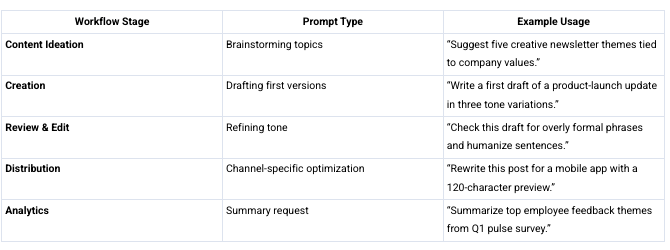 These workflows run inside Staffbase Employee AI in the same secure environment — no copying data to public AI tools. Your company data stays private.
Example: Turning a campaign brief into a full content workflow
Imagine your communications team needs to launch a sustainability initiative. With AI prompts examples for internal comms, the workflow might look like this:
Brainstorm prompt: “Generate five content ideas to promote our sustainability campaign across internal channels. Include participation challenges and recognition ideas.”
Draft prompt: “Write a short teaser article announcing the program kickoff, 200 words, conversational tone, add emoji section headers.”
Leadership quote generator: “Create three quote options from an executive voice supporting company values around sustainability.”
Translation Prompt: “Translate the teaser article into Spanish and French, maintaining enthusiasm and clarity.”
Engagement Follow‑Up Prompt: “Draft a survey invitation asking employees which sustainability actions they are most interested in.”
With the right tools, these steps could be performed in a single unified workspace. Drafting, governance, translation, and distribution are handled seamlessly by Employee AI.
Best practices for using ChatGPT or generative AI in internal communications
Many internal comms teams already experiment with ChatGPT internal communications prompts or free generative AI tools. If you haven’t started using generative AI to boost your internal communications yet, now’s the time to catch up.
A recent Forbes Advisor survey revealed that nearly half of business leaders — about 46% — already rely on AI tools to help them create sharper, faster, and more engaging employee messages. Believe me, you don’t want to be left behind.
Public AI tools can be useful for experimentation, but for sensitive or branded communications, use a secure, in-platform solution like Staffbase Employee AI. Handling everyday writing tasks and quick drafts gives you back precious hours to focus on the strategic, creative, and people‑driven parts of internal communication that truly make an impact.
A few quick ground rules will keep those experiments ethical and effective:
Keep confidentiality sacred. Never paste internal data into unsecured tools.
Always review outputs manually. AI can misinterpret brand tone or cultural nuance.
Train your AI assistant (like Staffbase Employee AI) with approved tone and examples rather than public data.
Start small, expand fast. Begin with manageable use cases. Rewrite announcements, summarize leadership updates, or localize newsletter intros.
Measure success. Use open or read‑rate analytics to see if AI‑assisted content performs better.
How Staffbase Employee AI makes prompting easier and more secure
Behind every great AI prompt is an equally great platform. Staffbase Employee AI was explicitly built for enhancing employee experience. Simply put, it’s not an external plugin pretending to understand internal comms.
Embedded in daily workflows
Unlike generic tools, Staffbase Employee AI lives right where communicators already work: inside the intranet, mobile app, or content hub. Prompts don’t require switching tabs or apps; they’re built directly into the writing window.
AI governance and security
Every organization’s communications come with proprietary language and confidentiality. With Staffbase’s in-platform AI, messages are processed within your organization’s secure environment. The platform supports enterprise-grade security and compliance (ISO 27001) with GDPR-aligned processing.
AI writing support built for internal communications
Employee AI suggests structure, rewrites, or summaries that keep internal messages concise and human. Need your memo shortened to 100 words or rewritten in a motivational style? One click, and it’s ready.
Data insights without the risk
AI features can help summarize engagement insights available in Staffbase to speed the feedback-to-action cycle — without exporting sensitive data.
Multilingual brilliance
Multinational companies gain an immediate advantage with built-in AI translation, keeping tone, context, and compliance intact across languages. There’s no extra API juggling. Everything’s done under one trusted platform.
Future trends: Where AI prompts in internal communication are headed
The future of AI use cases in internal comms is rapidly shaping around three trends:
Conversational interfaces: Employees will soon interact directly with corporate AI assistants for information. Example, “What’s the update on the new benefits plan?”
Hyper‑personalization: AI for employee communications will tailor tone, medium, and timing based on recipient preference.
Strategic assist: Rather than replacing communicators, AI will handle logistical and linguistic work, freeing humans for creativity and leadership planning.
Soon, AI content creation internal communications workflows will look less like “prompt → response” and more like co‑writing partnerships between humans and machines. And in that world, internal communicators will no longer be translators between departments; they’ll be conductors orchestrating clarity across an entire workforce.
The prompt library you’ll actually use
Below is a compact “save or bookmark now” library of AI prompts examples for internal comms teams. Just think of this as an updated Dewey Decimal System and customize each for your context.
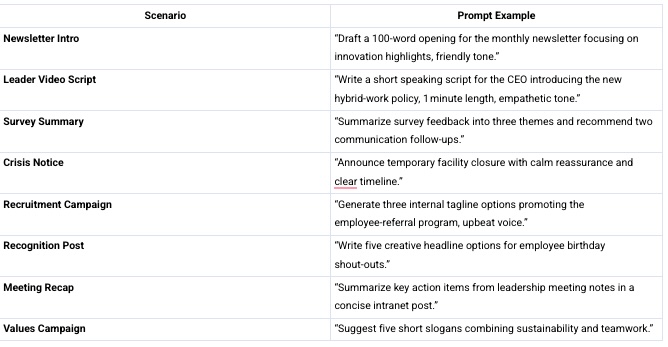 The possibilities are endless! But only if you craft prompts thoughtfully.
From prompts to impact
The age of AI‑assisted messaging internal communications isn’t about outsourcing creativity; it’s about reclaiming time, amplifying voices, and building consistent brand trust. Well‑crafted prompts are the building blocks of smarter communication, essentially the spark that turns data into dialogue.
By combining clever prompt design with an AI‑native employee experience platform such as Staffbase Employee AI, internal communicators can confidently lead this transformation. It’s efficiency without losing empathy, automation without losing authenticity.
Are you ready to open a draft, type a playful prompt, and watch your next internal message practically write itself? The future of internal comms has arrived.
Want to see how Staffbase's AI-native solutions can transform your organization?