

Staffbase vs. Flip: Which employee app should you choose in 2026?
Both platforms serve frontline workers well. Only one scales beyond them without forcing you to add a second system.

The short answer
The frontline app category was built by Staffbase in 2014. Both platforms deliver it equally well today. The decision is never really just about the app because 68% of organizations that launch with a frontline app expand to additional channels within one to two years. That makes this comparison straightforward: Staffbase is the only platform in this category that scales from a world-class frontline app into a governed, multichannel digital front door — covering intranet, email, enterprise integrations, and AI answers your workforce can trust. Flip doesn't offer that path.
If your organization will still have the same requirements in two years that it has today, either platform works. If there's any chance the app needs to become more, only one platform was designed for that from the start.
This comparison reflects our assessment of both platforms as of April 2026. Verify current product capabilities directly with each vendor.
What do most Flip vs. Staffbase comparisons get wrong?
Most comparisons frame this as "Staffbase for enterprise, Flip for frontline." That framing is wrong in both directions — and it happens to be exactly what Flip's competitive positioning relies on.
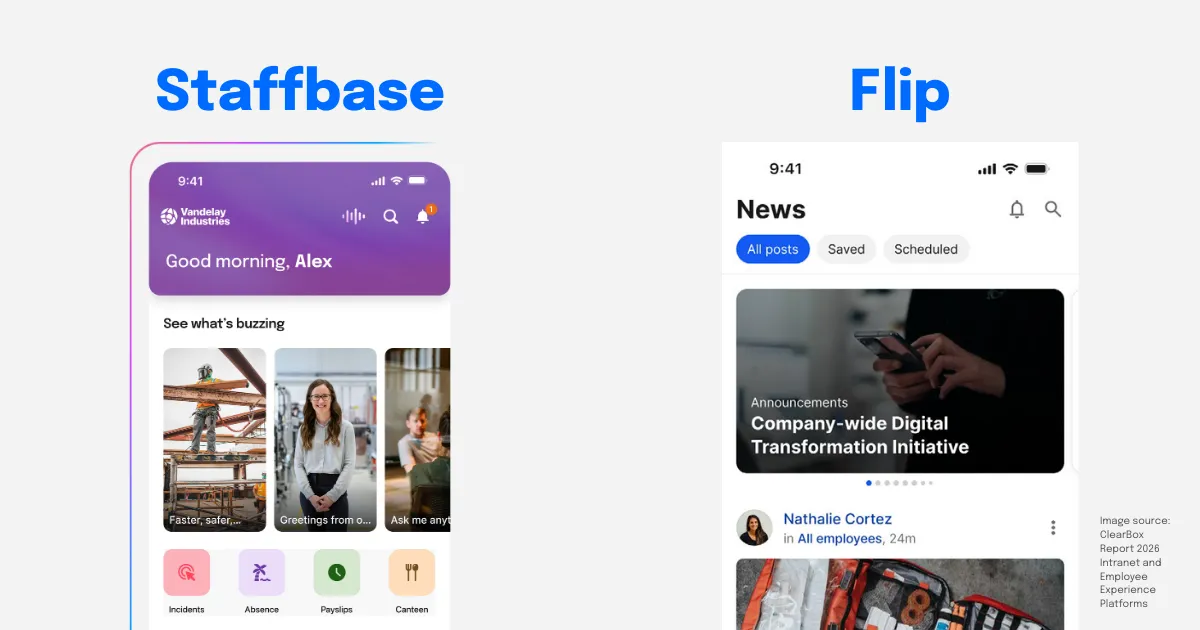
Staffbase was founded in 2014 as a mobile employee app built specifically for workers without desks, corporate email addresses, or IT affinity. Flip entered that same category in 2018. The frontline app experience was never something Staffbase added later — it's where the platform started. ClearBox 2026 scores both platforms identically on mobile and frontline support. That's not a close call; it's a tie.
The real difference isn't which workforce each platform serves. It's what the platform can become when requirements grow. Staffbase has closed the operational gap that once distinguished the two — native task management and expanded integrations are now part of the same platform that handles multichannel publishing, governed intranet, and enterprise-grade AI. Flip has not made the equivalent move in the other direction.
Why do frontline app projects fail, and what does that mean for this decision?
Frontline app projects fail when they deliver announcements but not a daily utility. Installation is easy; sustained engagement requires operational relevance.
Reaching frontline workers on a mobile app sounds straightforward. In practice, it remains one of the most commonly failed requirements in this category. Getting an app installed is a launch event. Getting employees to open it the following Tuesday (and the Tuesday after that) is a fundamentally different problem.
Continuous adoption requires more than a clean UI. It requires utility — a reason to return that isn't just another corporate announcement. The apps that sustain engagement are the ones that connect communication to something employees actually need, such as shift information, HR services, policy answers, and operational guidance. Without that daily utility, even well-designed apps quietly fade into the background.
A great example of daily utility is ALDI Australia. They rolled out their branded Staffbase app, MyALDI, to all 16,000+ employees across 580+ locations, the majority of them frontline workers without desk access. The result: 99% of the workforce registered, with 94% active every month and 84% active every week. For a retail operation where one store manager previously handled all administrative workload manually, MyALDI became the single place employees go for payroll, rostering, benefits, training, and company news, turning communication into a daily operational habit rather than a corporate broadcast.
The real question in any frontline app evaluation isn't whether the platform can reach your workforce on day one. It's whether it gives them a reason to come back on day 365.
The assumption behind that fragmentation is that the app is a frontline tool and the intranet is for everyone else. The data doesn't support it. Across Staffbase deployments, 95% of customers roll out the employee app to their entire workforce, not just frontline workers. And adoption among desk-based employees follows. People who spend their day at a laptop still check the app on their commute, between meetings, and on the floor. Convenience isn't a frontline need; it's a human one.
The organizations that treat the app as a frontline-only channel end up maintaining two systems. The ones that recognize everyone is a mobile worker regardless of job type end up with one.
Key takeaway: The best tool for day one isn't the best choice if it creates a second system by day 365.
How do Staffbase and Flip compare when scored independently?
Independent evaluation (ClearBox 2026) scores Staffbase and Flip equally on mobile and frontline support, but gives Staffbase higher scores in governance, integrations, knowledge management, and communications management.
However, most independent analyst evaluations of the employee experience platform market don't include Flip at all. Gartner, Forrester, and IDC, the reports that enterprise procurement teams typically reference, cover platforms operating at enterprise scale. Flip does not appear in those reports.
Staffbase, on the other hand, is a Leader in the 2025 Gartner® Magic Quadrant™ for Intranet Packaged Solutions for the third year in a row.
The most rigorous evaluation that includes both platforms is the ClearBox Intranet and Employee Experience Platforms report. ClearBox is one of the few analyst firms that conducts hands-on product evaluation; scores are based on direct platform testing, not vendor-submitted information. The 2026 edition covers both Staffbase and Flip across eight capability scenarios relevant to real enterprise deployments, which makes it the most credible like-for-like comparison available.
The scores tell a clear story:
Scenario | Flip | Staffbase |
|---|---|---|
Mobile & Frontline Support | 4.5+ | 4.5 |
Employee Experience | 4 | 4.5 |
Communications Management | 3+ | 4.5 |
Community & Engagement | 3+ | 4 |
Information Finding & Search | 3 | 3 |
Platform Management | 3.5 | 4 |
Digital Workplace Integrations | 2.5+ | 3+ |
Knowledge & Content Management | 2+ | 3.5 |
Two things stand out.
First, Mobile & Frontline Support, the core of Flip's positioning, scores identically across both platforms. This is the independent confirmation of what this comparison argues from the start: both platforms genuinely serve frontline workers well. Neither has a meaningful advantage here.
Second, every other scenario goes to Staffbase. Not narrowly in most cases. The gap is largest in Communications Management (3+ vs 4.5), Knowledge & Content Management (2+ vs 3.5), and Digital Workplace Integrations (2.5+ vs 3+).
The rest of this comparison explains what sits behind those numbers, what the gaps mean in practice, where they show up operationally, and when they matter for your organization.
Source: ClearBox 2026 Intranet and Employee Experience Platforms report. Full methodology and scoring criteria available at clearbox.co.uk.
Will your frontline app still fit in two years — or will you be forced to add a second system layer?
68% of organizations that launch with a frontline app expand to additional channels within one to two years. That makes architecture and not feature lists, the most consequential decision in this evaluation.
The biggest risk isn’t picking the “wrong” frontline app on day one — it’s picking one you outgrow in year two. Many organizations start with a frontline app and later need an intranet for desk and hybrid employees. When the platform can’t deliver that expansion natively, a second system layer becomes unavoidable, creating duplicate workflows, split analytics, and competing sources of truth.
ClearBox 2026 highlights this architectural gap directly: Flip scores 2+ on Knowledge & Content Management versus Staffbase’s 3.5, and its desktop environment is described as comparatively basic, resulting in a notably different experience for desk-based employees.
Ask in any demo:
If we introduce a front-door intranet for the whole organization, is that the same platform or a bolt-on?
Can frontline and desk employees truly share one content model and one analytics view?
Why this matters: 68% of Staffbase customers who start with the app expand beyond it within one to two years. If expansion is that common, architecture is not a secondary concern; it's the primary one.
Case study: From frontline app to global front door
In 2017, a large global logistics company launched a Staffbase-powered mobile app for more than 300,000 frontline employees who had no intranet access at all. Within weeks, more than 70% were engaging with push messages.
But success exposed the next requirement. Once frontline workers were digitally connected, a standalone app was no longer enough. Employees needed the same depth of access as desk-based colleagues: policies, HR services, and company-wide communications.
What began as a frontline app evolved into a global intranet built on the same Staffbase platform, now serving more than 600,000 employees across more than 200 countries. Seventy percent of employees say it positively changed how they work.
The app was the entry point. The intranet became the front door. One platform now serves both.
What makes AI answers trustworthy and what breaks them?
AI answers are only as trustworthy as the content governance underneath them. While most employee apps now include some form of AI or automation, the visible chat interface is rarely the differentiator. The real difference lies in how content is structured, owned, reviewed, and maintained over time.
If draft policies sit next to published ones, if outdated procedures remain searchable, or if local updates conflict with global guidance, AI will generate confident-sounding answers based on unreliable inputs. That isn’t a model problem. It’s a governance problem.
A platform built primarily as a social feed or task engine may handle updates well in the early stages. But once policies, HR services, and compliance content live there, governance becomes structural, not optional. ClearBox found that Flip has no native document library; documents are "merely attached to pages," and the platform lacks the governance and lifecycle features required to manage content over time. Their conclusion: "Organizations with strong knowledge-related requirements may find [Flip's approach] too limited."
Ask in any demo:
Can the AI distinguish between draft and authoritative content?
Can content have defined ownership, review cycles, and expiry?
Can answers be scoped by role or location?
Why this matters: As soon as the app becomes a knowledge source rather than just a news feed, reliability determines whether employees trust it or ignore it.
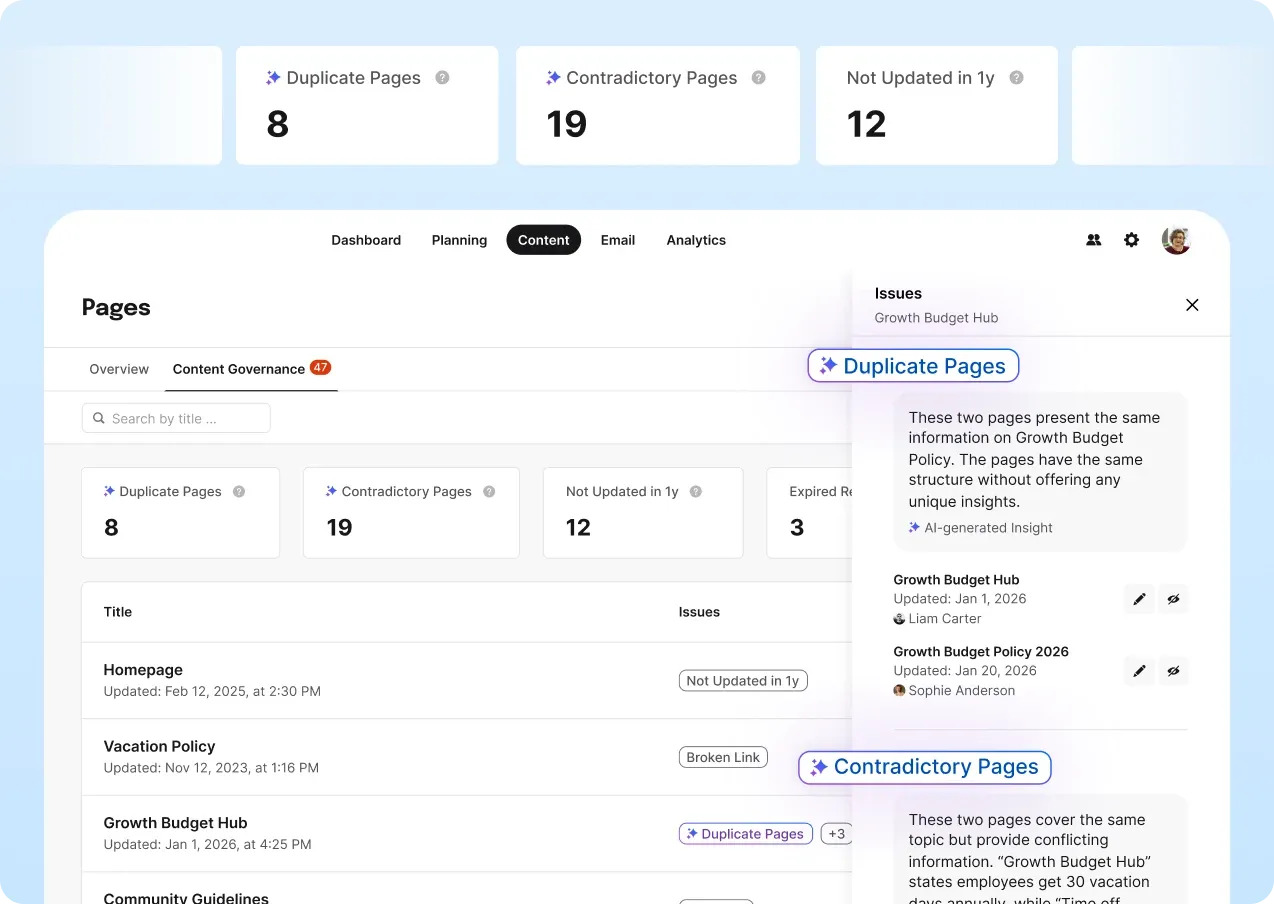 Example of content governance inside Staffbase: It is the systematic way to keep your intranet and employee app reliable, up to date, and easy to navigate. It enables teams to detect outdated content, broken links, expired reminders, and unused pages automatically, reducing manual audits and administrative overhead. At the same time, it keeps communicators in control, combining automation with human oversight to ensure trust, accuracy, and long-term content quality.
What breaks first when your frontline app has to scale across countries?
Frontline apps often start simple: one country, one language, one central team publishing updates. Growth changes that reality. Multiple regions, multiple languages, local managers needing autonomy, central governance needing consistency.
Some platforms scale by duplicating content per language or by centralizing all control. Both approaches create friction, either editorial overload or local disengagement. ClearBox scores Staffbase 4.5 versus Flip's 3+ on Communications Management, noting that "comms teams requiring sophisticated capabilities, such as more multi-channel options or campaign support, may find Flip too simple."
Ask in any demo:
How are multiple languages handled? One unified article or separate duplicates per language?
Can local managers publish independently within defined governance boundaries?
Do analytics consolidate engagement across regions and languages, or split it?
Why this matters: Adoption grows when local leaders have ownership. Complexity grows when the architecture wasn't built for it.
Is Flip an intranet?
Flip can function as a lightweight web-based communication layer, but it does not provide the structured governance and knowledge management capabilities of a full enterprise intranet.
For organizations where the desktop experience is intentionally minimal, where structured knowledge lives in SharePoint, and where the app serves primarily as a communication and community layer for frontline workers, Flip’s web experience can support that limited scope. If you are comfortable keeping your document library and your employee app in separate systems — and have no ambition to unify them — that separation may not feel restrictive today.
However, that model raises a strategic question: if most structured knowledge lives in Microsoft and the app primarily surfaces frontline updates, what role is the intranet layer actually playing? For organizations with a meaningful mix of frontline and desk workers, multiple locations, or plans to use Microsoft integrations as a strategic layer rather than a storage backdrop, that separation becomes a structural limitation, not a design choice.
A true enterprise intranet requires more than publishing posts on a larger screen. It requires structured navigation hierarchies, rich page templates, granular permissions, content ownership and review cycles, and lifecycle management tools that allow editors to maintain long-lived information at scale. Intranet teams call this "gardening," keeping evergreen content current, authoritative, and findable.
The 2026 ClearBox report found that Flip has no native document library, that documents are "merely attached to pages," and that the platform lacks the governance and lifecycle features required to manage content over time. Their conclusion: "Organizations with strong knowledge-related requirements may find [Flip's approach] too limited."
Why this matters more in the age of AI, not less
There is a reasonable argument that AI makes the traditional intranet less relevant. If employees can ask a question and get an answer, why do they need to navigate a page hierarchy at all?
The argument sounds logical, but it misses the dependency.
AI answers are only as reliable as the content they draw from. If the underlying content layer contains draft policies sitting next to published ones, outdated procedures that were never reviewed, and local guidance that conflicts with global standards, the AI will produce confident-sounding answers that can't be trusted. That isn't an AI problem; it's a context problem.
The platforms that will deliver genuinely useful AI experiences are not the ones with the most capable chat interface. They are the ones that help editors keep content governed, current, and role-aware, so the AI always knows what's authoritative, what's draft, what's relevant for a warehouse worker in Poland versus a manager at headquarters, and what expired six months ago.
This is why content governance, the unglamorous discipline of ownership, review cycles, expiry, and structured context management, is becoming the primary differentiator in this market. Not as an IT concern, but as an AI readiness concern.
Ask in any demo:
Can the AI distinguish between draft and authoritative content?
Can content have defined ownership, review cycles, and expiry?
How does the platform ensure that what the AI surfaces is current?
If your ambition remains app-only, this distinction may not matter today. If you expect your platform to become the context layer that powers AI for your entire workforce, governance architecture becomes the most consequential decision you will make.
What does Flip do well?
Flip performs best as a fast, mobile-first frontline communication app with strong operational features and lightweight deployment, making it a strong fit for organizations with stable, app-only requirements and limited need for intranet governance or multichannel expansion.
The mobile experience is purpose-built for frontline workers. Flip's UI is clean, intuitive, and designed for people who aren't power users: no IT affinity required, minimal learning curve. Employees can be onboarded quickly, and the experience feels familiar from day one.
Operational features are a real strength. Flip goes beyond communication into the daily operational layer: shift planning, integrations, task management, digital employee cards, and digital forms are all native to the platform. For HR buyers especially, this demonstrates immediate, tangible utility for frontline teams beyond receiving news.
Deployment is fast and lightweight. Flip can be live quickly, without heavy IT involvement, and without requiring employees to have a corporate email address. For organizations that need to move fast and don't have the internal resources for a complex rollout, this simplicity is a genuine advantage.
It has meaningful traction in specific markets. Flip has built a real presence in the DACH region and in frontline-heavy industries like manufacturing and automotive, with customers including Bosch, Porsche, and McDonald's Germany.
Where Flip makes sense: organizations that need a well-designed, fast-to-deploy frontline app, communicate in one or two languages, operate in one or two locations, and have stable app-only requirements. If that description fits your organization now and in two to three years, Flip delivers on its promise.
Flip delivers on its promise — for the scope it was built for. The question isn't whether it works today. It's whether that scope still matches your requirements in two years.
What users say about Flip on independent review platforms
The strengths and trade-offs described above are broadly reflected in independent user reviews across platforms like G2, Capterra, and Gartner Peer Insights. Users consistently praise Flip's mobile usability and ease of adoption for frontline workers.
One G2 reviewer writes: "The app is highly intuitive, keeping the barrier to adoption as low as possible." — G2 Review, Application Manager
Similarly, Capterra reviewers frequently describe Flip as "quick and effective" for sharing announcements with employees who do not have desk access.
At the same time, several reviews point to limits in feature depth when requirements expand. On Gartner Peer Insights, one reviewer notes that while the core communication functions work well, they would welcome more advanced capabilities such as structured content management.
Taken together, independent user feedback reinforces the core pattern: Flip is widely regarded as strong for mobile-first frontline communication, but organizations with broader intranet, governance, or multichannel needs should evaluate the platform's long-term fit carefully.
Key takeaway: Flip is a strong product for app-only frontline deployments. Its advantages are real. The question is whether those advantages hold when the scope expands.
What does Staffbase do well?
Staffbase is designed for organizations that expect their employee app to evolve into a governed, multichannel digital front door — not remain a standalone frontline tool. It combines frontline app functionality with structured intranet governance, enterprise integrations, and unified analytics in a single platform.
The frontline app is the foundation, not the limit. Staffbase delivers the full baseline of a modern frontline solution: branded mobile experience, login without a corporate email address, offline functionality, push notifications, communities, live streaming, HR self-service, and native task management through Staffbase Tasks.
Over twelve years and more than 2,000 enterprise deployments, the platform has expanded beyond frontline communication into a broader employee experience architecture. That added scope is sometimes described as complexity. In practice, it reflects the range of problems the platform is built to solve.
Organizations with stable, single-location, app-only requirements may not need that breadth. Organizations that expect growth — more channels, more governance, more integrations, and AI-backed knowledge — benefit from an architecture designed to scale without introducing a second system later.
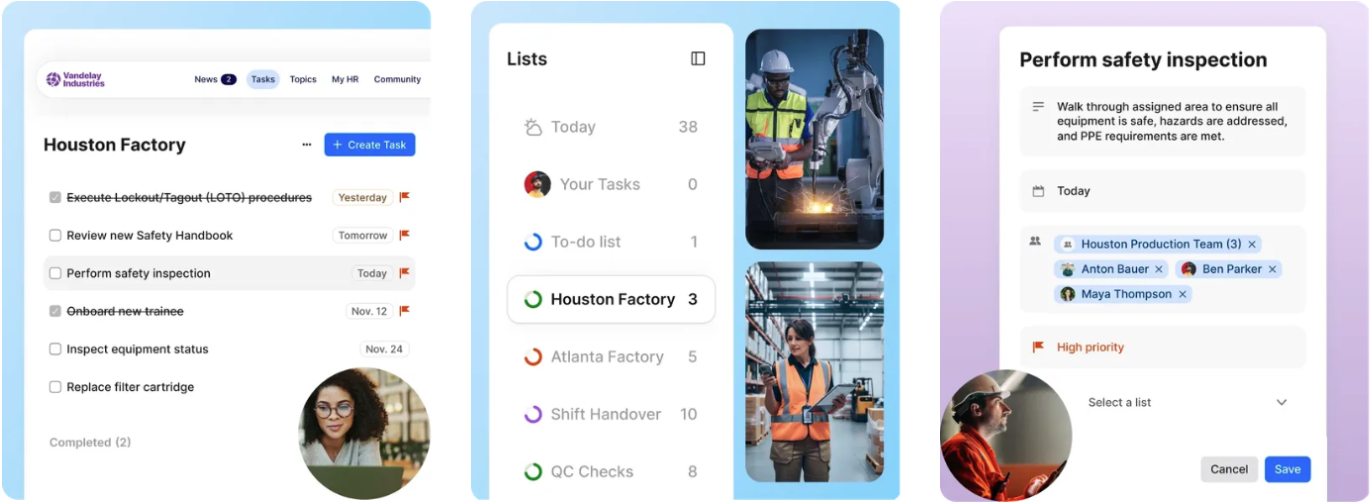 Now also natively available inside Staffbase: Task management. Assign, track, and complete tasks in one central place. See your personal to-dos and team assignments at a glance, monitor progress in real time, and collaborate seamlessly, all without leaving the app.
One platform for every employee. Where many organizations end up managing a frontline app alongside a separate intranet for desk workers, Staffbase runs both from one system. Frontline and office employees share one platform, one content model, and one analytics view. That is the difference between a unified company culture and two parallel digital workplaces that produce inconsistent information and duplicated editorial effort.
Multichannel reach from a single editorial workflow. A communicator in Staffbase publishes once and reaches employees via the app, email, digital screens, and live town halls, with full analytics on what landed where. Staffbase On Air extends this further: an AI-generated audio briefing that turns company updates into a format employees can consume on a commute, between shifts, or on the production floor.
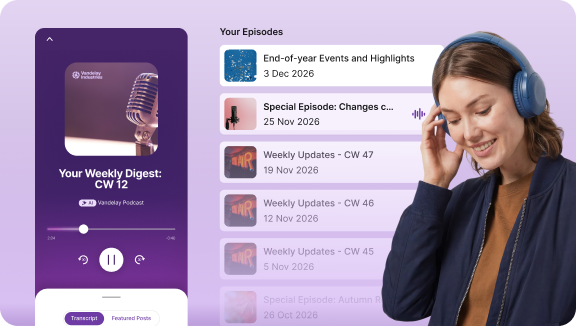 Staffbase On Air turns company updates into personalized audio briefings, think podcast-style content that employees can listen to on a commute, between shifts, or on the production floor, without needing to open an app or read a single line of text.
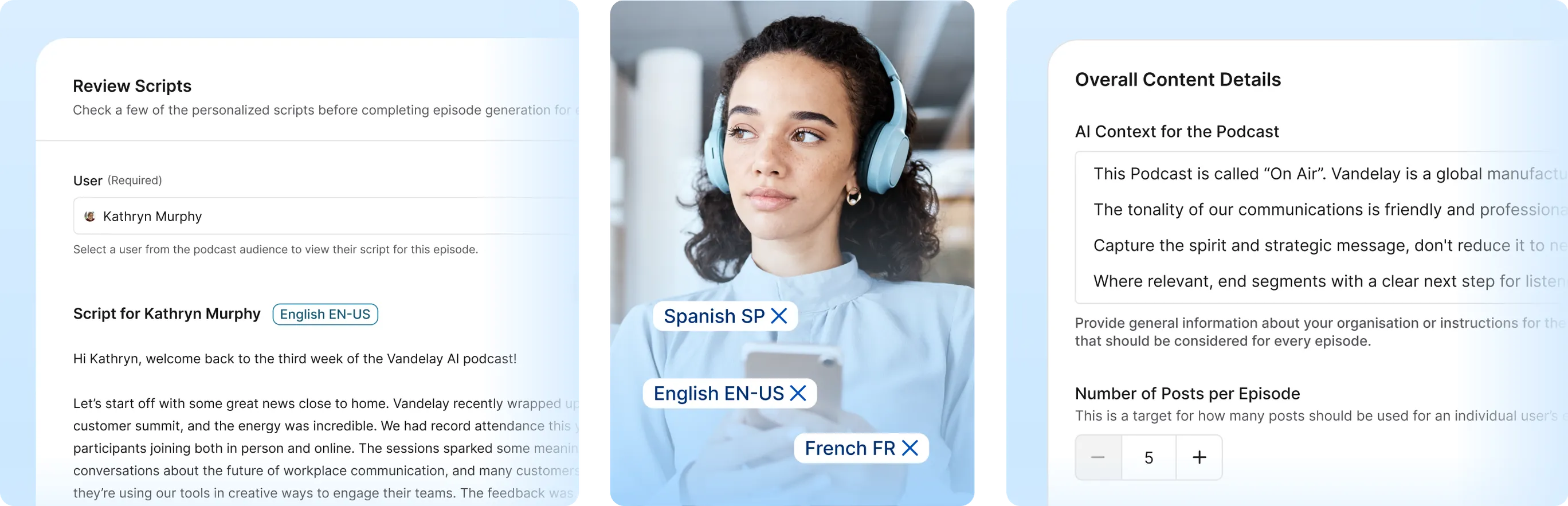 Communicators can configure tone, length, and frequency; employees can choose their trusted sources.
The bigger difference is not the channels; it’s what happens after the send. Flip is built for transactional communication: short-lifecycle updates that get consumed and replaced. Staffbase is built for communicators who need to demonstrate strategic impact over time. Mission Control gives teams a unified view of what landed, what moved behavior, and what to do differently next. As Swedish restaurant chain Maxburger puts it: "It stopped being a reporting tool and became the thing that shapes their communication strategy."
If your job ends when the message goes out, that distinction doesn't matter. If your job includes proving that communication drives business outcomes, it's the whole game.
Structured content governance that makes AI reliable over time. Staffbase Content Pro gives editors AI-supported alerts when content becomes outdated, surfaces what needs review, and helps maintain a governed knowledge base as a living system. This is the foundation that determines AI answer quality — not just at launch but also twelve months later when content has evolved.
Multilingual publishing without fragmentation. In Flip, publishing in multiple languages requires a separate duplicate for each language version, each with its own analytics, its own engagement data, and its own comment thread. A post with 200 reactions across five languages appears as five posts with 40 reactions each. Editorial effort multiplies; engagement data fragments. Staffbase treats all language versions as one unified article: one analytics view, one engagement score, one comment thread across languages.
Governed proximity at scale. Staffbase Spaces allow local editors, plant managers, regional leads, and country HR teams to create and manage content independently within a global governance framework. An employee in Vietnam sees local updates from their site alongside the global CEO message and company-wide compliance policy, all from one system.
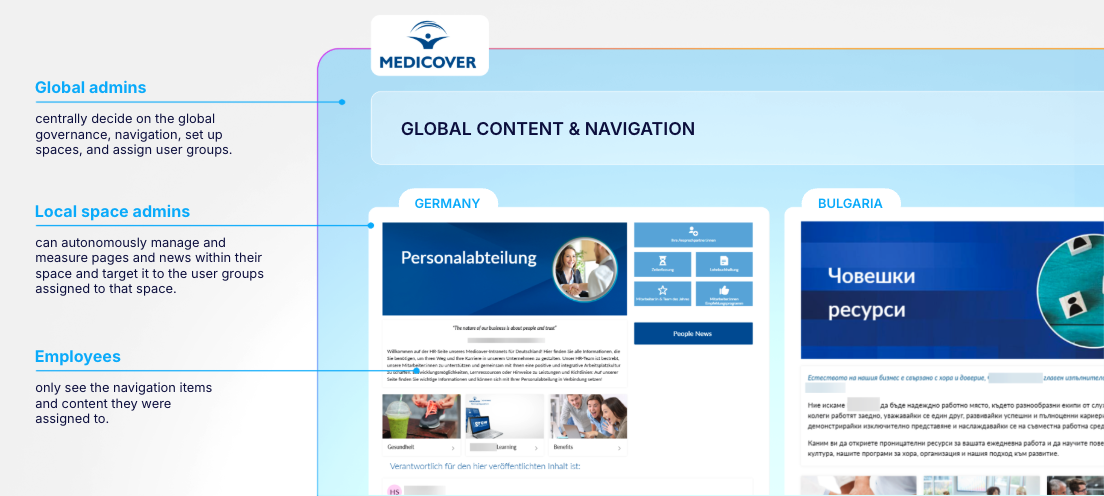 Example: Medicover leverages Spaces for localized landing pages for their country segments, while still retaining their overall corporate identity.
Enterprise-grade Microsoft 365 alignment. Staffbase integrates with Microsoft 365 in a way designed to stay within Microsoft's licensing boundaries. This is covered in detail in the Microsoft section below.
What users say about Staffbase on independent review platforms
Independent user reviews on platforms such as G2, Capterra, and Gartner Peer Insights reflect the core strengths described above, particularly Staffbase's mobile-friendly ease of use for frontline communication and its ability to scale into broader enterprise communication workflows.
Ease of mobile use and frontline adoption: many reviewers highlight the intuitive mobile experience and low barrier to adoption that helps organizations reach desk and frontline workers alike. One G2 reviewer emphasizes usability and mobile convenience:
"It has a highly user-friendly interface and the setup was pretty easy and intuitive." — G2 Verified Reviewer, Communication Officer (Jan 2026)
The same sentiment appears in another G2 review, pointing to both ease of use and early adoption momentum:
"Our employees, as well as admins and editors, quickly find their way around and use both the mobile and web app intuitively... the possibilities for expansion are also a big plus." — G2 Verified Reviewer, IT Project Manager (Sep 2025)
Capterra reviewers echo that Staffbase's interface and deployment help teams go live quickly and connect widely:
"You can communicate fast, it is easy to use, you have a modern design that can be adapted to your branding, and the support team helps you quickly." — Capterra Reviewer
Independent reviewers also recognize Staffbase's effectiveness in connecting distributed teams and supporting structured communication:
"We use Staffbase to streamline all our internal team communications. It works well both for front-line and remote employees and ensures important information reaches every employee easily and fast." — Gartner Peer Insights Reviewer
Taken together, these reviews reinforce the article's framing: Staffbase combines a mobile-first, easy-to-adopt experience with the depth and structure that support broader employee experience needs as organizations grow.
Key takeaway: Staffbase is a more complex platform than Flip because the problems it solves are more complex. For organizations that want one platform serving every employee across every channel with AI they can rely on, that complexity is where the value lives.
Staffbase vs. Flip: Capability comparison
Capability states below are described as: Native / Available with constraints / Requires additional system / Verify current state in demo. Where a cell reads "Verify," this reflects either active product development or areas where independent validation is advisable before relying on vendor descriptions alone.
Assessment reflects April 2026. Verify the current product state directly with each vendor.
Funktion | Staffbase | Flip |
|---|---|---|
Branded Employee App | Native | Native |
Login without @company email | Native | Native |
Offline fuctionality | Native | Native |
Push-notifications | Native | Native |
Task management | Native (new 2026) | Native |
HR-Self-Service | Native | Native |
Communitys | Native | Native |
Live-Streaming / Town Halls | Native (new 2026) | Native |
Personalized start page | Native, down to employee level | Not available (ClearBox 2026) |
Native E-Mail-newsletter and campaigns | Native | Not available (ClearBox 2026) |
Knowledge base with governance & lifecycle manag. | Native (Content Pro) | Limited (ClearBox 2026) |
Structured intranet | Native and mature | Verify current status in demo |
Digital Signage | Native | Needs additional system |
AI-Podcast | Native (On Air) | Not available |
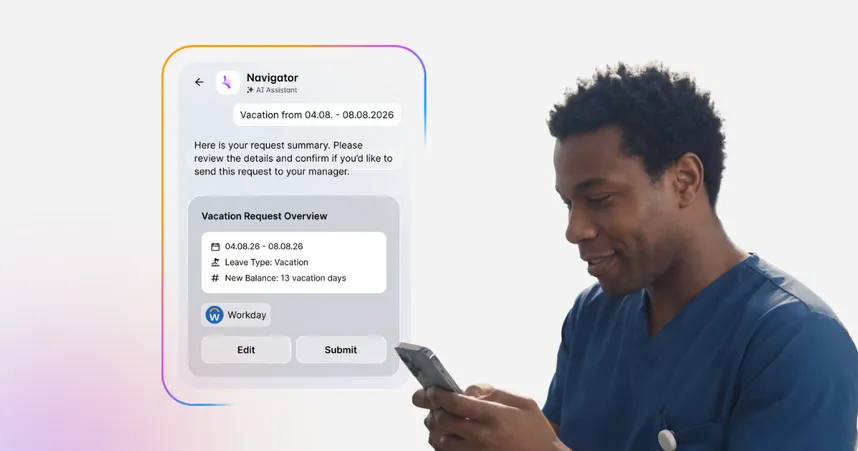
AI-Assistent | Native (Navigator) | Native |
Search | Native + semantic search + connectors | No global search, no external sources (ClearBox 2026) |
Multi-language | Native, all languages linked to the same article | Very limited, language versions create separate articles (less measurable, harder to update) |
Campaigns | Native | Not available (ClearBox 2026) |
Asset Management (library of reused media files) | Native | Limited, verify current status in demo |
Local autonomy with global governance | Native (Spaces) | Limited, verify current status in demo |
Multichannel-analysis | Native | Limited, verify current status in demo |
Standard-HR-integrations | Native, broad offering | Native, broad offering |
Custom-integrations | Native, extensive partner ecosystem | Native, verify current status in demo |
Microsoft-365-compliance - connecting front line workers without licence | Native (News Central) | Check compliance - risk of multiplexing! |
What is the Microsoft licensing risk most frontline app vendors won't mention?
If your frontline workers are not Microsoft 365 licensed, how your employee app surfaces Microsoft content becomes a compliance question, not just a technical one.
For most organizations evaluating a frontline employee app, this question eventually arrives, usually from IT. More than 95% of enterprises in this space are also Microsoft customers. Desk workers are typically licensed. Frontline workers, in most cases, are not. The requirement in the middle is almost always the same: how do we surface news and updates from Microsoft 365 for employees who don't have a license?
The technical answer is straightforward. The licensing answer requires verification.
Surfacing Microsoft-licensed content like SharePoint news to unlicensed frontline users through a third-party app can create a compliance exposure under Microsoft's multiplexing licensing rules. The specifics depend on your deployment architecture and licensing agreement, which is precisely why this should be verified, not assumed.
What to ask any vendor: "If our frontline workers are not M365-licensed, how does your platform surface Microsoft content to them, and how do you ensure that approach stays within Microsoft's licensing terms?" Ask for a written architecture note. Ask your Microsoft licensing contact to confirm. The answer will tell you a great deal about how seriously the vendor treats enterprise-grade compliance.
Staffbase addresses this with a specific architectural approach called News Central. Rather than pulling Microsoft content into Staffbase for unlicensed users, it works in the opposite direction: Staffbase content is pushed into Microsoft SharePoint and Microsoft Teams and made searchable via Microsoft Graph and Microsoft Search. Desk workers see Staffbase content seamlessly inside their Microsoft environment. Frontline workers access the same content through the Staffbase app. Editors publish once, designed to stay within Microsoft's licensing framework.
Key takeaway: If your frontline workers are not M365-licensed, make Microsoft compliance and the avoidance of multiplexing a specific due diligence item. The architecture each vendor uses to address these matters.
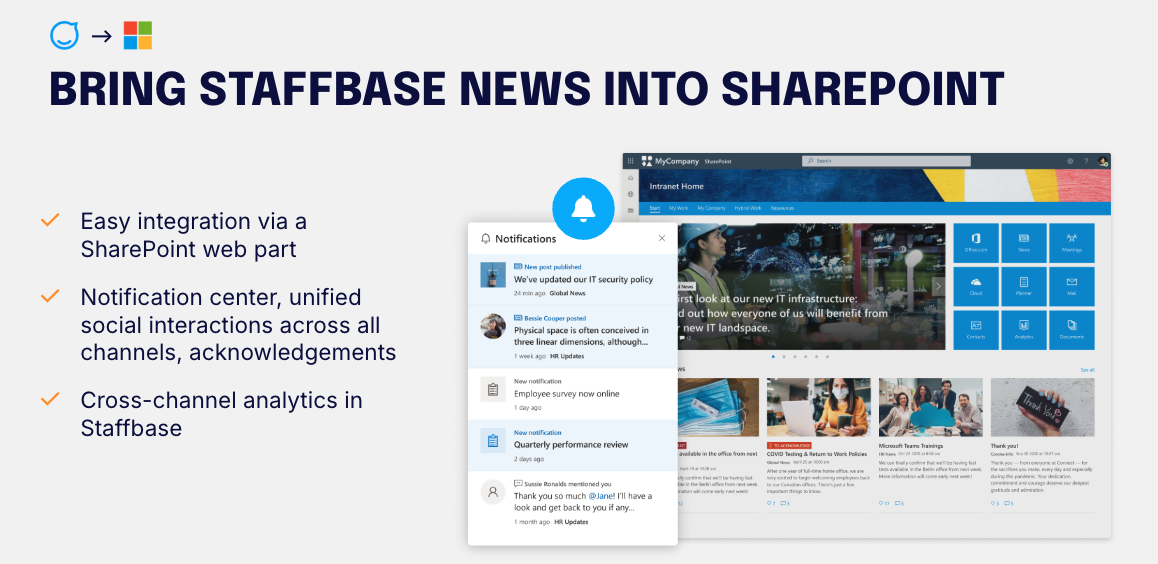 Where this plays out in practice
Manufacturing
Manufacturing organizations typically manage a workforce split between shift workers on the floor and managers and engineers at desks, often across multiple plants in multiple countries. A frontline app solves the mobile access problem. What these organizations consistently find they also need is a governed way to manage safety procedures, compliance documentation, and site-specific processes: content that must be accurate, current, and retrievable instantly.
When that content is multilingual and maintained by a small central team, platforms that require duplicate content per language create a real editorial burden. That's where content governance, AI-supported review cycles, and unified multilingual publishing shift from useful features to operational requirements.
Staffbase works with 550+ manufacturing companies, including BMW, Continental, Volkswagen, and John Deere.
Logistics and Distribution
The case study with the large global logistics company above represents the clearest example of how this plays out in logistics at scale. The pattern holds across the sector: a workforce in constant motion across depots, routes, and time zones needs more than push notifications. It needs governed content that stays current and AI that can surface the right answer for the right role and location. With 600,000 employees across 220 countries, governed proximity is not optional; it is what makes one system viable where two systems would collapse under their own complexity.
Retail
Retail comms teams are typically small and responsible for reaching thousands of store employees across hundreds of locations. The consolidation argument matters more here than almost anywhere else: a team of two or three people cannot sustain parallel systems. One editorial workflow covering the app, email, and digital screens, with local store managers empowered to publish within a central framework, is the difference between a platform that reduces workload and one that multiplies it.
Retail customers include ALDI, Walgreens, Maxburger, and others operating across hundreds of locations with small central comms teams.
Healthcare
Healthcare has some of the most demanding content governance requirements of any sector. Policies change. Procedures are updated. Compliance is non-negotiable. A nurse who receives an outdated answer from an AI assistant isn't just inconvenienced; the consequences can be serious. The distinction between AI that draws only from content marked as current and authoritative and AI that draws from an unstructured content pool matters directly here.
Staffbase serves 300+ healthcare organizations covering more than 3 million employees, including UC Health, RHÖN-KLINIKUM, and Bethany Children's Health Center.
Construction
Construction workforces are among the most dispersed and hardest to reach: distributed across sites, often with unreliable connectivity, frequently multilingual, and changing in composition as projects start and finish. For comms teams managing content in four or five languages across active sites, platforms that require duplicate content per language create a concrete editorial burden. Site managers are the primary trusted voice for most construction workers, making local editor autonomy within a governance framework a direct determinant of platform adoption.
Staffbase customers in construction include STRABAG and SAK Construction, where the platform is used to reach dispersed site workers across multiple languages and locations.
Key takeaway: The architectural differences between the two platforms show up as operational consequences. The same three requirements surface consistently: governed content at scale, multilingual publishing without duplication, and local empowerment within global structure.
How should IT, HR, and comms teams evaluate Staffbase vs. Flip?
IT and Security: "Will this create risk or reduce it?"
The wrong choice here isn't just a product problem. A platform that requires a second system within 18 months means a second security review, a second vendor contract, and a second integration project — all unplanned, all funded from a budget that didn't account for them.
The Microsoft question comes first. Surfacing Microsoft-licensed content for unlicensed frontline users creates a potential compliance exposure. Staffbase's News Central architecture is designed to avoid that exposure entirely, positioning Staffbase as a complement to the Microsoft stack. For a CIO or IT director, that's the difference between a platform they can approve without reservation and one requiring ongoing legal monitoring.
HR: "Will this make our lives easier or harder?"
Two platforms means two employee journeys, two sets of login credentials for frontline workers, and fragmented data on who read what, completed what, and engaged with what. That fragmentation doesn't stay in IT but it lands in every HR report you produce.
On integrations: Staffbase provides standard out-of-the-box connections with leading HR and people systems. Where custom integrations are needed, HRIS workflows, absence requests, and payslip access, Staffbase takes ownership of building them as part of the service offering or brings in a partner.
Internal Communications: "Will this give me more control or less?"
A frontline-only app that can't scale to your intranet means your team maintains two content models, two analytics views, and two editorial workflows indefinitely. The platform that looks simpler on day one often creates the most complexity by month eighteen.
Staffbase is built for comms autonomy. The editorial workflow covers every channel (app, email, screens, town halls, On Air) from a single interface without IT involvement for day-to-day publishing. Mission Control and campaign analytics provide a single view of reach, engagement, and impact across every channel and audience.
The gap is independently validated: ClearBox 2026 scores Staffbase 4.5 versus Flip's 3+ on Communications Management, noting that "comms teams requiring sophisticated capabilities, such as more multi-channel options or campaign support, may find Flip too simple."
The multilingual model matters particularly here. Publishing one article with all language versions treated as a single unified piece, with one engagement score and one analytics view, means the comms team spends time on strategy rather than maintaining five duplicates of the same content.
When local managers take ownership of their own content, the central comms team stops being a production bottleneck and becomes a strategic function.
"Staffbase’s straightforward governance structure allows us to manage the platform centrally but have content created locally. For example, our nursing staff only see what’s relevant to them, which helps reduce noise and makes it easier for them to quickly get the updates they need."
Katarzyna Szablowska, Corporate IT Solutions Manager at Medicover
Should I choose Staffbase or Flip?
Choose Flip if: Your organization needs a fast, well-designed frontline app, and that is genuinely the full scope of the requirement. Flip is the right choice if your workforce is concentrated in one or two locations, you communicate in one or two languages, your editorial team is small and app-focused, and your requirements are stable. You don't need a structured intranet, multichannel publishing, content governance at scale, or AI beyond automated workflows. If you're a smaller organization operating in a single country with no intranet intent and no Microsoft licensing complexity, Staffbase may offer more than you need.
Choose Staffbase if: Your ambition goes beyond a standalone frontline app, not because your requirements are complex today, but because you want a platform that grows with you rather than one you outgrow. Choose Staffbase if you want every employee — frontline and desk — on one platform with one content model and one analytics view. If you operate across multiple locations or countries and communicate in multiple languages, and want that managed without duplicating editorial effort or fragmenting engagement data. If you want AI grounded in governed, role-aware content that distinguishes authoritative from draft. If Microsoft compliance is something your IT team will scrutinize. If you want a structured intranet backed by a decade of enterprise deployments, you can independently verify.
Based on Staffbase customer data, 68% of customers who start with the app expand to the full platform within one to two years. The organizations that plan for that from day one avoid the disruption of migrating their workforce mid-journey.
Every organization that migrated to Staffbase from a frontline-only platform says the same thing: they wished they'd asked the day-365 question before they signed, not after. We make it the first question in every demo.
The right platform for day one is only the right choice if it's still the right platform on day 365. If you want to pressure-test that — bring your requirements, your Microsoft setup, and your two-year roadmap. We'll show you exactly where each platform holds and where it doesn't.
Book a Staffbase demo to pressure-test your “day 365” requirements — and see whether one platform can scale from frontline app to full digital front door.

About the author
Frank Wolf is co-founder and Chief Strategy Officer of Staffbase. Before founding Staffbase in 2014, he spent more than 12 years as an independent intranet and employee communication consultant, leading dozens of intranet and digital workplace implementations across organizations of all sizes.
He is the author of two books on employee communication and digital workplace strategy. Social Intranets (2012) was one of the early works on social and collaborative intranet design. The Narrative Age (2024) examines strategic communication and change management, specifically how organizations can use storytelling to lead employees through periods of transformation, a question that sits at the center of what AI-driven change will require from internal communicators.
Staffbase was founded out of a specific frustration: classical intranets, even as they adopted social features, remained fundamentally limited to desk-based employees. Frontline workers, the majority of the global workforce, were excluded not just from communication but from the digital services that could meaningfully improve how they work. That gap was the founding motivation for Staffbase, one of the first companies globally to focus on the employee experience of frontline workers.
Frank speaks regularly on the future of employee experience platforms in an AI-driven world. Recent speaking engagements include the Ragan AI Horizons conference and the IABC World Conference. He is also a TEDx speaker.
The views in this article reflect Frank's assessment based on direct market experience, customer deployments, and independent analyst research. Staffbase is the platform he co-founded.
A note on Flip claims about competitors in the employee app category
Comparison articles and competitor webinars in this market contain claims that are worth verifying independently before they influence a decision. We'd apply that standard to our own content too.
In a public webinar on August 13, 2025, Flip positioned Staffbase alongside SharePoint as a desktop-first intranet platform and cited Staffbase's reach figures of 10–30%. For context: many of our 990+ employee app customers have adoption rates above 90%. The 2026 ClearBox report, based on independent hands-on product evaluation, scores Staffbase and Flip identically on Mobile & Frontline Support.
When a vendor's competitive positioning relies on claims that independent evidence directly contradicts, the right question isn't just whether to believe them about us. It's whether to believe them about themselves.