



How Staffbase invests in AI skills for every employee
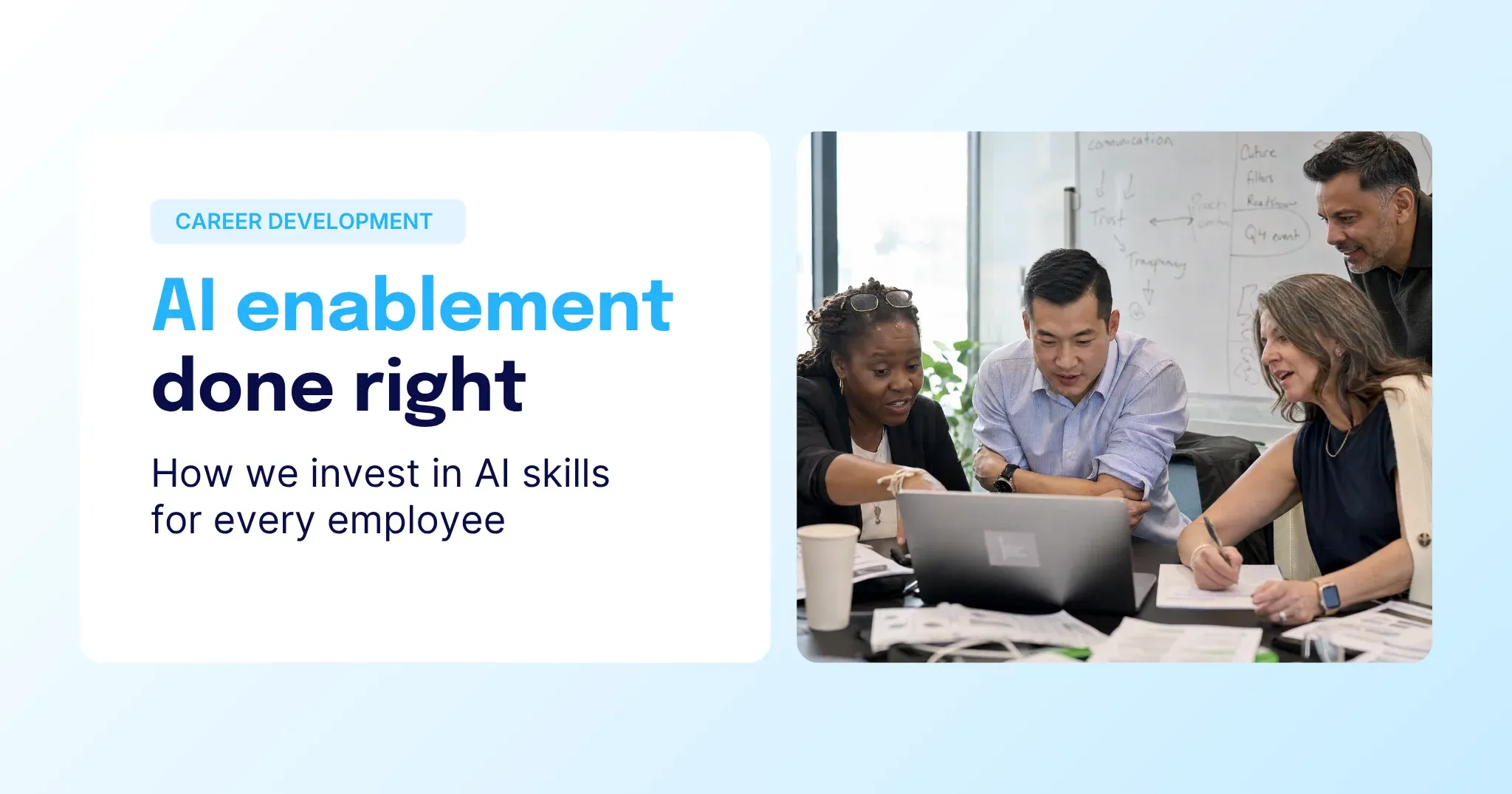

Why we're investing in AI skills and what that looks like
AI is changing what “being good at your job” means, faster than most people expected. We don't think that's something to wait out. It's the reason we've made AI skill-building a real, structured part of how we invest in our people this year, not a one-off workshop, but an ongoing program.
Here's why we think this matters, and what we've built.
Why now
We've noticed the same thing a lot of companies have: using AI well is a different skill than using AI at all. It's a familiar story by now: someone spends ten minutes wrestling with a prompt, gets a mediocre result, and decides the tool just isn't worth the effort. We think that's usually a training gap, not a tooling gap, which is exactly why we built a structured path instead of leaving people to figure it out alone. So instead of leaving people to figure it out on their own, we've built a structured path and we expect everyone to move along it, not just the people who happen to be curious already.
How we think about the path
We don't think about AI skills as one single skill to pick up. It’s more like a progression. At the start, that means using AI as a helpful assistant for everyday tasks: drafting something faster, digging through a long document, organizing information that used to take an hour by hand. From there, it becomes something more powerful: chaining steps together, building small automations for the repetitive parts of your own job, the kind of thing that quietly gives you back real time in a normal week. Further along, it starts to look less like “using a tool” and more like designing how a piece of work gets done in the first place.
The goal is simple, even if the path takes a while: help everyone automate the repetitive stuff, so there's more time left for the work that truly matters.
What we've done so far
This isn't a plan for later. It's already happened.
It started with a fast, low-barrier entry point: a handful of highlight clips, each under 15 minutes, covering practical AI skills like working through long documents or organizing messy data. These were paired with informal peer sessions where people compared notes on what was genuinely working for them. The point was to make the first step small enough that everyone could take it.
Alongside that, we brought in outside perspective on purpose. In April 2026, we hosted a senior AI transformation advisor from Microsoft for a live conversation about treating the AI era with curiosity. We turned it into a shared moment across our offices: watch parties in our locations, not just a link in an inbox. We recorded it too, so nobody was left out because of a time zone or a scheduling conflict. It set the tone for what came next: not a fear-driven scramble to keep up with AI, but genuine curiosity about where it could take us.
Then, in May and June 2026, we followed up with the hands-on step: a four-part AI training with behavioral mathematician and data & AI strategist Barbara Lampl, open to employees across the company. This is where it got concrete. It was built around a principle we keep coming back to: use your own judgment to define what you need before you start prompting. AI supports the thinking. It doesn't replace it. Each of the four live sessions was followed by homework: testing the new skill on a real task, not a hypothetical one, and a follow-up Q&A the next day, so people could bring their actual questions after trying it themselves. By the final session, participants were building working automations for their own role. That was the moment where the mindset from earlier in the year turned into something people could actually use.
Where this is headed
We call the final stage of the progression ‘Impact Architect’ and it's worth explaining what we mean by it, because it's less about mastering a tool and more about a different way of working entirely. It's the distance between being what we internally call a ‘Task Hacker’ (someone using AI for quick, one-off wins) and someone who's redesigning how a piece of work gets done in the first place.
Getting there means graduating from using AI for one-off tasks to designing smart systems that can run on their own. It means moving from “I asked AI to help with this” to “I built something that handles this automatically.” It's a genuinely different skill, and it's the reason this is a progression rather than a single training.
Three things guide why we're investing in this at all:
Getting time back for the work that matters. The point of automating the repetitive, manual parts of a job isn't automation for its own sake, it's reclaiming time for the work that actually needs a person's judgment, creativity, or relationships. That's true for someone individually, and it adds up across the whole company.
Building a habit of testing new ideas, not just adopting old ones. We'd rather have people actively trying new tools and testing bold, sometimes half-formed ideas than waiting for a finished playbook. Continuous learning is easy to say and harder to actually build. This is our attempt to make it a real habit rather than a value on a poster.
Treating this as unfinished, on purpose. ‘Impact Architect’ isn't a finish line we expect everyone to cross on a fixed date. It's the direction we're building toward, and we'd rather be honest that we're still in the middle of it than pretend the work is already done.
What this is really about
This isn't a side project for the people who happen to like AI. It's closer to how we think about any skill worth investing in: give everyone a real path, meet people at whatever point they're starting from, and make sure getting better doesn't depend on individual hustle or luck.
AI happens to be the specific skill in focus right now. The underlying idea, that we'd rather build real infrastructure around a skill than hope people pick it up on their own, is the same one that shapes how we think about growth more broadly.
Curious what else we invest in when it comes to your growth? See what life at Staffbase really looks like.