From crisis app to digital backbone: how the NÖ Landesgesundheitsagentur uses LGA update to connect communication and operational processes for 28,500 people
At a glance
Organization: Niederösterreichische Landesgesundheitsagentur (NÖ LGA)
Industry: Healthcare, public administration
Locations: 77 (27 hospital sites, 49 care centers, headquarters) · Lower Austria, Austria
Employees: 28,500, roughly 95% non-desk employees
App: LGA update (Staffbase)
Award: VOICES Award 2025 – Best Employee App Strategy
In March 2020, the Niederösterreichische Landesgesundheitsagentur (NÖ LGA) launched an employee app in five working days, with no strategic rollout plan behind it. There simply was no other option. What started as an emergency fix is now the central platform for 28,500 people across 77 locations: for communication, for operational processes, for HR services, in a workforce where roughly 95% have no fixed desktop workstation. This case is particularly relevant for healthcare organizations with multiple sites and a large frontline workforce that want to consolidate fragmented tool landscapes onto a single platform.
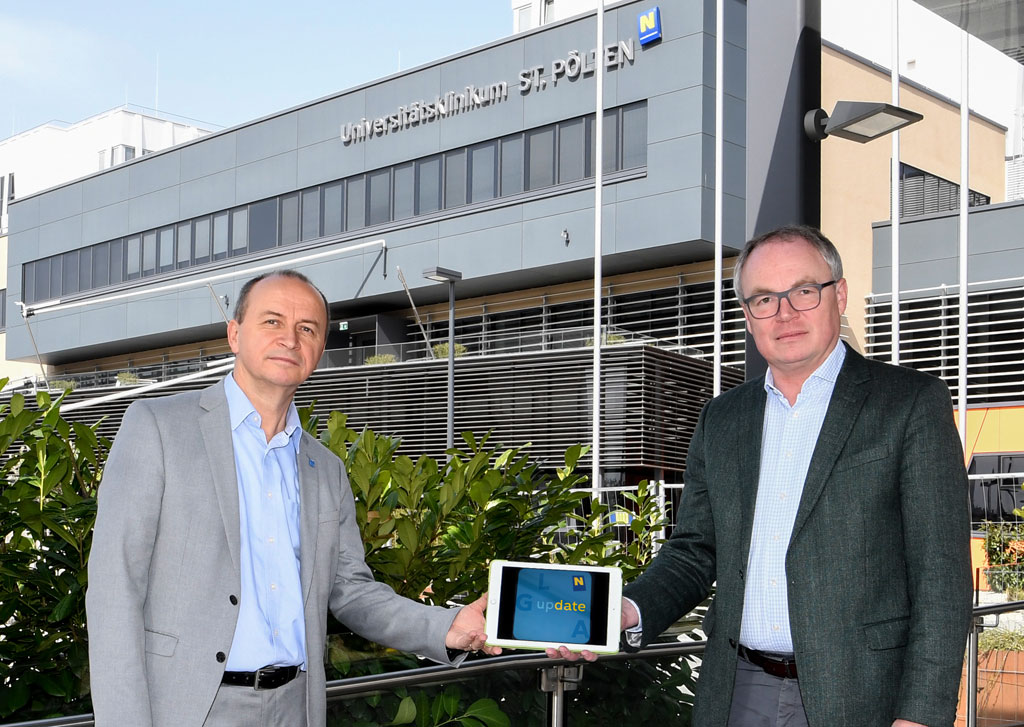 NÖ LGA Executive Director Konrad Kogler (left) and Deputy Governor Dr. Stephan Pernkopf presenting the new “LGA update” app
What the platform solves today:
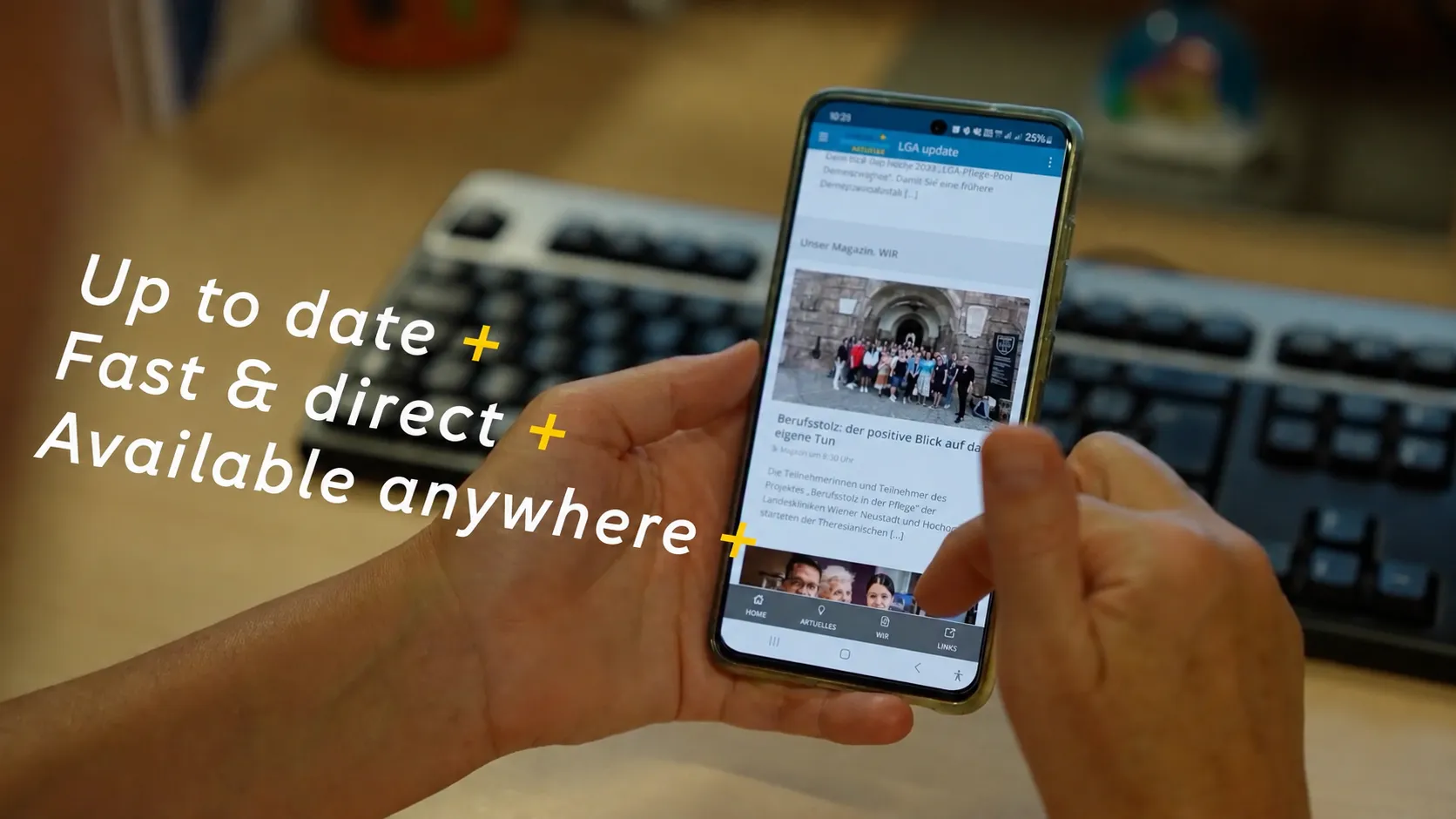
Reaching nursing staff, doctors, and other healthcare professionals without PC access – in real time, on their smartphones
Available care beds across all 49 care centers, viewable in real time – fewer phone calls, faster discharge management
Making medical databases and training materials accessible through a single entry point
Replacing nearly all site-specific intranet systems and parallel tools – one platform instead of many
Giving the executive board a reliable channel into every one of the 77 facilities for the first time – including in crisis situations and structural reforms
Results:
23,000 active users – 80% of the entire workforce, with no mandatory use requirement; 65% access via mobile
8.5 million total visits since the 2020 launch; 250,000 visits per month, growing continuously since day one
85% very satisfied according to a 2025 in-app survey (n ≈ 1,000) – the majority say no other communication tool could replace LGA update
Today: 50% communication, 50% operational use cases
The starting point: how do you reach 28,500 employees without a shared channel?
What the NÖ LGA lacked from the start was a shared internal communication channel. Around 95% of the workforce, including nursing staff, doctors, and medical-technical professionals, had no regular access to a fixed desktop workstation. Information traveled through management hierarchies, got stuck along the way, or arrived too late. Each location ran its own intranet, its own email distribution lists, and its own communication processes. In organizations without a shared information base, information often falls by the wayside – the NÖ LGA learned this firsthand.
Passing on information was entirely dependent on individual managers. Important updates either reached the workforce too late or not at all.
Matthias Hofer, Chief Communications Officer, Niederösterreichische Landesgesundheitsagentur
When the COVID-19 pandemic hit in March 2020, the limitations of this system became impossible to ignore. The communications team made a call: no lengthy debates, no pilot project. The app had to be available immediately. Within five working days, LGA update, built on the Staffbase platform, went live. The mobile version followed one week later.
From crisis communications to a permanent platform
In 2020, the app solved the most urgent problem: 7,500 new users in the first two weeks, twice-daily COVID status updates with real-time data on infections, ventilated patients, and suspected cases for each hospital. Faster than any analog channel could have managed.
Rather than shelving the app once the pandemic ended, the team kept developing it, based on what employees actually needed.
Developments from 2020 to 2026:
Executive board newsletter, employee magazine WIR as a digital online publication, digital newsstand with more than 450 newspaper titles
Rollout of location Spaces – local editorial teams with their own content and permissions (30 active Spaces, 15 in preparation)
Idea exchange (110 ideas submitted, ~50 implemented), media library, podcast “Das Sprechzimmer G1.3”
Exchange platforms for individual occupational groups (nursing directors, IT, works councils, disability representatives) – private areas for shared discussion and document sharing
Integration of key operational processes and HR tools: from time tracking and shift planning to training and a bed capacity overview
What emerged goes well beyond a communication channel. Roughly half the app's use today is operational, not editorial. In 2025, LGA update received the VOICES Award in the Best Employee App Strategy category.
The concept: why an employee app in healthcare needs to do more than communicate
The app has to be useful beyond communication. Services, perks, operational shortcuts: that's the reason employees open it every day. Information almost becomes a bonus.
What used to be a paper notice on the ward is now a digital channel. In an industry that runs on personal contact, the app creates an important connection – direct, fast, and location-independent. Digital communication isn’t a cure-all – but it’s an important ingredient.
Matthias Hofer, Chief Communications Officer, Niederösterreichische Landesgesundheitsagentur
How to launch an employee app in healthcare: the works council, personal devices, and just getting started
One question many communications managers in healthcare organizations know well: how do you get IT, the works council, and data protection on board before you’ve even started?
At the NÖ LGA, it happened differently than usual. The pandemic left no time for standard approval processes. The team decided to act first and convince people of the benefits afterward. The works council was involved from the beginning, not as an approvals body, but as a partner.
Personal devices are a common objection when it comes to employee apps in healthcare. The NÖ LGA resolved it through a clear position: no one has to use the app. Those who choose not to use it accept the risk of information gaps. That may sound blunt, but it's honest. And it works.
The team that pulled everything together in five working days included communications, IT, and legal. Today, a single full-time position in the communications department manages the entire platform: technical maintenance, editorial work, and support for all locations. Local Space admins at the individual sites round out the setup.
6 operational use cases: how LGA update changes daily work in hospitals and care centers
1. Bed capacity tool
What happens: Authorized employees can see in real time which care beds are currently available in which NÖ care centers – broken down by care needs.
How it works: The tool is integrated directly into LGA update and draws on live data from all 49 care centers. During a consultation with a patient’s family, staff have the full overview right on their smartphone.
Value: Previously, relatives would turn up at facilities in distress and ask staff directly. Today, the result is fewer phone calls, fewer misunderstandings in discharge management – and more time for actual care.
2. Idea exchange
What happens: Employees submit improvement suggestions directly through the app. Every submission receives a personal response – whether implemented, declined, or still under review. No suggestion goes unanswered.
How it works: Submissions go directly to an HR unit at headquarters that handles every single entry. This isn’t a silent suggestion box.
Value: 110 ideas submitted, around 50 implemented. One concrete example: a glove dispenser that an employee sourced through a locksmith for €49, instead of the usual €250–300 from a trade supplier. The knowledge of individuals becomes the knowledge of everyone.
3. Digital newsstand
What happens: All employees have free access through the app to more than 450 national and international newspapers and magazines – around the clock.
Value: According to Matthias Hofer, there’s no comparable organization in Austria offering this benefit. Since launch, more than 45,000 visits have been recorded, especially during night shifts — precisely the shift that is otherwise hardest to reach.
4. Online library and medical databases
What happens: Employees have direct access through the app to scientific databases – MEDLINE, Springer, The Lancet – as well as expert videos and training materials.
Value: Previously, access was unevenly distributed, often known only by word of mouth, and tied to an office PC. Today there's a single entry point, accessible from anywhere, at any time. Anyone who needs to look something up mid-shift no longer needs a free office computer to do it.
5. Service center and forms
What happens: Admission forms, information brochures for families, childcare applications, corporate design templates – everything employees need in their daily work, in one place.
How it works: The service center is a dedicated area in the app. Documents can be accessed, filled in, and – where needed – printed directly from there.
Value: For an organization with 77 locations that previously had no shared system, this is no minor detail. Locations that ran their own filing systems or intranet solutions for exactly these functions are now switching to the shared LGA update ecosystem.
6. Location Spaces
What happens: Every hospital and care center has its own dedicated area in the app, managed and populated by the local team.
How it works: The communications team provides an individual framework for each location. Each Space admin receives personal onboarding: structure developed together, a dedicated session, a purpose-built guide. Day-to-day content is the responsibility of the location. 30 Spaces are active, with 15 more in preparation.
Value: Locations that were reluctant to give up their independence found a way forward through the Space model. Many used the switch as an opportunity to retire their old, separately run intranet systems.
What platform consolidation actually means for hospitals
Internal communication in hospitals rarely fails because people don't care. It fails because there are too many parallel systems to manage. Platform consolidation solves that, but it also has direct operational and financial consequences.
At the NÖ LGA, nearly all site-specific digital employee tools have been replaced by LGA update. Email distribution lists were dissolved, site-specific intranet systems were discontinued, and mass emails were significantly reduced. What used to run across many parallel channels, and with it many parallel licensing and maintenance costs, now runs on one platform.
The NÖ LGA points to licensing savings on third-party tools as a significant cost factor, even without an exact figure calculated. On top of that, the overhead that parallel systems always generate disappears: training for multiple tools, support requests to multiple vendors, governance problems when no one has a clear view of what’s being communicated where.
The result: one platform, one full-time central role with overall responsibility, and decentralized Space admins with clear accountability at each location.
The benefits go beyond cost. When everyone works on the same platform, the executive board can reliably reach all 77 facilities for the first time. Doctors, nursing and care staff, and administrative employees all receive the same information at the same time. When a crisis comes, whether a pandemic or a structural reform, the system is already there because people use it every day and trust it.
This also pays off in staff retention. The NÖ LGA ranks in the best-performing third in Austria for low staff turnover, despite strong competition for nursing and specialist staff from employers in Vienna, Bavaria, and the Czech Republic.
What multi-site healthcare organizations can take from this
The problems the NÖ LGA started with in 2020 are familiar across the German-speaking world: multiple locations, a predominantly frontline workforce, fragmented communication channels, no shared digital channel for employees. Any healthcare organization with several sites will recognize this.
Act first, optimize later. The app was live in five days – desktop version first, mobile one week later. Organizations that wait for a complete strategy before starting rarely get off the ground in this industry.
An employee app in healthcare is more than a communication tool. Organizations that only push company news lose attention fast. Bed planning, forms, and operational integrations give employees a daily reason to open the app. Company news comes along for the ride.
Make the works council a partner, not a gatekeeper. The key was dedicated areas for occupational groups and works councils. Trust as a launch strategy works – especially in a sensitive environment like healthcare.
Decentralization needs structure, not control. The Space model works because local ownership and a shared framework come together. Local relevance doesn’t emerge despite the central system – it emerges through it.
Six years later: a reaction becomes infrastructure
What Matthias Hofer and his team built in March 2020 started as a reaction to a crisis, not a strategy. Over six years, that reaction has become something 23,000 people use every day, voluntarily, from the early shift to the night shift, from the care center to the university hospital.
The Niederösterreichische Landesgesundheitsagentur received the award for the best employee app strategy in the German-speaking world in 2025. The app itself isn't especially elaborate. What set it apart was one question the team kept asking: what do employees actually need, day to day?
How this could look for you
The fastest way to figure out what an employee app for internal communication and operational processes could look like for your healthcare organization – with your structure, your locations, your works council – is a live demo. The NÖ LGA showed that you can start in five days.