
Exploring the top AI tools for HR in 2026


HR teams are experiencing pressure to do more with less. As workforces become more distributed and employee expectations rise, AI tools help HR scale support, personalization, and responsiveness without adding headcount.
The best AI tools remove friction, not human judgment. AI excels at repetitive and data-heavy tasks, freeing HR professionals to focus on empathy, strategy, and complex people decisions.
Employee communication is the foundation of successful AI in HR. From onboarding to engagement to executive messaging, clear and timely communication determines whether HR initiatives actually land with employees.
Rather than adding more tools, HR teams see the most value from AI-native platforms that unify multiple HR use cases and reduce tech stack complexity.
With AI-powered sentiment analysis and pattern recognition, HR teams can identify sentiment trends and engagement patterns earlier than manual analysis alone — before they turn into retention risks.
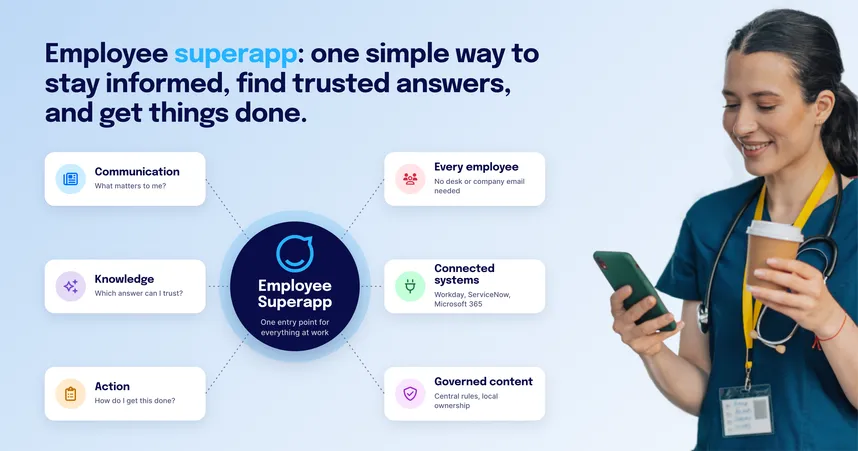
As an AI-native Employee Experience Platform, Staffbase supports communication, engagement, onboarding, and insights through a single, governed system — helping HR teams move from information delivery to real alignment and impact.
HR work is fundamentally people-focused. It requires judgment, empathy, and the ability to navigate complex situations that don’t fit into simple rules or workflows. Those responsibilities haven’t changed — but the volume of administrative and repetitive work surrounding them has increased significantly.
For years, HR teams have spent large amounts of time on manual tasks: reviewing resumes, coordinating approvals, sending routine updates, managing communications, and analyzing survey data after the fact. This work is necessary, but it limits the time HR can spend on strategy, employee experience, and meaningful human interaction.
AI changes that balance. Applied correctly, AI tools help HR teams reduce manual workload, improve responsiveness, and scale support without adding headcount. Tasks like screening, content drafting, personalization, and data analysis can be automated or accelerated, allowing HR professionals to focus on decisions that require human judgment and context.
At the same time, the rapid growth of AI tools has created confusion. Not every solution is designed for HR, and not every AI claim translates into real value. This guide focuses on practical use cases, helping HR teams understand where AI is effective today, where it adds the most value, and how to evaluate tools with clarity rather than hype.
Why HR leaders are talking about AI more than ever
The last few years in HR have felt like the jump from a landline to a smartphone. Technology is advancing rapidly with AI, requiring new skills and knowledge to keep pace.
According to research from the Society for Human Resource Management, AI has rapidly transformed HR in 2025 alone: 43% of organizations now leverage AI in HR tasks, up from 26% in 2024. These changes are seen across the employee lifecycle, from hiring to onboarding to retention and far more.
AI tools have been a major time saver, reducing time-to-hire by an average of 40%. As the Society for Human Resource Management outlines, of HR leaders using AI, over half apply it in recruiting to screen resumes, write job descriptions, and communicate with candidates.
AI has also been crucial for boosting employee engagement and retention, helping to shape a positive workplace culture overall. In fact, a 2025 report from WiFi Talents reveals that 44% of HR teams use AI tools for employee engagement and retention.
On top of this, 54% of HR professionals say AI helps identify internal talent for promotion, and 56% use sentiment analysis powered by AI to gauge employee morale.
And with happier employees come higher productivity rates: 80% of companies report increased productivity after adopting AI in HR processes.
Why HR leaders need to adopt AI best practices
AI is likely already part of your day-to-day, but perhaps you want to know how to best integrate it into your workflow. Whatever your area of comfort and knowledge, there’s no denying that the market is shifting, and there’s a huge opportunity to get familiar with AI. WiFi Talents projects that the global AI in HR market is expected to reach $15.7 billion by 2026.
This all adds up to one overarching theme … and it’s that AI is here and it’s revolutionizing the workflow of HR teams. Before we dig into the tools, here’s why AI matters for HR right now:
1. HR workloads are ballooning
Whether your workforce is remote, hybrid, frontline, or global, employees expect fast answers, personalized support, and seamless experiences — all at scale.
2. Manual work drags down strategic HR
Time spent sending email updates or comparing spreadsheets doesn’t help HR build culture, improve retention, or design better experiences.
3. People want human support
AI is powerful, but where it really shines is taking care of repetitive work so your people team can focus on human judgment, empathy, and creativity.
The top AI tools for HR in 2026
 Instead of cataloging individual AI products, this guide focuses on the core HR tasks that AI supports today, how different categories of tools address those tasks, and where they provide measurable value.
It also explains how AI-native employee experience platforms, such as Staffbase, fit into this landscape — particularly in areas where communication and engagement play a central role, including onboarding, internal communications, employee engagement, and executive messaging.
Whether you are evaluating AI tools for the first time or reassessing an existing HR tech stack, this guide is designed to clarify priorities, reduce complexity, and show how AI is shaping HR work in practical, sustainable ways.
1. Recruiting and talent acquisition AI tools for HR
What these AI tools do: AI tools screen resumes, assist with candidate sourcing, optimize job descriptions, schedule interviews, and even interact with applicants through chatbots.
How they help HR teams: Traditional recruiting involves a huge amount of repetitive labor. AI doesn’t replace recruiters — it amplifies them. By reducing manual screening work, recruiters can focus more on candidate conversations and culture fit.
Practical benefits:
Candidates increasingly expect a smoother experience
AI can help close the gap between the application and the offer more efficiently, while still leaving humans in the loop for decisions
More time saved for HR teams to focus on strategy and process
Relevant tools:
HireVue: video interview AI and talent insights, with a focus on skills validation for specific roles.
Eightfold AI: talent intelligence that excels at interviewing candidates and capturing workflows during the hiring process.
Harver: a suite of automated solutions to hire better and faster, including predictive assessments and talent matching.
2. AI onboarding tools for HR
What these AI tools do: AI can automate task assignments, personalize onboarding content, answer new hires’ questions, and guide them through compliance and training steps.
How they help HR teams: Onboarding is much more than paperwork. It’s the crucial point where an employee begins to feel connected to the company and their peers. Since it’s such a pivotal moment, AI accuracy can help your HR team make sure that onboarding is seamless — and that your company’s reputation remains positive.
Practical benefits:
Smooth onboarding: new hires get the right information right when they need it. And you’re not weighed down by constant admin questions (like “How do I set up my email signature?” or “Where can I find my benefits?”).
More consistent experience across locations and teams. This is especially important if you’re part of a global, distributed workforce. Some AI tools can even auto-translate your messages into the location language.
Personalized journeys based on role, team, geography
Relevant tools:
Enboarder: journey-based onboarding automation
Talentech: HR platform that also syncs with recruitment
Staffbase: As an AI-native Employee Experience Platform, Staffbase brings onboarding into the bigger picture with one central hub. And if you’re overwhelmed by too many tools, don’t worry. The platform connects the employee experience seamlessly with internal communications from day one. We don’t treat onboarding as a silo — we see it becomes a smooth first leg in the ongoing employee journey.
Staffbase supports AI-assisted localization, reducing the need for manual translation when communicating with multilingual and geographically distributed employee groups.
3. AI-powered internal comms tools
What these AI tools do: AI-powered tools for internal communications can draft messages, tailor content by audience, suggest better wording, optimize send times, and even analyze engagement metrics.
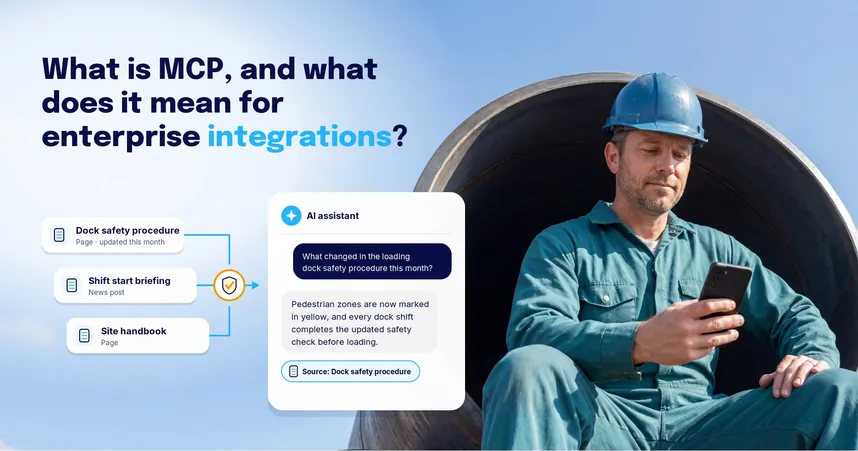
AI is also changing how content is consumed. Features like On Air convert written updates into short AI-generated audio briefings, making it easier for employees — especially frontline or mobile workers — to stay informed without needing to read long posts during a shift.
How they help HR: Too often, internal comms can feel like sending a newsletter and hoping it sticks. AI helps teams understand who’s listening, how they’re responding, and what resonates.
Plus, internal communication should be a strategic priority for HR. When strong communication is a strategic focus, it helps create a positive, connected employee experience that leads to retention.
And when internal comms isn’t a priority? Staffbase’s 2025 International Employee Communication Impact Study shows that 63% of employees who are considering leaving their jobs cite poor internal communication as a contributing factor.
Practical benefits:
HR needs to announce a policy change without stirring up confusion
Global teams need localized, culturally appropriate messaging
Comms can adapt to different employee segments (like frontline vs. remote). This personalization can then lead to better timing to send messages, resulting in higher open rates and engagement.
Richer insight into what employees care about, resulting in even more tailored and resonant messages.
Relevant tools:
Staffbase provides an AI-native Employee Experience Platform with an intranet core, mobile access, and multi-channel publishing across app, email, and desktop. The platform supports AI-powered communication by integrating content creation, distribution, and measurement within a single, governed system.
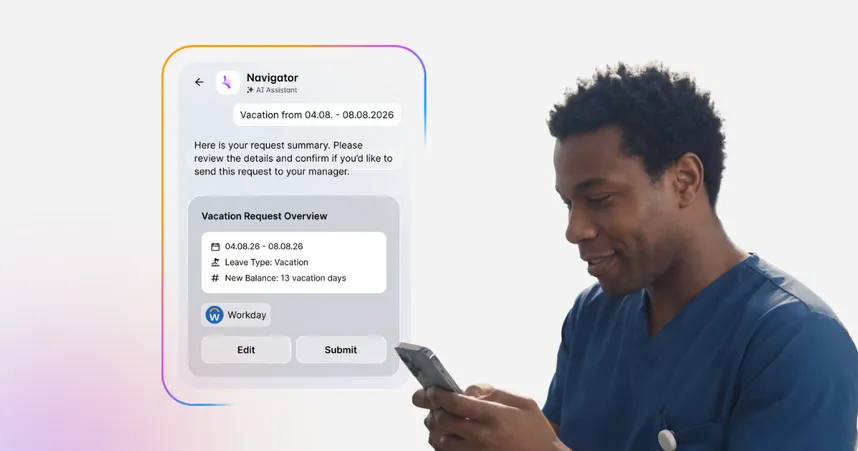
Within the platform, tools such as AI Companion and Employee AI support core HR and internal communications tasks, including drafting and adapting content, surfacing verified answers through AI-powered search, analyzing engagement and sentiment trends, and delivering personalized communication to different employee groups. This allows teams to focus less on formatting and manual coordination and more on clarity, relevance, and impact.
From a security and compliance perspective, Staffbase is designed for large, regulated organizations. All AI processing runs in an isolated, encrypted Azure OpenAI environment with strict tenant separation. Customer data is not shared across organizations and is not used to train external or public AI models, ensuring data privacy, governance, and organizational control.
4. Employee engagement, culture, and sentiment analysis tools
What these AI tools do: From sentiment analysis to pulse surveys and predictive analytics, AI tools help HR understand employee mood, engagement drivers, and risk of turnover.
How they help HR: AI does more than just process data. It’s also valuable for pattern detection, like revealing how employees in your organization feel — before sentiment becomes a crisis.
According to research from Yomly, AI-driven engagement tools can increase survey response rates and surface signals that may indicate disengagement or misalignment faster than traditional methods. And predictive analytics can forecast turnover risk with meaningful accuracy, giving HR teams time to act.
Practical benefits:
Segmenting engagement by team or location
Detecting sentiment shifts after major changes (for example, organization restructuring) and informing crisis comms and more strategic, leadership-level comms.
Personalizing employee recognition and feedback loops
Relevant tools:
Culture Amp: a pulse survey platform built with AI-driven engagement insights
Lattice: performance and engagement analytics linked directly to employee review cycles
Staffbase: With AI-powered sentiment analysis in Staffbase Studio, editors can continuously track how employees feel across surveys, feedback, and communications over time and see how sentiment evolves as new initiatives roll out.
Staffbase’s edge here is a connected experience stack where insights from communications, onboarding, and continuous feedback live in the same platform. This means that your HR team has a more holistic view of the employee experience.
5. Learning & development (L&D) AI tools
What these AI tools do: Easily create personalized learning paths for your employees, including skill recommendations, adaptive training content, and progression analytics.
How they help HR: Generic “one-size-fits-all” training doesn’t cut it anymore. AI can tailor learning based on role, skill level, and engagement patterns.
Practical benefits:
Personalized course recommendations, unique for each employee
Skills mapping and gap analysis that can help steer employees on the right career course
AI‑powered content curation to help easily build and adapt training content, which means less strain on your HR, internal comms, and IT teams.
AI-backed learning programs can boost engagement and knowledge retention by significant margins.
Relevant tools:
Degreed: learning experience platform with a focus on AI coaching
Cornerstone + EdCast: personalized learning ecosystem and AI-enabled development paths
6. Performance management AI tools for HR
What these AI tools do: To help you manage employee performance, AI can help you analyze feedback trends, identify strengths and development areas, and automate timely check-ins and growth conversations.
How they help HR: When performance data is noisy and subjective, AI adds consistency and pattern recognition, helping managers make more balanced decisions.
Practical benefits:
Save time with automated recurring performance tasks like check-ins, reminders, and report generation, freeing managers to focus on coaching.
See objective trends and patterns in feedback, helping reduce bias in evaluations and giving a clearer view of performance.
Discover tailored learning paths or growth opportunities for employees based on strengths and gaps.
Improved engagement: Frequent, data-backed feedback encourages ongoing conversations and keeps employees motivated.
Helps detect early signs of underperformance or disengagement, allowing managers to intervene before issues escalate.
Relevant tools:
Lattice: an HR platform with real-time performance insights, including automated check-ins and reviews.
Leapsome: AI-powered people platform for performance reviews, goal setting, learning, engagement, and much more.
15Five: AI-enabled performance management platform known for in-depth performance analytics.
7. Executive and strategic communications AI tools
What these AI tools do: Draft executive messages, analyze sentiment on leadership communication, and tailor content for different audiences.
How they help HR: You know how valuable executive and strategic communications are to your organization. But that doesn’t mean this is always easy to translate. AI helps make sure those communications translate into understanding, alignment, and engagement across the company.
Practical benefits:
AI can draft and optimize messages quickly, saving executives time while maintaining clarity and professionalism.
Messages resonate with different teams, locations, or roles, improving comprehension and engagement.
Sentiment analysis reveals how messages are received, allowing leaders to fine-tune tone or content in real time.
AI helps maintain a coherent and credible tone across multiple communications, reducing mixed signals.
By reaching employees with the right message at the right time, leaders can drive stronger alignment on strategy, engagement, and other top priorities.
Identify areas of misunderstanding or concern before they escalate, and earmark areas for proactive dialogue with leadership.
Relevant tools:
PoliteMail: leader-specific communication insights built for employee email communications in Outlook.
Staffbase: As an AI-native Employee Experience Platform, Staffbase not only optimizes executive messaging with built-in AI drafting and analytics but also integrates communications seamlessly into the broader employee experience — from mobile apps to internal channels — so leaders can reach people wherever they work and truly measure impact.
Build a practical, governed AI approach for HR with Staffbase
The growing number of AI tools in HR can make adoption feel complex. The most effective approaches focus less on individual features and more on the work HR teams need to support — communication, onboarding, engagement, and insight — across the full employee lifecycle.
This is where Staffbase fits into the HR AI landscape. As an AI-native Employee Experience Platform, Staffbase provides a centralized communication and engagement layer that supports HR work from onboarding through ongoing employee experience.
Rather than adding another point solution, it integrates AI into existing HR workflows, helping teams reduce manual effort while maintaining governance, security, and consistency.
The result is clearer communication, better alignment across roles and locations, and more reliable insight into how messages and initiatives are landing with employees. This enables HR teams to focus on decision-making, employee experience, and long-term impact instead of tool management.
Ready to discover how Staffbase will revolutionize your digital employee experience?