
Top 10 employee communication software for 2026


Jennifer O'Brien in Employee App
Working in a nine-to-five isn't what it used to be. Frankly, the workplace has evolved. Between hybrid schedules, dispersed teams, and frontline workers who rarely touch a desk, keeping everyone informed (and engaged) isn’t as simple as sending a company-wide email.
That’s where employee communication software comes in. It unifies your intranet tools, mobile apps, internal email, and analytics, so that every employee, regardless of location, can stay connected to your company culture.
But not every platform is created equal. Some tools enable quick chat. Others prioritize structured content. And only a few excel at both — and do it all across multiple channels. That’s where Staffbase comes in. As the first AI-native Employee Experience Platform, we’re built from the ground up to enable enterprise-scale communication, drive employee action, and engage every employee.
Buckle your seatbelt (or grab that much-needed double espresso); let’s break down what employee communication software means in 2026, including why it matters, what to look for, and what tools lead the way.
Understanding employee communication software and why it matters
So here is the 411 on employee communication software. Employee communication software is technology that helps organizations share updates, announcements, stories, and resources across all employees in a single, organized system. It helps HR, leadership, and corporate comms reach people everywhere with clarity and consistency.
In short, it’s how you make sure “everyone heard the news” means literally everyone. These platforms are the foundation of internal communication. HR, leadership, and corporate comms need to be heard far and wide, and employee communication tools empower those voices to get the message out loud and clear.
The most modern and trusted communication software solutions include:
A company intranet for organized, searchable knowledge
Targeted announcements, such as email newsletters (with segmentation)
Mobile apps to reach frontline and remote teams
Analytics to know what’s working, who’s reached, and where to improve
The cost of ignored engagement
You may be asking yourself, “Why does it matter now?” Let’s look at some recent, industry-shaking stats:
A Gallup study found that a whopping $8.8 trillion is lost globally every year because of employee disengagement and turnover.
According to McKinsey, employees can spend two or more hours a day just looking for the information they need to do their jobs.
The chart from Deloitte’s 2020 Global Leadership Communication Research study shows that “Seventy-nine percent of organizations say fostering a sense of belonging in the workforce is important or very important for their success over the next 12 to 18 months, but only 13 percent say they are very ready to address this trend.”
Strong internal communication isn’t some nice-to-have corporate perk. It’s a growth driver.
Of course, many organizations aren’t operating on an effective communication platform. There’s one email thread for HR updates, one Slack channel for IT announcements, and one employee newsletter shared by printed posters. In fact, 68% of employees report that critical company updates are often unseen.
Which is why dedicated employee communication platforms have taken off. Businesses are seeking the best tools that integrate intranet, mobile, and email into a complete ecosystem. That way, communicators have full transparency over what reaches which audiences.
Plot twist: when we say integration done right, we mean Staffbase. With multichannel publishing to intranet, app, email, SMS, and digital signage; our no-code approach to publishing; and AI-driven, automated segmentation, it’s our mission to power high-performance organizations that can connect and drive real impact at scale.
The different types of employee communication software explained
 The landscape of employee communication tools is vast and sometimes confusing. So let's bring out our inner Nancy Drew and decode it.
1. Real-time chat tools
These are the workhorses behind rapid-fire messaging and project updates. Perfect for quick questions or collaboration, but not so much for formal, structured company-wide communication. You know, like a human resources policy that is still relevant six months later…then go look for it in Slack’s message history…exactly.
2. Intranet platforms
The intranet is the virtual hub of your organization. It’s the go-to source for all things company news, policies, and leadership stories. Platforms like Staffbase offer more with employee targeting, personalization, and built-in analytics.
3. Frontline communication apps
Frontline workers often don’t sit at desks or have corporate email. Mobile-based communication apps connect these employees with alerts, shift updates, and safety information. Staffbase’s Employee App keeps them engaged via push notifications, offline access, and branded experiences.
4. Internal email and newsletter tool
Yes, it’s still the most universal communication channel. (Spoiler: Email isn’t dead.) Modern internal newsletter tools (e.g., Staffbase Email) let comms teams build visually engaging messages with analytics that go far beyond open rate.
5. SMS and digital signage solutions
SMS comes in handy when speed matters, like factory floor notifications or urgent shift changes. SMS or digital signage can reach employees instantly. Staffbase includes both in its multichannel toolkit.
6. All-in-one solutions
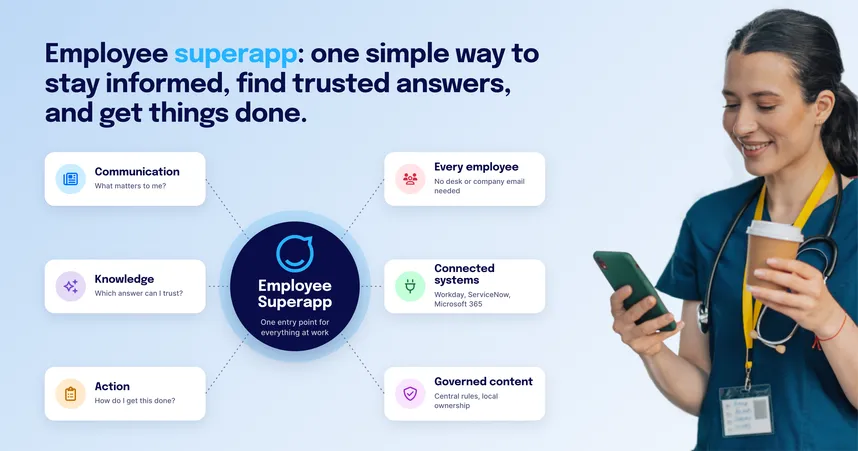
While most vendors focus on one area, Staffbase integrates them all into a single platform: an intranet, an employee app, branded email, SMS, and signage. All wrapped up in analytics and AI. This unified approach eliminates silos and ensures company-wide consistency.
The verdict? Organizations increasingly prefer integrated employee communication platforms that simplify publishing and deliver messages across every channel simultaneously. Staffbase leads this category with Employee AI — designed to give every employee the speed, clarity, and confidence they need to achieve more.
Must-have features that make employee communication software effective
So what separates just another tool from a true communication powerhouse? Let’s look at the must-have features and how Staffbase excels at each.
1. Ease of use (no coding, no IT bottlenecks)
Your communication team shouldn’t need to know code. Tools should include drag-and-drop editors, templates, and built-in brand styling. Staffbase’s Studio Publisher gives non-technical communicators full creative control. This enables fast updates without IT involvement.
2. Multichannel delivery
Modern employee communication doesn’t happen in one space. Whether through intranet posts, emails, mobile push notifications, or even SMS, your platform should deliver consistent messaging anywhere employees work.
3. Personalization & audience segmentation
No one likes irrelevant updates. Modern platforms allow targeting by department, location, or job title.
4. Analytics that prove impact
Forget vanity metrics. You need insights that connect communication to outcomes. Staffbase’s Smart Impact Analytics tracks everything from readership to behavioral results so that comms teams can prove their strategic value.

5. Integrations with existing systems
A great employee communication platform plays well with others: Microsoft 365, Google Workspace, Slack, HRIS tools like Workday or ServiceNow. Staffbase seamlessly integrates with these ecosystems to keep all systems aligned.
6. AI capabilities
Staffbase Employee AI adds intelligence to every step: personalized news digests, AI-assisted writing, smart search, and employee sentiment analysis. It transforms how communicators create and measure their content.
7. Scalability and governance
Whether you have 500 or 600,000 employees (like DHL Group, one of Staffbase’s success stories), governance features such as approvals, version control, and editorial workflows keep communication organized and secure.
The best employee communication software in 2026 (And how they compare)
1. Staffbase: The All-in-One Champion
Description:
Staffbase is an AI-native Employee Experience Platform that unites intranet, email, mobile app, SMS, and digital signage. It’s tailored for enterprise communication, designed to bridge the gap between office-based and frontline employees through a single powerful platform.
The star attractions:
⭐ No-code publishing for comms teams
⭐ AI-assisted content creation, personalization, access to tools via chatbot (Employee AI)
⭐ Multichannel communication (intranet, app, email, SMS, signage)
⭐ Audience segmentation by role, region, or department
⭐ Smart Impact Analytics with a platform and outcome-based analytics
⭐ Integrations with Microsoft 365, Google Workspace, HRIS, and ServiceNow
⭐ Global translation and scalability
Pros:
✅ True multichannel reach
✅ Built for large enterprises
✅ AI features revolutionizing content creation
✅ Proven security and compliance
✅ Measurable communication impact
Cons:
❌ More than smaller startups might need
Pricing: Available on request.
Best for:
Organizations with a distributed workforce that need a unified, secure, and analytics-driven communication platform.
2. Workvivo
A social-style communication app recently acquired by Zoom, Workvivo blends company news, recognition, and community into an engaging feed.
The star attraction:
⭐ Creates a more social workplace experience with a social news feed and chat built into the platform
Pros:
✅ Seamless web and mobile user interface for employees
Cons:
❌ Lacking collaboration tools for internal communications teams
Pricing: Offers a business and enterprise plan. Available on request. Best for: Medium-sized companies focused on bottom-up engagement.
3. Haiilo
Formerly Smarp, Haiilo offers a comprehensive platform for seamless communication.
The star attraction:
⭐ Boost brand reach and visibility by empowering employees to share company content on social media.
Pros:
✅ User-friendly and community-driven
Cons:
❌ Doesn’t offer a free trial
Pricing: Three pricing plans available upon request.
Best for: Businesses prioritizing social sharing and culture.
4. Simpplr
A modern intranet tool with AI-powered recommendations and a clean user experience.
The star attraction:
⭐ Strong AI capabilities for personalization and sentiment analysis
Pros:
✅ Fast to deploy and simple to manage
Cons:
❌ Limited support for frontline employees and multichannel publishing
Pricing: Available upon request.
Best for: Mid-size organizations wanting a simple, attractive hub.
5. Firstup
A content-delivery platform focused on automation and personalization.
The star attraction:
⭐ A versatile employee engagement platform.
Pros:
✅ Centralizes communication across multiple channels
Cons:
❌ Complex setup and administration
Pricing: Available upon request.
Best for: Large enterprises prioritizing campaign automation.
6. Slack
The king of quick chats. Great for real-time collaboration.
The star attraction:
⭐Powerful communication instruments.
Pros:
✅ Create dedicated channels for different tasks
Cons:
❌Can be pricey, and features on the free trial are limited
Pricing: Available on request.
Best for: Teams needing daily collaboration, not centralized communication.
7. Microsoft Teams
A Comprehensive collaboration platform, excellent for internal meetings and chat within the M365 ecosystem.
The star attraction:
⭐Advanced communication tools that offer features like video and audio calls, real-time chat, and virtual meetings.
Pros:
✅ Deep integration with M365 ecosystem
Cons:
❌Challenging for businesses to communicate with deskless workers due to limited access to standard platforms like email
Pricing: Available upon request.
Best for: Microsoft-heavy organizations that already use SharePoint.
8. Connecteam
Focused on frontline communication and task management.
The star attraction:
⭐ Team instant messaging allows 1:1 and group conversations and chats that are searchable.
Pros:
✅ Onboarding is made easy with its intuitive interface
Cons:
❌ Lacks advanced HRIS features
Pricing: Available on request.
Best for: Operational teams with field workers.
9. Ineract
An intranet platform that is well-suited for highly regulated sectors
The star attraction:
⭐Great for regulated industries
Pros:
✅ Specifically designed for regulatory compliance and governance
Cons:
❌ Limited multichannel options
Pricing: Available on request.
Best for: Government sectors.
10. LumApps
An enterprise intranet platform with strong customization for Google and Microsoft users.
The star attraction:
⭐ Combines communication, social collaboration, and productivity integrations.
Pros:
✅ Strong integrations and multilingual capabilities.
Cons:
❌ Complex setup, steep learning curve.
Pricing: Available on request.
Best for: Global organizations needing customizable intranet experiences.
How AI-native innovation makes Staffbase the platform built for the future of communication
If bulletin boards defined the workplace of the past, the modern era belongs to AI-native platforms. Here’s what Staffbase AI looks like in practice:
AI personal digests: Employees receive personalized updates based on their roles, interests, and priorities, helping to cut through the clutter.
AI-powered search: No more endless digging. Employees get instant, summarized, and actionable results. (Think of all the time you will save!)
AI writing companion: Helps communicators draft and refine content, matching the company tone automatically.
Sentiment analysis: Measures employee mood and engagement across communications.
Narrative insights: Maps how company stories evolve and impact culture over time.
Staffbase provides AI that supports humans — not replaces them. Here’s some food for thought for the security-conscious IT teams: Employee AI runs on Microsoft Azure with enterprise-grade encryption. Date is protected and never used to train external models.
A practical guide to finding the best employee communication platform for your organization
 Don’t just pit checklists against each other. Choose a platform that will work with your culture, systems, and people. Instead, evaluate based on your specific needs:
Identify your audiences
Who needs to get what? If you have office employees, remote workers, and 20,000+ in the field, you need multichannel flexibility.
Assess your technology
Is messaging scattered across Slack, Outlook, intranets, and HR systems? The more fragmented the experience, the lower your engagement.
Factor in scale and integrations
Choose a platform that grows with your business and easily integrates with Microsoft 365, HR systems, and collaboration tools.
Value analytics and ROI visibility
Your comms team shouldn’t have to speculate about their impact. So choose software with Smart Impact-like analytics.
Don’t overlook adoption and support
A platform’s success is determined by how smoothly it rolls out. Platforms like Staffbase offer onboarding advice, technical training, and change management resources from real experts.
In fact, Staffbase fills every gap your competitors have left open. It’s an easy-to-use, enterprise-grade, AI-native employee engagement platform that empowers internal communicators to deliver measurable results.
Learn more with a real-world example
Alaska Airlines, one of the most respected brands in aviation, uses Staffbase to keep thousands of employees — from pilots and flight crews to ground operations — connected in real time. The platform enables quick updates across mobile, intranet, and signage channels, ensuring that every team member, no matter their location, stays informed, aligned, and engaged, all while maintaining the airline’s hallmark culture of service and safety.
With integrated analytics, Alaska Airlines tracks engagement trends to refine communication strategies. At the same time, mobile-first features ensure frontline staff receive vital updates instantly before takeoff or during turnarounds, further enhancing agility, confidence, and teamwork across the skies.
Best practices for successfully rolling out employee communication software
Have you ever heard the saying ‘the second mouse gets the cheese’? When rolling out employee communication software, you want to make sure you do it right the first time. The best communication tool is no good if it’s not adopted well (Just like the first mouse learned). Here’s how to make your launch a success:
Define objectives: What does “success” look like to you? More readers? More engagement? Fewer silos?
Involve leadership early: Visible executive support communicates value and encourages adoption company-wide.
Launch in phases: Don’t go all in. Try the intranet with one department or region, get feedback, then scale.
Provide training and support: Equip content creators in all departments. With Staffbase’s native Customer Success teams, it’s ready-built.
Tell your employees about your launch: Advertise and promote your intranet like any other product you’re rolling out. Generate hype with teasers, how-to videos, and contests. I mean, who doesn’t love a bit of hype?
Invite continuous feedback: Use built-in survey tools and analytics. Features like Staffbase’s Smart Impact tools make it easy.
Scale intelligently: After you’ve established good engagement with your launch, broaden the intranet’s use case: Tether it to HR systems and data sources, enable AI digests, and deploy mobile options for frontline employees.
Staffbase tools empower and guide you through each phase of the rollout journey — from planning and preparation to employee onboarding, training, process automation, and optimization.
And thanks to its modern, human-centered design, communicators no longer have to suffer outdated admin dashboards and can finally focus on impact. (So really, there is no need to end up like a mouse without cheese.)
Final thoughts on employee communication software
The future of employee communication is intelligent, integrated, and Staffbase-led.
The workplace continues to evolve, but one truth remains constant: Companies with clear, inclusive, and efficient internal communication win. Employee communication software isn’t just about messages. It’s about connection, culture, and trust.
And when it comes to choosing the best employee communication platform for 2026 and beyond, Staffbase stands at the top:
🏅 It’s the first AI-native Employee Experience Platform, making communication faster and smarter.
🏅 It’s multichannel, reaching every employee in real time regardless of location.
🏅 It’s enterprise-proven, powering success for global brands like DHL.
🏅 And it’s built for communicators. No coding, no silos, no missed messages.
So if your people deserve better communication and your comms team deserves better tools, there’s really only one direction to look.
Want to see how intelligent communication can move your company forward?
FAQ
How do I choose the right employee communication software for my company? Get the answer to this and other frequently asked questions below.