


What are the key features of an AI intranet for enterprise organizations in 2026?
The best AI intranets in 2026 resolve employee questions instantly with governed, trusted answers. Learn which capabilities make that possible — and why governance determines whether AI improves clarity or scales confusion.

The short answer
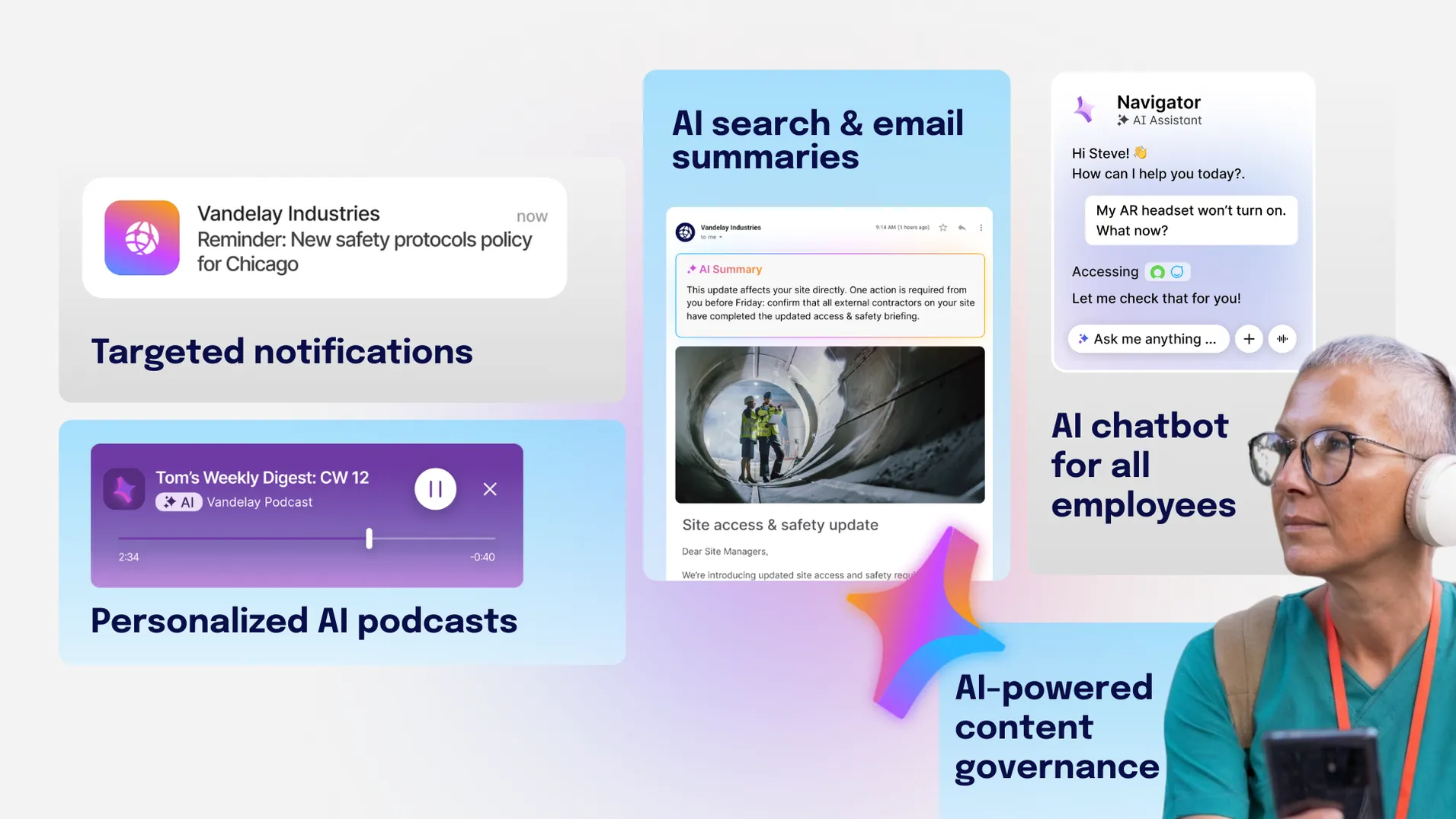
The key features of an AI intranet in 2026 focus on delivering trusted answers quickly. Enterprise organizations need conversational AI search that resolves questions instantly, governance systems that ensure information is owned and reviewed, personalized delivery that surfaces relevant updates, multilingual accessibility for global teams, and analytics that reveal whether communication actually reaches employees, , and, increasingly, an AI assistant that can act on the answer in the systems employees already use.
These capabilities only work together. Governance ensures answers come from owned, reviewed content. Personalization enables critical updates to reach the right employees. Analytics reveal whether communication improves clarity or creates confusion. Together, they transform the intranet from a content repository into a resolution engine employees can rely on.
Why your content junkyard is your most expensive mistake in 2026
The biggest enterprise AI failures come from unowned, outdated content. When a powerful AI engine is pointed at unmanaged SharePoint folders or legacy wikis, it doesn't fix the mess. It automates it. This is the content junkyard problem. Three patterns make it unavoidable:
AI amplifies whatever it can access. If content is outdated, unowned, or contradictory, AI scales those problems. Faster answers can therefore mean faster mistakes.
Employees don't verify AI answers. Once AI becomes the first point of contact, people tend to stop cross-checking documents. If the answer is wrong, the damage is immediate.
Trust collapses after one failure. In internal systems, employees rarely give AI a second chance. One incorrect or unsafe answer, a deprecated safety step, or an outdated HR policy can be enough to abandon the tool entirely.
Most teams optimize the wrong thing. They treat AI like a content vending machine, focusing on writing faster and publishing more. The result is a silent ROI failure. The license is paid. The feature ships. But usage drops.
The intranet becomes a ghost town, not because the AI was weak, but because it wasn't safe to trust. The fix isn't better prompts or a faster rollout. Governance and ownership are what make AI scalable, and they are far cheaper to implement upfront than to repair trust after AI gets it wrong.
From warehouse to engine: Why the intranet shift is possible
For years, intranets promised clarity but largely delivered storage. They tended to be desktop-first, lightly governed, and disconnected from frontline realities. Content ownership was inconsistent, review cycles were optional, and frontline employees were often excluded altogether. The idea of an intranet as a place for authoritative answers was more aspiration than reality.
The conditions have changed. In 2026, AI has made the intranet the first point of contact and raised the cost of ambiguity in doing so. When employees ask a question, they often don't browse, compare, or second-guess. They tend to act on the answer they're given. That makes governance, ownership, and validity non-negotiable.
This is the shift from content warehouse to resolution engine. AI amplifies the work of communicators, but only information that is clear, approved, and structured survives that amplification. Everything else becomes noise.
Junkyard management: How to prepare your current intranet to be AI-ready
Most organizations recognize the risk of layering AI on a cluttered intranet, but aren't sure how to start cleaning it up. The solution is preparation.
AI features accelerate confusion without clear governance and lifecycle controls. Before adding AI, focus on making your intranet safe to answer with:
Start with questions, not content: Identify the employee questions that require clear, actionable answers.
Separate discussion from decisions: Keep drafts and conversations out of AI's reach.
Assign ownership to every answer: If no one owns accuracy and review cycles, AI shouldn't use it.
Define what AI should not answer: Exclude high-stakes, emotional, or ambiguous topics.
Reduce before you generate: Consolidate conflicting guidance into one verified answer.
Fix governance before models: If content isn't trustworthy, AI will only scale the problem.
With this groundwork in place, AI can do what it does best: resolve questions quickly from a source employees can trust.
The 7 key features of an AI intranet for enterprise organizations in 2026
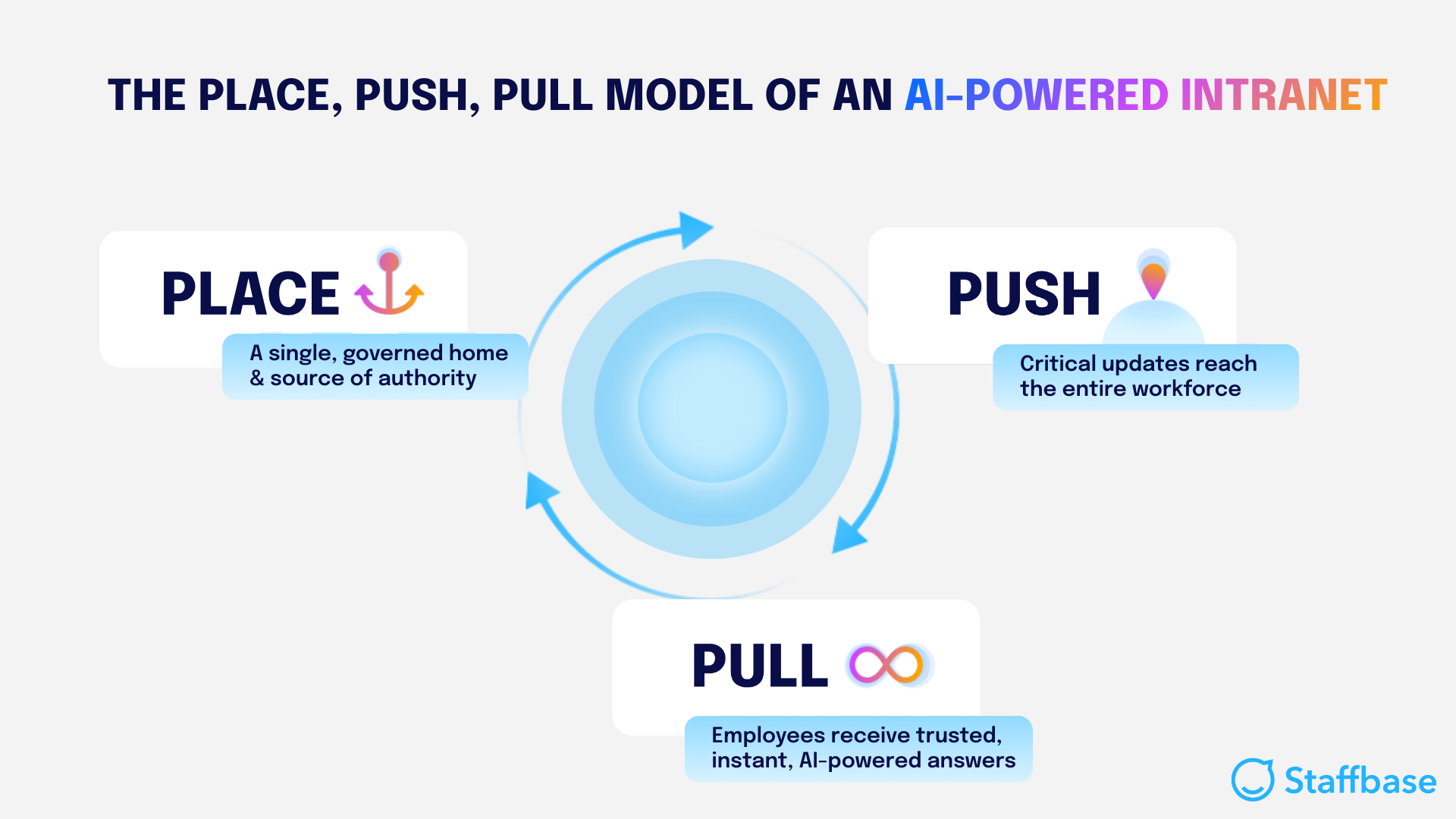 Effective AI intranet features do two things: make the right answers available and make sure they're seen. The Place, Push, Pull model, introduced in our onboarding guide, applies here too.
Dimension | What it means |
|---|---|
Place | A single, governed home for official information |
Push | Targeted delivery and smart follow-ups |
Pull | Instant, trusted answers on demand |
Together, these three dimensions remove friction from real work, especially for frontline employees who need clarity in seconds. The seven features below are organized around them.
1. AI-assisted content creation & governance
Enterprise AI intranets in 2026 need to do more than generate content quickly; they also need to ensure that what gets published is accurate, approved, and safe for AI to use. AI-assisted content creation can help teams draft updates, structure policies, and summarize knowledge in seconds. But speed only matters when the information behind it is trustworthy.
That’s why governance is the real differentiator. Without clear ownership, approval workflows, review cycles, and expiration controls, faster publishing simply increases risk. A modern, governed intranet doesn’t treat every document as equally reliable. Instead, it separates information that merely exists from information the organization actually stands behind. That distinction is what protects trust at scale.
Why this matters at enterprise scale
Place: Employees recognize the intranet as the official home for approved content.
Pull: When employees ask a question, AI retrieves answers from reviewed and validated sources.
Push: Critical updates generated or supported by AI follow defined approval workflows before being distributed.
What this looks like in practice
Staffbase Content Pro keeps the content behind your AI accurate, owned, and ready to use. AI writing assistance helps teams draft updates, policies, and summaries faster — built directly into the Page Designer, so no CMS expertise is required. Governance controls then make sure only content with defined ownership and active review cycles can be surfaced by Staffbase Navigator. AI doesn't decide what's correct. It draws answers from content your organization has already reviewed and stands behind.
Example use case: An HR team updates its remote work policy using AI writing assistance to draft a clear new version in minutes. Before it goes live, the intranet routes it through legal approval, assigns an owner, and sets a review date. When employees later ask the AI assistant for guidance, it answers only from that officially approved policy.
2. Instant answers with AI search, chatbots, personal assistants, and email summaries
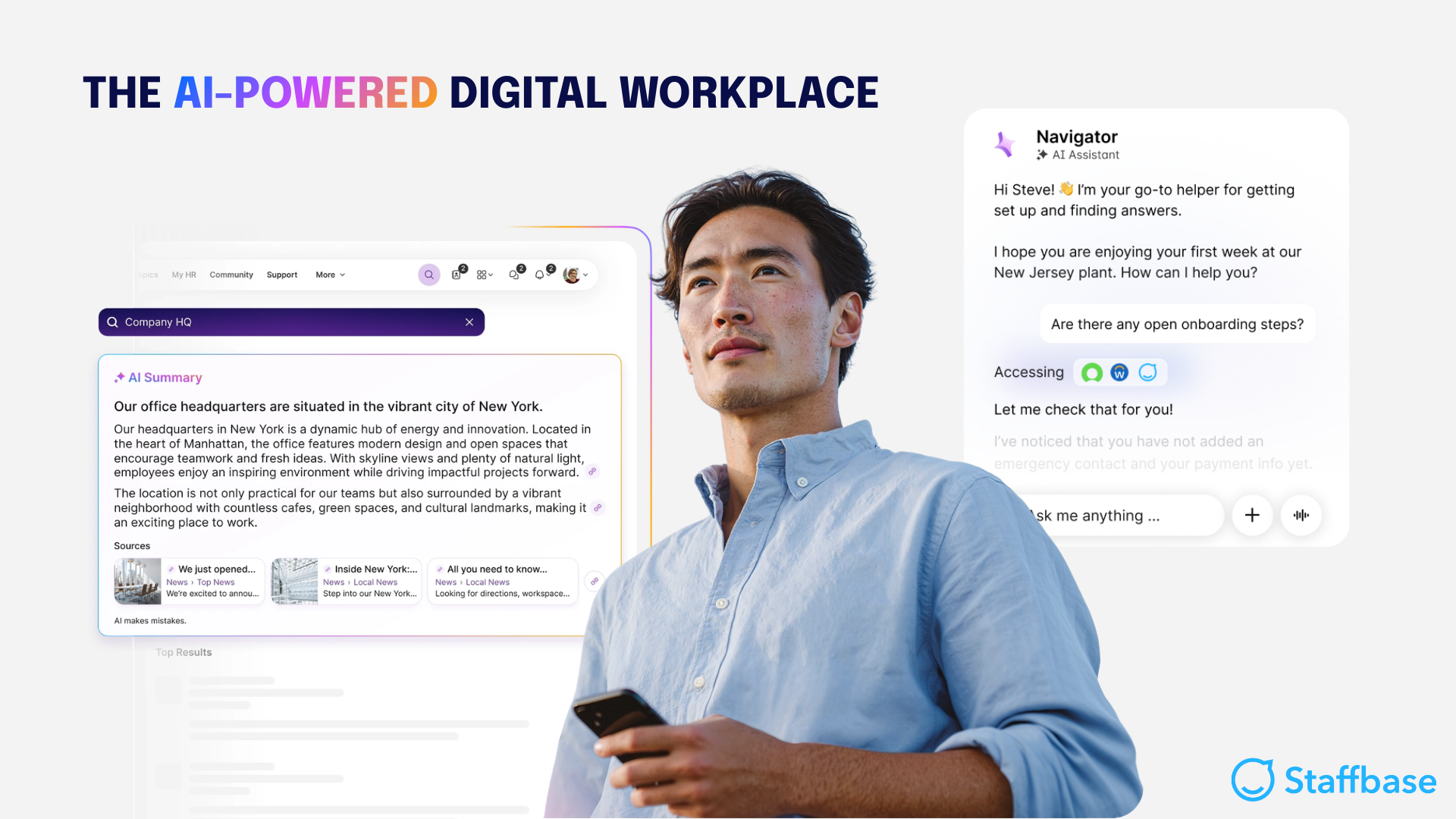
In 2026, employees want fast answers, not search results to sort through. Modern AI intranets deliver instant, conversational responses through AI search, chatbots, personal assistants, and even AI-generated email summaries. Instead of scanning document lists, employees ask a question and get one clear, actionable response.
An AI-powered assistant like Staffbase Navigator combines conversational AI with governed enterprise search. It interprets intent, retrieves verified information, and delivers answers grounded only in approved, current company sources, from intranet pages to connected systems like Workday or Atlassian. That distinction matters, especially in time-critical moments like checking safety guidance, confirming HR policies, or clarifying operational procedures on the frontline.
Employees spend up to 1.8 hours a day searching for information, according to McKinsey. AI assistants reduce that friction by turning the intranet into a resolution engine that helps organizations reclaim productivity and move faster with confidence.
Why this matters at enterprise scale
Pull: Employees ask a question, receive a single, trusted answer instantly, and can complete the next step without switching tools.
Place: The intranet becomes the recognized home of verified answers.
Push: As AI assistants integrate into daily workflows, the platform earns regular attention, increasing visibility and reach for critical updates and internal campaigns.
What this looks like in practice
With Staffbase Navigator, the AI assistant for every employee, people ask in their own words, by voice or text, and get one answer drawn from approved company sources. Every answer links back to where it came from. Admins decide exactly what those sources are: Spaces, pages, and news channels in the Staffbase Intranet and Employee App, plus connected systems such as Workday or Atlassian. Navigator also respects each employee’s access and visibility in every one of them.
From answer to action: connectors and MCP
Many answers end in a next step: requesting time off, clocking in for a shift, or filing an IT ticket. That step usually happens in a different system, behind a different login.
Navigator brings that step into the same conversation. Connected to Workday, it lets employees check their absence balance, request time off, check in and out of shifts, and find payslips. Connected to ServiceNow, it searches the knowledge base and catalog and creates tickets. Connected to Atlassian, it finds Jira issues and Confluence pages, with links back to the original.
Admins add ready-made connectors from the Connector Marketplace in Studio. Navigator is also built on two open standards, the Model Context Protocol (MCP) and Agent2Agent (A2A). This lets IT connect the MCP servers and AI agents the organization already runs, so adding another system is a configuration step, not a project.
Acting doesn’t mean looser governance. Navigator always acts as the signed-in employee, within their permissions, so people only ever see and change their own data. When Navigator can’t fully resolve a request, it doesn’t guess. It summarizes the request and sends it to a monitored inbox, keeping a human in the loop.
Example use case: A store associate asks, “How many vacation days do I have left?” Navigator checks her balance in Workday and links to the approved leave policy. She then requests next Friday off in the same conversation, without opening another app or finding her supervisor.
When employees rely on one platform to stay aligned and get what they need quickly, AI-assisted answers become a natural extension of how work gets done, not another tool to remember.
 3. AI-generated podcasts & audio summaries
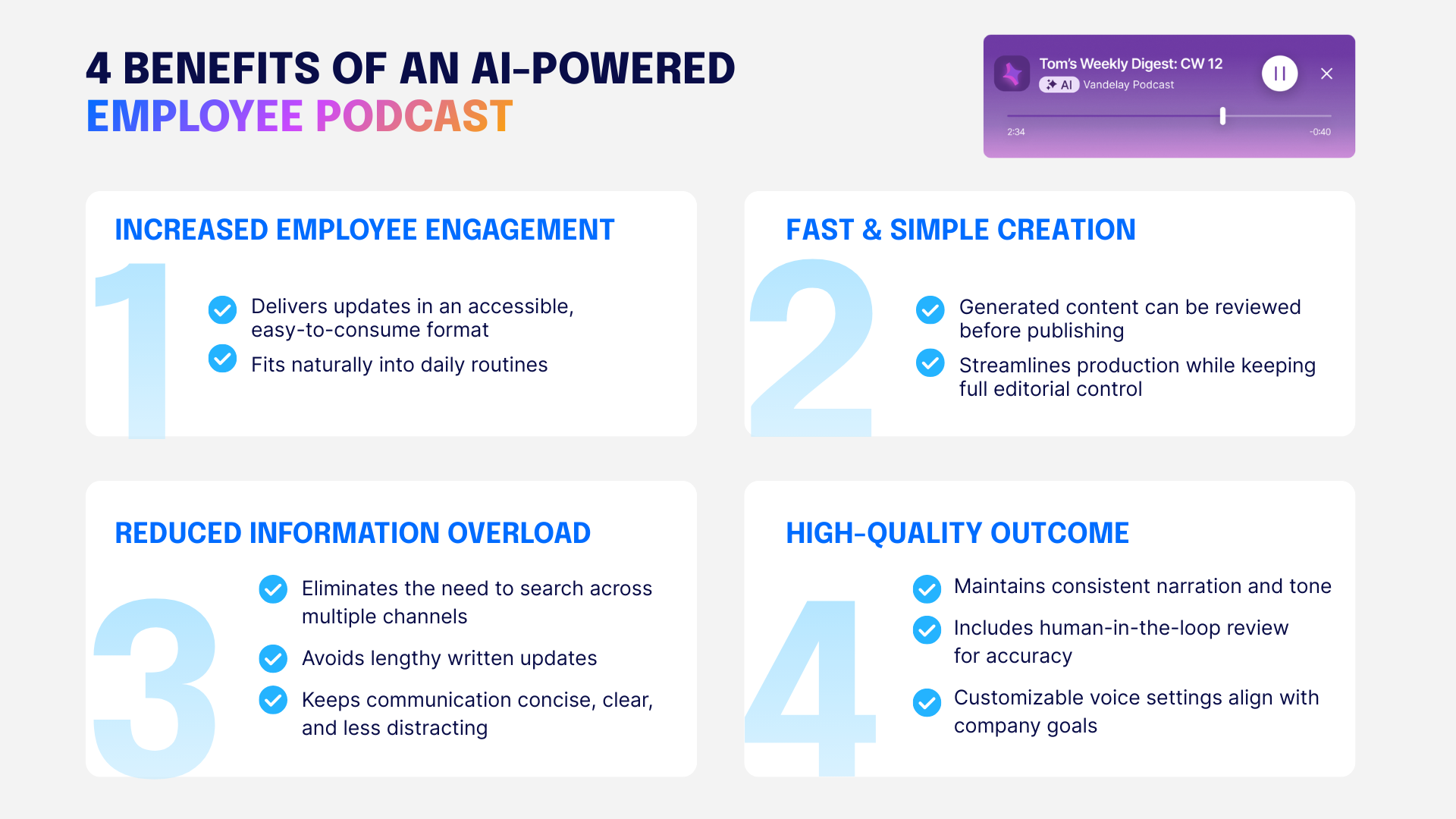
For many frontline roles, the challenge is attention. Drivers, nurses, machine operators, and technicians can’t pause their shift to read updates, even when those updates matter. AI-generated podcasts and audio summaries close that gap by automatically turning written articles and announcements into short, personalized briefings.
Instead of scrolling through posts, employees can listen while working, commuting, or between tasks. An audio update meets frontline teams where they are, without asking them to change how or when they work. In mobile-first environments, audio isn't another channel competing for attention, but rather a smarter way to keep everyone informed.
Why this matters at enterprise scale
Push: Critical updates reach employees even when reading isn’t possible, ensuring important messages don’t depend on screens.
Place: Audio briefings are generated from the same governed intranet content, reinforcing a single, authoritative source of truth.
Pull: Employees can replay AI-generated summaries on demand, giving them control over when and how they absorb information.
What this looks like in practice
With Staffbase On Air, the AI-powered podcast feature within the Staffbase platform, written articles and personalized news feeds are automatically transformed into short, custom daily audio briefings. Because these podcasts are generated directly from governed intranet content, the audio format doesn’t introduce new versions of information. Rather, it reinforces the same approved message in a format that fits frontline realities.
Example use case: A warehouse employee listens to a two-minute AI-generated audio summary during a break, staying up to date on safety reminders and operational changes without searching through the app or missing critical updates.
 4. AI-powered translation & language accessibility
In global organizations, communication breaks down when language versions drift apart. Companies traditionally solved this with manual translation workflows, which can create delays, inconsistencies, and duplicate versions of the same message.
A governed enterprise intranet solves this differently. Content is created once, then translated on demand into different languages. This ensures employees access the same approved message, rather than regionally rewritten versions.
Translation in modern platforms is supported by AI, but is rarely fully automated or left unchecked. Instead, AI accelerates translation while keeping humans in control of accuracy and approval.
This matters because language is not just a formatting issue; it's also a trust issue. When employees receive slightly different versions of the same message, confidence drops.
Why this matters at enterprise scale
Place: A single, governed source ensures every language version reflects the same approved message — not local reinterpretations.
Push: Critical updates can be translated and distributed quickly, without waiting for fully manual translation cycles.
What this looks like in practice
With the Staffbase platform, translation is built directly into the intranet and employee app experience in collaboration with the third-party service Azure AI Translator. Content is created once, governed centrally, and translated as needed using AI-supported services. Editors can review and adjust translations before publishing, ensuring accuracy for critical communication.
Additional formats are supported where relevant:
Format | What AI supports |
|---|---|
Written content | Translated on demand, editor review before publishing |
Video | Subtitles generated automatically and are editable |
Audio | Summaries created from written content |
The same principle applies in conversation: Employees can ask Navigator in more than 100 languages and get an answer drawn from the same approved source, not a separate local version.
Creating a single source of truth
At Heraeus, reaching employees across 40 countries required more than translation. A single source of employee truth was needed.
By moving to a governed Staffbase-powered intranet with built-in translation capabilities, content was created once, owned centrally, and delivered consistently across regions.
The impact was immediate: 17,000 employees connected on one platform with an 83% weekly active usage rate. Language accessibility increased confidence, because everyone was acting on the same verified information, regardless of location or language.
5. Personalized content recommendations & targeted notifications
In large organizations, visibility can’t rely on chance. Employees work across roles, regions, shifts, and devices, meaning what’s critical for one group may be irrelevant to another. Modern AI intranets solve this with personalized content recommendations that surface information based on role, location, language, and behavior. Instead of broadcasting every message to everyone, communication becomes precise and relevant.
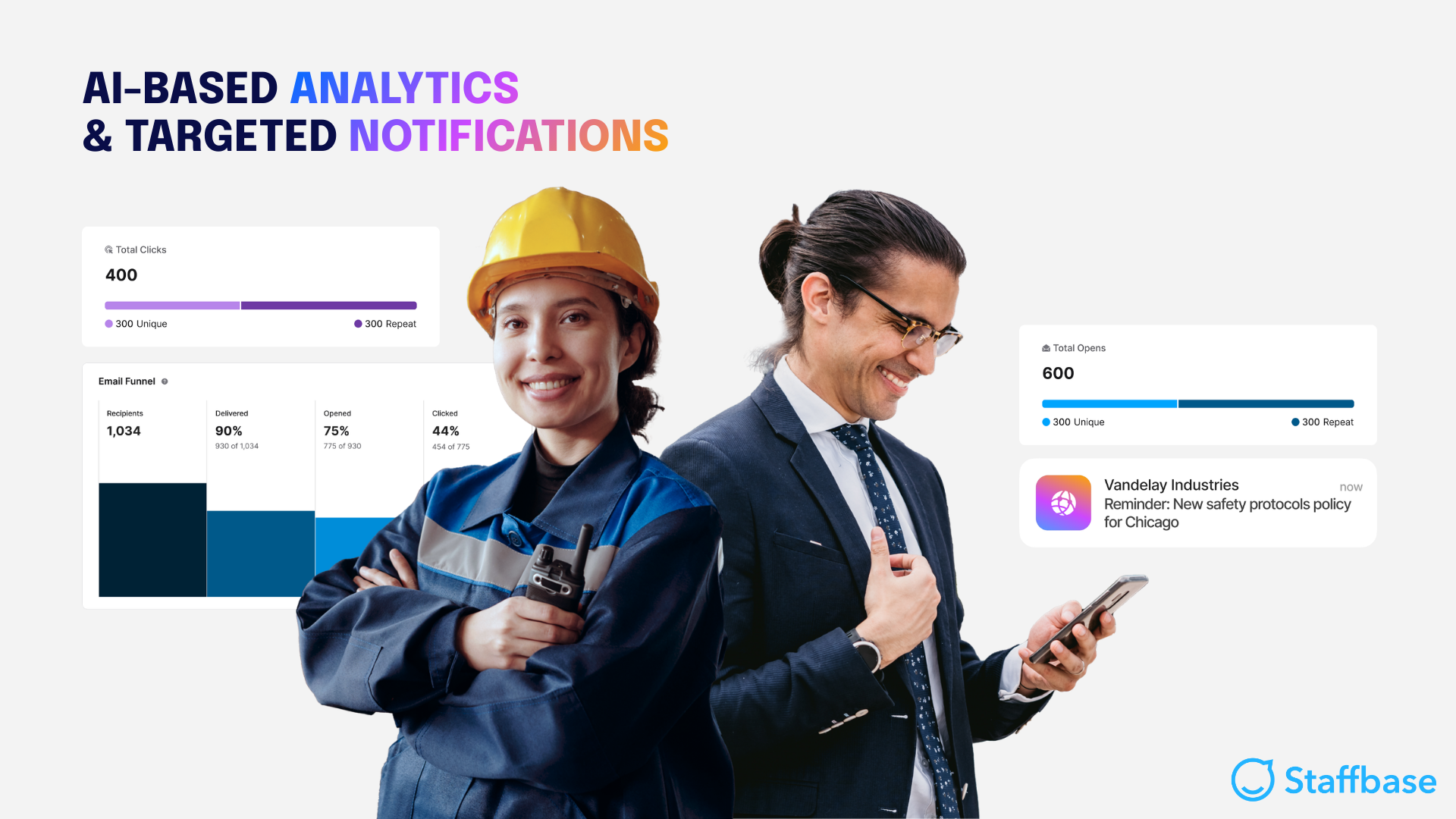
At the same time, intelligent follow-up automation ensures important updates don’t slip through the cracks. If a critical announcement hasn’t been seen, the system automatically re-notifies only the employees who still need it without adding noise for everyone else. Together, personalization and targeted follow-ups turn communication from mass distribution into measurable visibility.
Why this matters at enterprise scale
Push: Relevant updates are surfaced proactively, and critical messages are re-delivered only where needed, ensuring urgency doesn’t depend on timing or luck.
Place: All recommendations and follow-ups originate from governed intranet content.
Pull: As employees consistently receive content tailored to their needs, the platform earns trust, making employees more likely to return when they need answers.
What this looks like in practice
With Staffbase, communicators can target content by role, location, language, and department to ensure employees only receive what's relevant to them. For mandatory updates like a safety policy, an acknowledgment feature lets employees confirm they've read the content, giving communicators full visibility into who has and hasn't engaged.
Editors can then manually resend notifications exclusively to those who haven't opened the post yet, avoiding unnecessary noise for everyone else. Follow-up emails to non-openers are also available via Staffbase Email. Meanwhile, Staffbase Smart Impact ties it all together by measuring reach, engagement, and sentiment, so communicators can demonstrate the real impact of critical communications across the organization.
 6. Sentiment analysis & AI-based analytics
Reach alone doesn’t equal impact. In 2026, enterprise organizations require insight into how employees interpret, react to, and engage with communication. That’s where AI-based analytics and sentiment analysis become essential.
AI-powered analytics move beyond surface metrics to identify patterns in engagement, detect sentiment trends in comments and feedback, and highlight where communication drives clarity (or confusion). Instead of simply reporting activity, AI helps interpret what employee behavior actually signals. This shifts internal communication from output tracking to impact measurement.
Why this matters at enterprise scale
Place: AI analytics reveal whether the intranet is functioning as a trusted source of truth.
Pull: By identifying which answers employees engage with, revisit, or ignore, AI highlights which content truly resolves questions.
Push: Insight into sentiment and engagement patterns makes it possible to refine timing, targeting, and formats, ensuring critical updates surface where attention is strongest.
What this looks like in practice
With Staffbase Smart Impact, communicators can go beyond clicks and impressions to measure real visibility, engagement, and sentiment across regions, roles, business units, and shifts. Sentiment analysis uses AI to label employee comments as positive, neutral, or negative, giving communicators a faster read on how messages land at scale. Instead of guessing where communication works, teams can identify gaps, spot reactions to major updates, and make informed decisions about where to adjust timing, targeting, or content.
Navigator adds the Pull side to this picture. Its analytics view shows which topics employees ask about most and where content gaps leave questions unanswered.
7. Easy access for frontline workers
Even the best AI intranet features fail if employees can’t get in. For frontline teams without corporate email addresses or daily desktop access, login friction is often the single biggest barrier to adoption. This feature removes that barrier by making access immediate, familiar, and secure, making AI answers available when and where work actually happens. When access is simple, trust and usage follow.
Why this matters at enterprise scale
Place: When access is simple and consistent, the intranet becomes the default destination employees recognize as “where work information lives.”
Pull: Employees can retrieve answers in the moment without needing corporate email, a desk, or additional credentials.
Push: With reliable access in place, critical updates can be delivered confidently, knowing they will actually reach the workforce they’re intended for.
What this looks like in practice
Staffbase supports zero-barrier access through options like QR-code login and employee ID authentication, allowing frontline workers to enter the platform securely without corporate email accounts.
The same access applies to Navigator: Frontline workers can ask questions by voice or text, without a corporate email address or a Microsoft license. For the full evaluation criteria, see our guide to choosing an AI assistant for frontline teams.
Wuppertaler Stadtwerke faced a common challenge: digital tools existed, but employees had little reason to use them regularly. Access alone was not enough; it needed to be tied to something employees actually depended on.
The shift came from combining simple access with real utility. By providing digital pay slips exclusively through the employee app, the platform became part of employees’ daily routines rather than an optional communication channel.
The result was a clear behavioral change: employees returned to the app because it was the easiest way to access essential information, not just company updates.
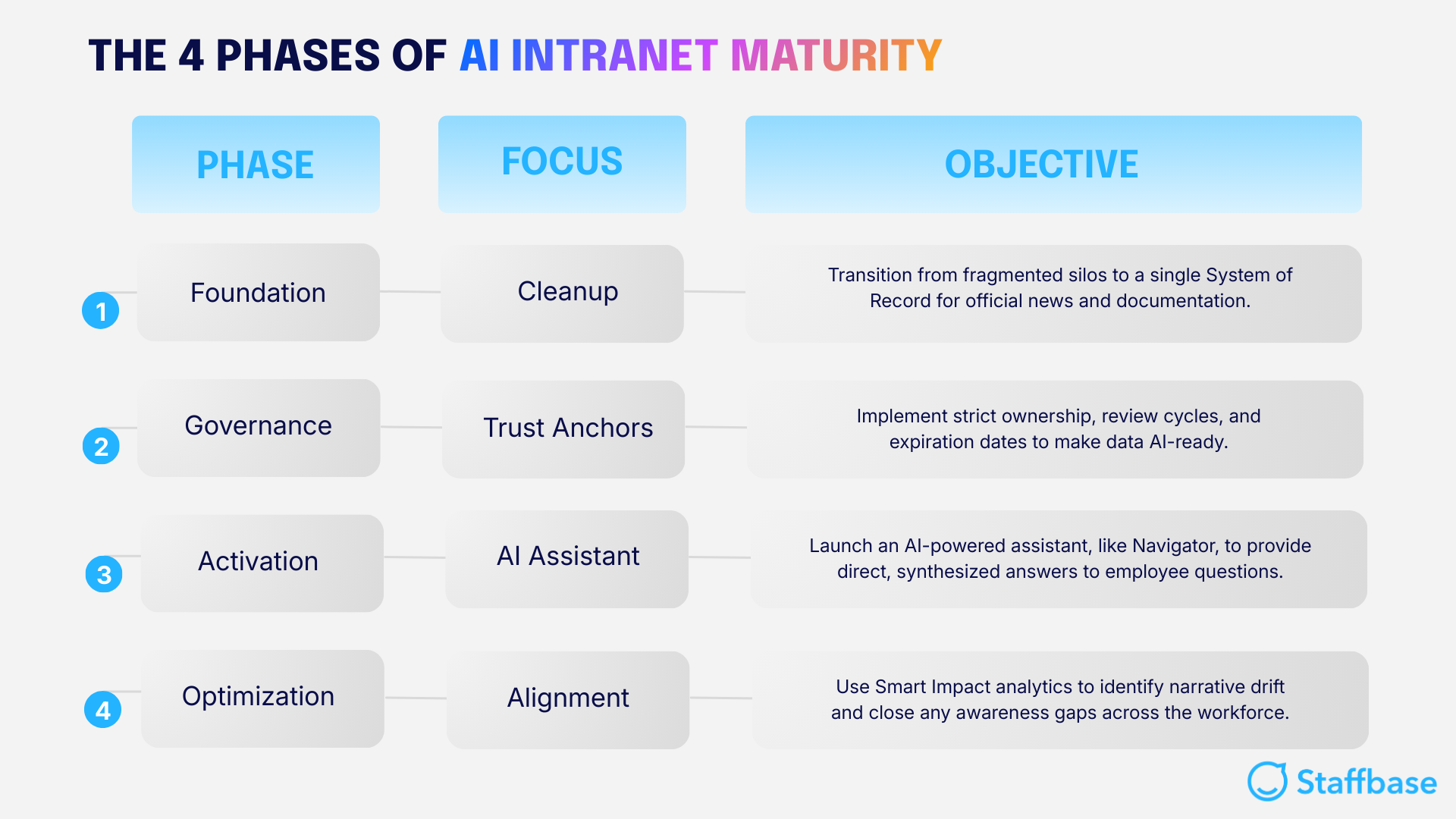
The AI maturity roadmap: 4 phases to a governed intranet
As organizations mature, successful intranets evolve from search-based systems to intentional communication architectures, balancing where answers live, how they're delivered, and when employees can pull them on demand.
Moving from a content warehouse to a resolution engine doesn't happen overnight. The four-phase maturity model below gives leaders a structured path, ensuring AI is built on governed foundations rather than a content junkyard.
 When to pump the brakes on AI intranet adoption
AI works best when it resolves clear, operational questions. There are moments, however, where its role should be deliberately limited.
Human moments need human voices: Restructures, layoffs, leadership changes, and sensitive cultural topics require accountability and empathy.
Unowned content isn't answer-ready: If information is outdated, under discussion, or lacks ownership, AI should not summarize it.
Speed does not equal certainty: When clarity isn't established, slowing down protects trust.
Action needs the same limits as answers: An assistant that files a ticket or submits a request should only act as the signed-in employee, within their permissions. If a tool can’t guarantee that, limit it to answering.
The bottom line: Clear boundaries are what make AI effective everywhere else.
Turn your intranet into a trust anchor with Staffbase
In 2026, the intranet has become where employees go for clarity they can act on. That requires more than AI layered onto legacy systems. It requires an intranet designed with governance, ownership, and reach built in from the start.
Staffbase was built to support that reality. Its AI capabilities are integrated into the intranet’s content lifecycle, permissions, and access model, and they extend into the systems employees already use. That lets enterprise organizations scale answers and actions without sacrificing trust.
If you're evaluating AI intranet features, the real question isn't what AI can generate. It's whether your intranet provides the context those answers depend on. That distinction is what separates AI pilots from platforms that scale.
See how Staffbase supports AI-powered communication built on trust.

Validity Note: This article reflects the Staffbase POV and enterprise market conditions as of September 2026.
Frequently asked questions (FAQs)
As AI becomes the first place employees go for answers, these FAQs clarify what the key features of an AI intranet for enterprise organizations actually enable — and where AI should be deliberately constrained in 2026.