
Staffbase vs. Firstup: Which is the better platform for your enterprise in 2026?


Which platform should you choose in 2026 — Staffbase or Firstup?
Choosing between Firstup and Staffbase in 2026 comes down to a fundamental difference in approach: campaign-driven distribution versus integrated workplace navigation. Firstup is strong in automated content journeys and push-based orchestration, but it often remains a separate destination, functioning more like a megaphone that amplifies messages than a true entry point into employees’ daily work.
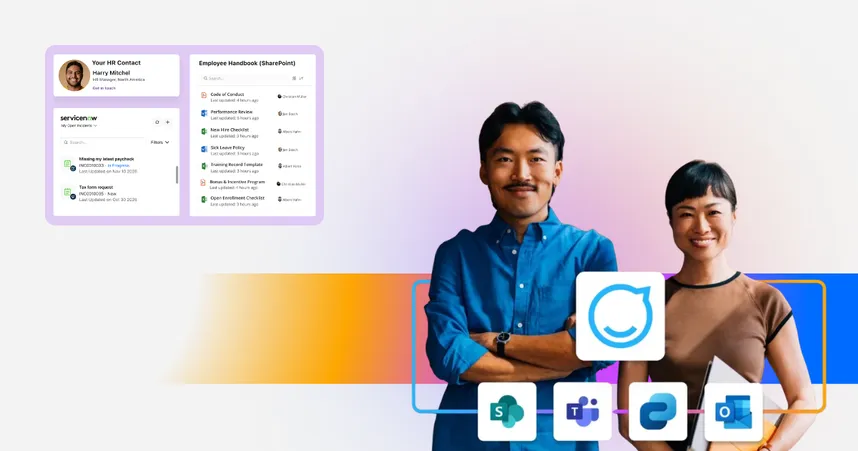
Staffbase, in contrast, serves as a unified front door to the digital workplace. By integrating tools like Microsoft 365, ServiceNow, and HRIS systems such as Workday — and combining them with operational services like task management, shift plans, custom forms, and the AI-powered chatbot Navigator — Staffbase helps employees find knowledge and complete tasks in one place.
Choose Staffbase if your priority is high adoption and operational utility, especially for frontline teams. Choose Firstup if your goal is a standalone distribution layer focused primarily on push-driven communication.
Our methodology: How we evaluate the 2026 enterprise landscape
Choosing an internal communications partner is a high-stakes decision that impacts IT architecture, HR compliance, and employee trust. To ensure this comparison is objective and actionable, we evaluated both platforms across five critical dimensions:
Architectural depth & integrations: We analyzed the curated data layer of both systems, specifically looking at how they handle bi-directional data flow with M365, ServiceNow, and Workday, rather than just superficial “link-outs”.
Frontline adoption: We reviewed adoption and engagement feedback from Firstup customers to assess employee reach and engagement, revealing a gap between technical reach (messages sent) and active engagement (employees opening the app).
Security & data sovereignty: We compared ISO certifications, SOC 2 compliance, and specifically how each platform handles anti-phishing trust through custom domains and white-labeled app store presence.
Total Cost of Ownership (TCO): We evaluated what we term the “silo tax” — the hidden cost of maintaining multiple tools (like needing a separate email provider) versus a consolidated platform.
Customer-led innovation: We reviewed verified customer reviews (e.g., Gartner Peer insights and G2) and analyst evaluations (e.g., Clearbox, Gartner) as well as product roadmaps to distinguish between "feature warehouses" and “navigation systems”.
This comparison reflects our assessment of both platforms as of February 2026. Verify current product capabilities directly with each vendor.
Why is the megaphone approach failing in 2026?
The fundamental misunderstanding in modern internal comms is the definition of orientation. Many organizations fall into what we call the information trap. It’s the belief that orientation comes from pushing content rather than providing a reliable way to find answers.
While platforms like Firstup excel at delivering automated content bursts, this one-way push logic creates a fragmented experience that employees eventually tune out. Orientation isn't just about receiving a message; it’s about having a reliable system to find answers.
In a push-heavy environment, employees are often left with critical daily questions: Where do I find my specific HR documents? How do I access my shift plan? What can I actually trust as the single source of truth?
When a platform acts only as a megaphone, it fails to provide the pull factors that drive long-term engagement. This is why we see lower adoption rates with comms-only solutions; if a platform doesn’t reduce friction in daily work — like finding policies, accessing tools, or resolving questions — employees stop returning to it.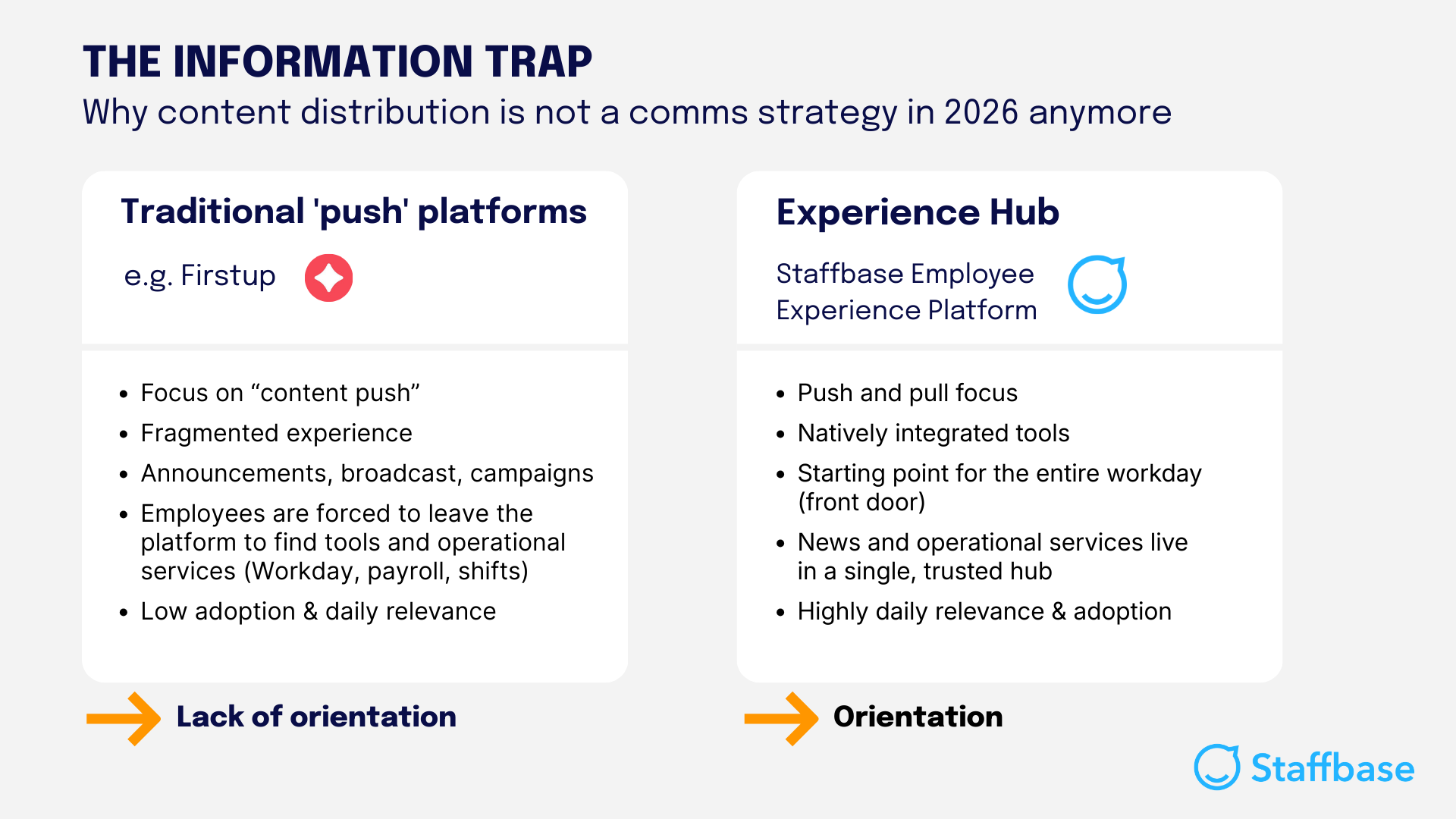
What we observe in fragmented ecosystems
When we look at organizations transitioning away from distribution-first platforms like Firstup, we consistently see three patterns that signal a strategy in crisis. These aren't just software issues; they're fundamental barriers to reaching a modern, mobile workforce.
The adoption gap: In large-scale enterprises, there is often a deceptive reach vs. reality gap. A platform might report high reach because an automated email was sent, but actual engagement tells a different story. We often observe a massive disconnect: Although most of the workforce is on the frontline, only a small percentage actively uses the mobile app. When a platform feels like an "extra destination" rather than a tool for work, the frontline — who have the least time to spare — simply opt out.
The silo tax: We frequently encounter teams trapped in a patchwork stack — using Firstup for mobile bursts but relying on legacy tools like Poppulo for more robust email needs. This creates a hidden tax on the communications team. Instead of one strategic workflow, editors are forced into manual content syncing across disconnected systems. This doesn't just waste time; it creates a disjointed employee experience where the Single Source of Truth depends on which device you happen to be holding.
The branding trust barrier: With heightened cybersecurity awareness, employees are trained to be skeptical of third-party links and unfamiliar app store downloads. We see a significant drop-off in adoption when a platform lacks a “white-label soul” — meaning it doesn't look and feel like an official, company-owned communication channel. If employees are asked to download a Firstup app instead of their own company’s branded front door, it triggers a psychological phishing alarm. Without full corporate branding, from the app icon to the email domain, the platform struggles to earn the trust required for high adoption in 2026.
True orientation in 2026 is about creating a navigation system, not just a distribution channel. Staffbase provides a unified front door to the digital workplace, ensuring that communication is part of a productive environment rather than an interruption. This is built on three pillars:
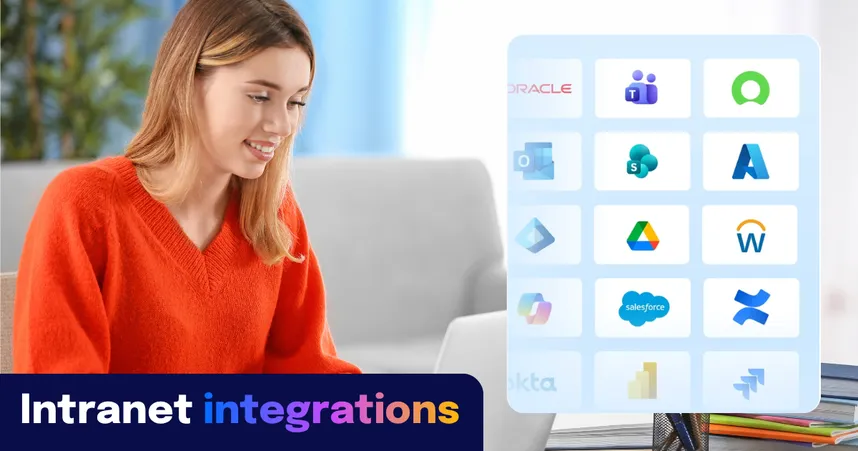
Deep system integration: Instead of sending employees elsewhere, Staffbase integrates natively with Microsoft 365, Google Workspace, ServiceNow, and HRIS platforms like Workday, keeping work and communication in a single, trusted flow.
Operational services: Staffbase goes beyond communication by surfacing essential services such as task access, shift plans, or payroll links, so the platform supports work, not just awareness.
AI-native support: Staffbase uses AI to reduce noise and uncertainty. Features like the AI-powered chatbot Navigator help employees get verified answers they can act on, rather than generating more content to consume.
The limitation of the megaphone approach is that it tries to guide employees through content. Staffbase guides employees through their entire workday — with communication, tools, and answers working together as one system.
How do Firstup and Staffbase philosophies compare? Evaluating the capabilities that drive 2026 engagement
When comparing Staffbase and Firstup, it is easy to get lost in a list of buttons and features. However, in 2026, the success of an Employee Experience Platform isn't measured by what it can do, but by how many employees actually use it.
Here is how the two approaches compare across the most critical strategic pillars:
Platform philosophy: Navigation system vs. distribution system
In 2026, the problem isn't that employees don't get enough information; it’s that they can’t find what they need to actually do their jobs. A platform that focuses only on orchestrating content bursts acts as a megaphone, adding to digital noise. A true navigation system acts as a front door, guiding employees to answers and tools, reducing the information trap where reach is high but resolution is low.
The Staffbase approach: A Navigation system built to be the single entry point for the workday. We prioritize pull factors, giving employees a reason to visit the platform (like seeing their shift or a policy) so that the push (the news) actually gets seen.
The Firstup approach: A Distribution system focused on automated delivery. It treats internal comms like external marketing—optimizing for clicks and impressions rather than task completion or workplace orientation.
The question you should ask the vendor: “Is the goal of this platform to make sure employees read more posts, or to make sure they spend less time searching for the tools they need to work?”
Branding & UX: Anti-phishing trust vs. vendor identity
Branding isn't cosmetic; it’s a security and adoption strategy. With all the digital noise, employees are trained to ignore unfamiliar links. If a notification doesn't look like it’s from your company, it triggers phishing skepticism. True individual branding—your logo, your name in the app store, and your own domain—is what builds the trust required for high engagement.
The Staffbase approach: Built on the principle of a “white-label soul," we provide full customization, from app store presence to deep CSS control. Your platform doesn't look like Staffbase; it looks like your company.
The Firstup approach: Often functions as a branded wrapper on a vendor-owned system. While basic colors can be changed, full white-labeling often comes at an additional cost, and the Firstup brand frequently remains visible to the end-user.
The question you should ask the vendor: “Is the app fully white-labeled and under our own name in the App Store by default, and do our push notifications carry our corporate identity—or the vendor's?”
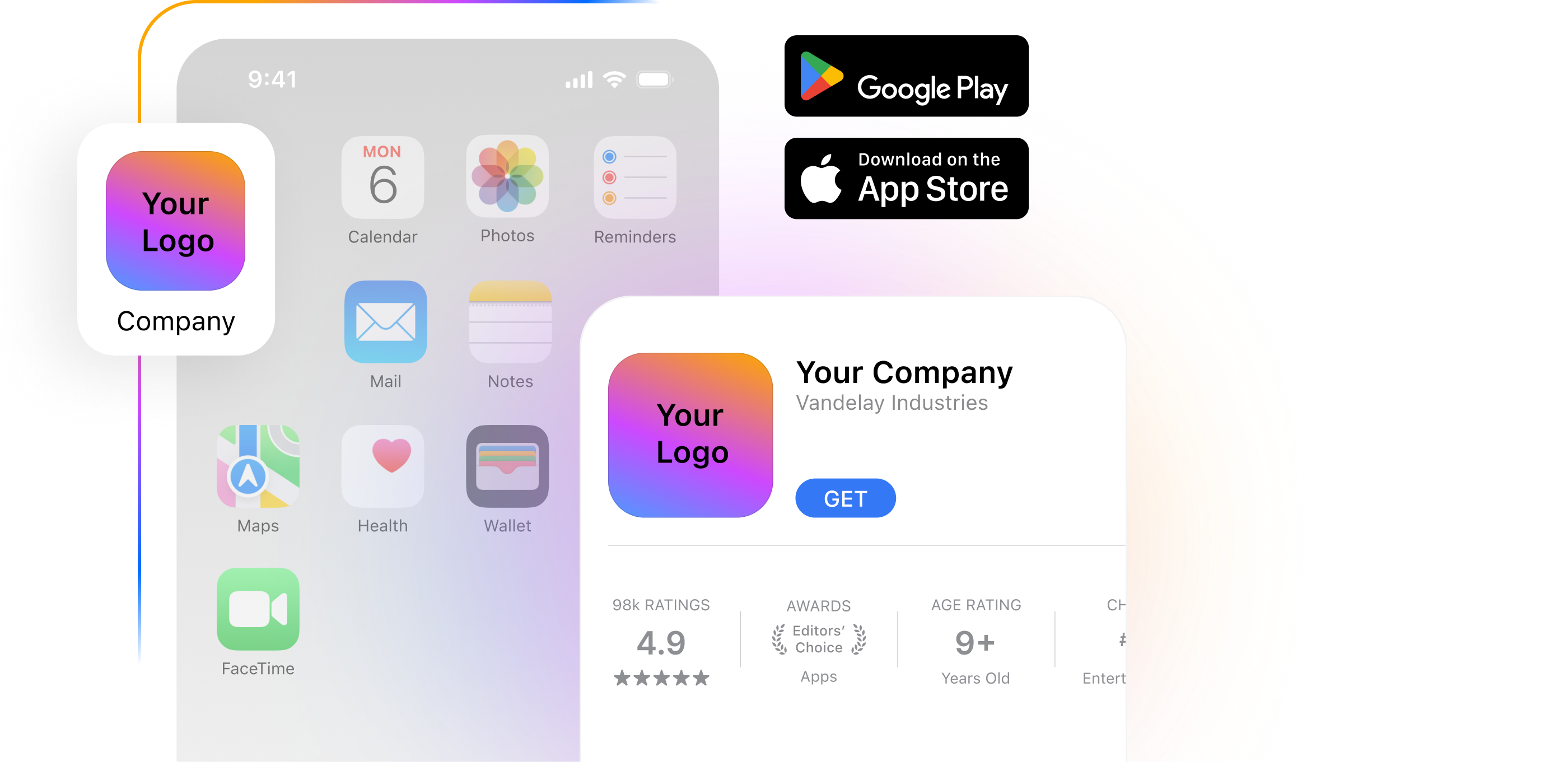 Branding capabilities of the Staffbase platform: a fully white-labelled app without additional cost
Multichannel scope: A unified journey vs. a fragmented stack
Employees don't all work the same way. Relying on a single distribution channel guarantees gaps. A true navigation system ensures that whether an employee is on a factory floor or a home office, the experience is consistent. If you have to use different tools for email and mobile, you are paying a “silo tax” in both licensing and editor time.
The Staffbase approach: At the heart of Staffbase is Studio Publisher, a unified orchestration engine that eliminates the silo tax on your communications team. Instead of managing disparate tools for email, mobile, and intranet, editors create a Single Source of Truth that is automatically optimized for every channel, including SMS and Microsoft 365, without requiring custom IT builds. This ensures your high-value messages achieve maximum reach without the manual overhead of content syncing across disconnected systems.
The Firstup approach: Primarily a distribution system focused on content orchestration. Because its email capabilities have historically been a secondary focus, many customers are forced to keep separate tools like Poppulo to handle complex newsletters.
The question you should ask the vendor: “Can we retire our separate email distribution tool and manage everything, including complex templates and SMS, from this single platform?”
A verified Staffbase enterprise customer in the services sector highlights the impact clearly: “Intuitive, user-friendly platform that has significantly improved our internal communication workflows. The introduction of the e-mail tool allows us now to streamline our messaging, personalize content, and reach our target audience more effectively.” (Source: G2)
Multilanguage: Inclusion at scale vs. basic translation
Understanding is really important for safety and belonging. If an employee has to manually copy-paste a message into a translator, you have already lost their engagement. In a global workforce, editorial control over language is a requirement for compliance and culture-building.
The Staffbase approach: Supports editorial multi-language publishing as well as user triggered translation into 110 languages via Azure AI Translator. Communicators can curate specific versions of a post for different regions, ensuring the source of truth is always accurate and culturally relevant.
The Firstup approach: Primarily relies on user-triggered machine translation (roughly 75 languages via Amazon Translate). While this helps for basic understanding, it lacks the editorial control needed for high-stakes corporate messaging.
The question you should ask the vendor: “Does your platform allow our internal editors to create and manage specific, human-verified versions of a single post across multiple languages or does it rely solely on user-triggered machine translation?”
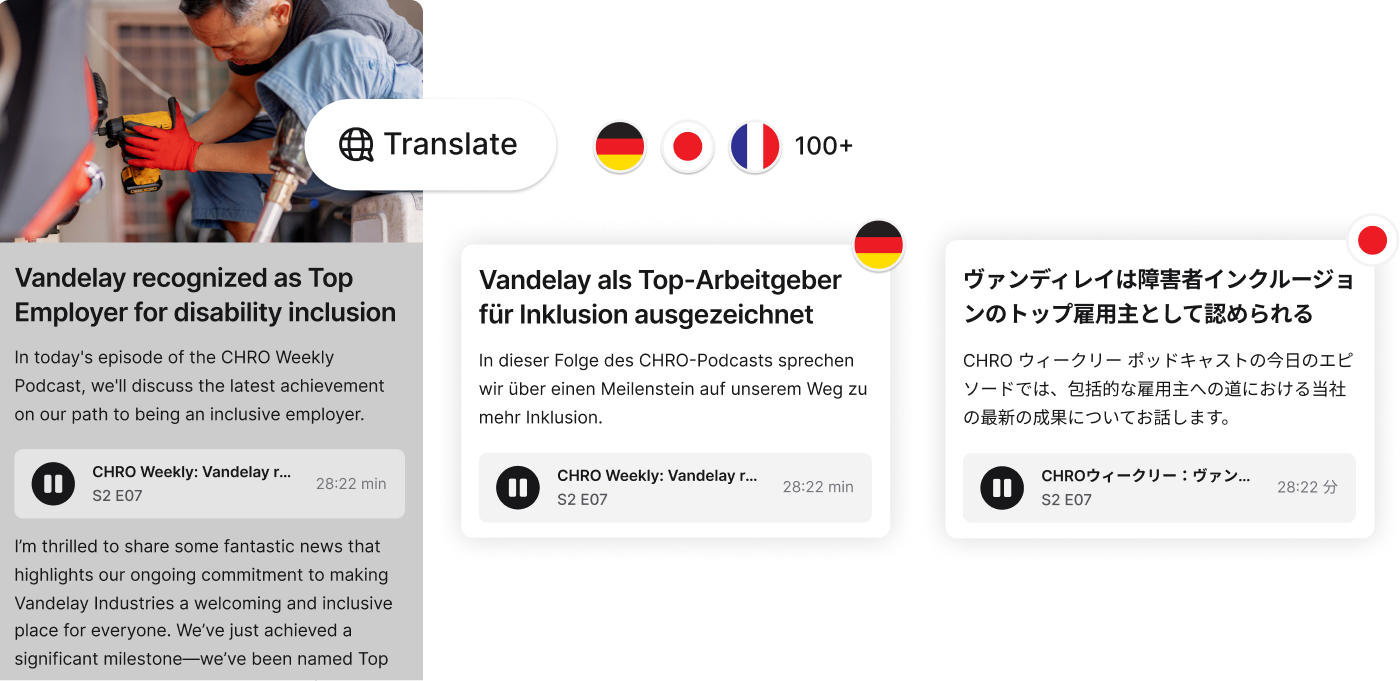 The Staffbase platform's multi-language capabilities
Knowledge management: Knowledge hubs vs. content feeds
News is temporary. Knowledge is what people rely on long-term. If your platform only offers a feed, important information like safety protocols or HR policies gets buried under the latest company announcement. For a platform to be a source of truth, it must support structured, long-form content that is easy to browse, not just scroll.
The Staffbase approach: Features knowledge hubs: This architecture creates a curated 'data layer' for your important operational knowledge (Standard Operating Procedures, policies, benefits). By structuring static content into a governed system of record, Staffbase transforms the platform from a newsstand into an enterprise brain, providing the verified memory your AI needs to resolve complex questions with higher accuracy.
The Firstup approach: Primarily feed-based. While it excels at short-form updates and social-style content, it often lacks the architectural depth to host and organize vast amounts of long-form documentation or structured knowledge pages.
The question you should ask the vendor: “Where do our 'evergreen' documents like safety manuals live: in a structured, easy-to-browse folder system, or are they links inside a news feed?”
Integrations: Embedded productivity vs. the link-out problem
In 2026, the silo tax is paid every time an employee has to leave their primary communication hub to complete a simple task. Most vendors claim integrations if they can put a button in a menu that opens a new browser window. We believe true integration means surfacing the right data at the right time. If an employee can see their remaining vacation days or their latest IT ticket status directly within the app, the platform becomes a navigation system for their work life, not just a newsfeed.
The Staffbase approach: Focuses on deep, bi-directional Integrations. We offer certified out-of-the-box connectors for Microsoft 365, ServiceNow, Workday, and Google Workspace. These aren't just links; they are functional widgets that allow employees to see calendars, approve requests, or search files without leaving the Staffbase environment. Staffbase also integrates directly with Cornerstone to support frontline learning and provides a flexible framework for customer-specific integrations.
The Firstup approach: Primarily uses minimal widgets or orchestration links. While Firstup can trigger a message based on a change in another system (like an HRIS update), the actual work usually happens elsewhere. It acts as a traffic controller that sends you to other apps, rather than a unified front door that brings those apps to you.
The question you should ask the vendor: “Do your integrations allow employees to view and interact with data, like approving an IT ticket or checking a shift, directly within the app interface, or do they primarily serve as links to external portals?”
Enterprise AI: The “Navigator” vs. the “Optimizer”
AI in 2026 should not just be used to generate more content for employees to consume. It should be used to reduce noise. The goal of AI should be to help an employee find a specific answer, like a policy or a payroll link, instantly, without scrolling through a feed.
The Staffbase approach: With the AI assistant Navigator, employees receive verified answers pulled directly from verified sources or connected systems like M365 and ServiceNow. At the same time, Employee AI personalizes communication through tailored news digests (podcasts) and tracks sentiment across surveys and feedback.
The Firstup approach: Focuses heavily on content orchestration. Their AI is designed to optimize when and where a message is sent to maximize clicks. It is mainly a tool for the communicator.
The question you should ask the vendor: “Does your AI help our employees find verified answers from our policies and HRIS systems, or is it primarily focused on optimizing the delivery of news posts?”
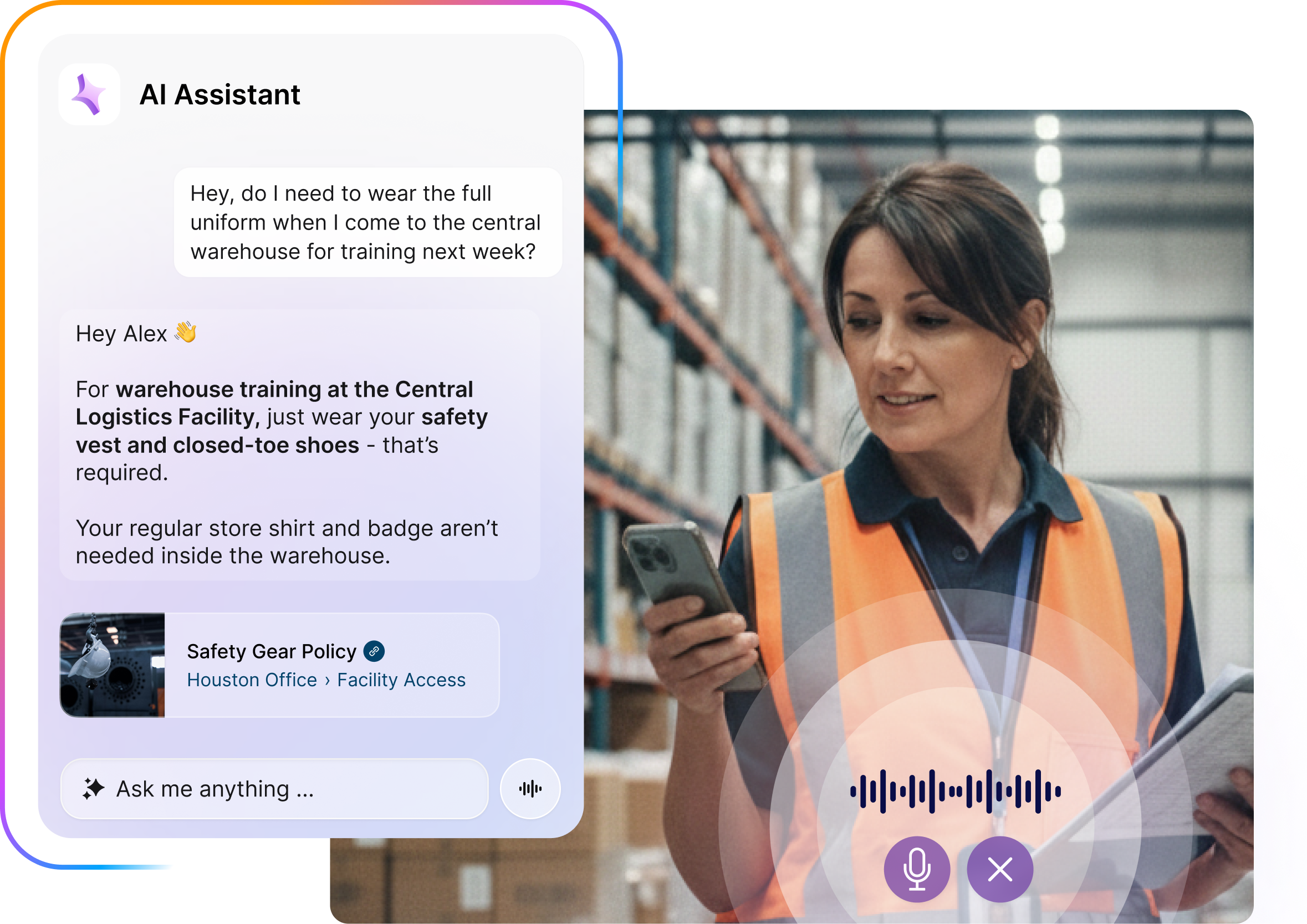 The Staffbase AI assistant Navigator
Frontline support: Operational utility vs. awareness
Staffbase was built to solve for the “hardest to reach”. To get a frontline worker to open an app, it must provide more than news: it must provide utility. If the app doesn't help them see their shift or their payslip, it is just extra noise in their day.
A Gartner Peer Reviewer recently validated this anywhere access as a driver for efficiency:
“We have been using Staffbase for smooth employee communication and it delivers seamlessly. Its availability on all devices means easy access to information and teams can communicate effortlessly whether in the office or working remotely. It has greatly enhanced productivity.”
Enterprise User
The Staffbase approach: Includes built-in operational services. We surface task management, absence requests, and payroll links directly in a unified front door. It is a place where work happens.
The Firstup approach: Functions primarily as a broadcast layer. While it can link out to other systems, it lacks the built-in operational tools (like native 1:1 and group chat or task lists) that make an app indispensable for daily work.
The question you should ask the vendor: “Does your platform provide built-in operational services or does it primarily rely on external links that force employees to log into other systems?”
Implementation: Strategic partnership vs. software delivery
Most IT projects fail not because of the software, but because of low adoption. This is why a vendor-led success model is superior to a partner-led one for internal comms. You need experts who understand behavior, not just installation.
The Staffbase approach: We decided early on to build our own Customer Success and Consulting team. We don't just hand off the software; we embed strategy and rollout expertise directly into the relationship.
The Firstup approach: Follows a more traditional software model, often relying on external implementation partners. This can create a gap between the vision sold during the demo and the reality of driving adoption on the ground.
The question you should ask the vendor: “Will we be working directly with a dedicated internal team from your company that specializes in communication strategy and frontline adoption, or is the rollout handled by an external third-party implementation partner?”
Search experience: Unified intelligence vs. news search
Search is the ultimate test of a Front Door Intranet. If an employee searches for maternity leave and only sees news articles about someone's baby announcement, but not the actual HR policy hidden in SharePoint, the search has failed. A modern search must bridge the gap between communication and the rest of the tech stack.
The Staffbase approach: Unified search. Using the curated data layer, Staffbase surfaces results not just from the news, but from connected enterprise systems like Microsoft 365, ServiceNow, and your Knowledge Hubs. It provides natural-language answers they can act on.
The Firstup approach: Generally limited to news. While it can search the content uploaded to its own platform, it often struggles to index and surface relevant results from deep within external repositories like SharePoint or a legacy Intranet.
The question you should ask the vendor: “When an employee uses the search bar, does it search across our entire digital workplace (SharePoint, HRIS, etc.), or does it only search the news posted within this app?”
A recommendation for your evaluation
We want to emphasize again that adoption is not a secondary metric. It determines whether your investment actually delivers impact. If you are evaluating these platforms today, we recommend asking specifically about weekly active engagement.
How many employees actively use the platform beyond the first week?
Does usage extend to the frontline, or is it concentrated at headquarters?
If we were in your position, requesting verified adoption data from current customers would be the first step in our research.
Overview
Firstup | Staffbase | |
|---|---|---|
Platform Philosophy | Distribution system: Focused on orchestrating content and automated delivery. | Navigation system: A front door where employees find answers and tools to do work. |
Branding & UX | Limited customization: ❌ White-labelled app costs extra ❌ No support for multi-branding | Full customization: ✔ White-label app, customized to your company ✔ Deep CSS control, custom icons, and buttons that adapt fully to corporate identity. ✔ Support for multi-branding |
Multichannel Communication | ✔ Employee app ✔ Intranet ✔ Digital signage | ✔ Employee app ✔ Intranet ✔ Digital signage ✔ SMS |
Multilanguage Capabilities | User-triggered machine translation to 75 languages | ✔ User triggered translation into 110 languages ✔ Editorial multilanguage publishing |
Knowledge Management | Feed-based: lacks structured long-form content or document hosting. | Knowledge Hubs: Ability to create vast, searchable content repositories. |
Integrations | Minimal widgets or integration options with key platforms such as Microsoft, Google, Workday, and ServiceNow (especially out-of-the-box) | ✔ Certified Staffbase–ServiceNow integration ✔ Deep, bi-directional Microsoft 365 integrations ✔ Google Workspace integration ✔ Workday ✔ Cornerstone ✔ API- und SDK-Toolkit |
Enterprise AI | Content Orchestration: uses AI to optimize when and where messages are sent. | AI Navigator: a proactive assistant that pulls verified answers and services from across enterprise systems. On Air: AI-generated personal podcasts that tailor company news to each employee’s interests and priorities. AI-powered sentiment analysis: continuously track how employees feel across surveys, feedback, and communications over time |
Frontline support | Primarily drives awareness and relies on external links for daily tasks. ❌ No built-in operational tools ❌ No built-in chat | ✔ Built-in task management, absence management, payslips. ✔ 1:1 and group chat |
Search Experience | Limited to news. Hard to find policies. Check Clearbox | Unified Search: Natural language search that surfaces results from connected enterprise systems. |
Decision clarity: Which platform is right for your strategy?
Choosing a platform is not about finding the best software in a vacuum; it’s about choosing the architecture that matches your organizational goals. To help you decide, we have identified the specific scenarios where each approach provides the most value.
When Firstup is the better choice:
While Staffbase provides a deeper Front Door Intranet integration, Firstup remains a strong contender for organizations with a specific set of requirements:
Marketing-led communication: If your internal comms function operates primarily like a marketing department—focused on high-volume automated campaigns, A/B testing content bursts, and consumer-style journey orchestration—Firstup’s delivery engine is built for that workflow.
Segment-only reach: If your project goal is limited to reaching a specific subset of employees (e.g., a Sales-only news app) rather than providing a unified digital home for the entire workforce, a standalone distribution layer may be sufficient.
Low integration requirement: If your tech stack is simple and you do not require employees to perform tasks (like approving IT tickets or viewing shifts) within the platform, the megaphone approach of linking out to external sites will meet your needs.
When Staffbase is the better choice:
Staffbase is the strategic choice for enterprises that view communication as a pillar of operational productivity:
Frontline-first cultures: If a large portion of your workforce is mobile or frontline, you need the pull-factors of operational utility (payslips, shifts, chat) to drive adoption. Staffbase is built to solve for the "hardest to reach."
Consolidation & silo tax reduction: If you want to eliminate the cost and complexity of managing separate tools for Email, Intranet, and App, Staffbase provides a single, unified codebase that reduces the burden on both IT and editors.
The Front Door Intranet vision: If your goal is to reduce digital noise by providing one trusted entry point where employees find news, services, and verified AI-powered answers in one place.
Anti-phishing trust: If your security team requires 100% white-labeled branding and custom domains to ensure employees trust the platform as an official corporate source of truth.
The strategic trade-off of 2026
Ultimately, the choice between Staffbase and Firstup is a choice between two different architectural futures. If you believe internal communications should remain a separate, automated broadcast layer, Firstup’s distribution-first model is built for that intent.
However, for the enterprise that views communication as the front door to a productive and aligned workforce, Staffbase is the only platform that eliminates the silo tax by unifying your tech stack into a single, trusted environment. In 2026, the competitive advantage belongs to organizations that don't just reach their employees, but resolve their daily friction.
How you can seamlessly switch from Firstup to Staffbase
For Firstup customers evaluating a move to Staffbase, we’ve outlined the critical steps and considerations to ensure a smooth and successful transition. A common misconception is that switching from one enterprise platform to another requires a massive rip-and-replace effort involving months of IT resources. In reality, moving from Firstup to Staffbase in 2026 is less about a painful migration and more about an efficient upgrade.
Because both platforms share a similar multi-channel architecture, the transition is streamlined, allowing you to focus on strategy rather than technical debt.
1. Effortless migration through AI and architecture
Since both Firstup and Staffbase follow a multi-channel approach, your existing content structures and audience segments are often compatible. We make the move seamless by:
Our AI-powered page builder: Instead of manually rebuilding your intranet, Staffbase uses an AI-native page builder to migrate and structure content with massive efficiency, reducing manual work.
Architectural alignment: You don't need to reinvent your communication strategy. You keep the channels you have (employee app, email, intranet) but upgrade their performance and integration depth from day one.
2. A low-risk investment in an unstable market
The internal communications market is currently in a state of flux — exemplified by the sunsetting of platforms like Workplace from Meta or recent acquisitions like Beekeeper. Choosing a partner in 2026 requires looking at long-term stability.
Proven reliability: Staffbase is a long-term, stable partner with a transparent roadmap and a consistent track record of delivering innovative features every quarter.
IT-friendly transitions: We focus on low-code and no-code native integrations. This means moving to Staffbase doesn't require tons of IT time because our integrations with SharePoint, ServiceNow, and Workday are built to work out of the box.
3. Immediate value: Expanding your reach
The moment you switch, you don't just replace Firstup; you expand your capabilities. Customers transitioning to Staffbase immediately gain access to:
Native SMS: For reaching workers who don't check apps or email.
Deep ServiceNow & HRIS integrations: Moving beyond simple links to embedded operational tasks.
Consumer-grade UX: Each channel (especially Email) receives an instant quality boost.
How Firstup-switched customers succeed with Staffbase
When organizations transition from Firstup to Staffbase, the success is measured by a shift in employee behavior: the platform stops just broadcasting content and becomes a real source of truth
By looking at real-world migrations across different industries, we see three consistent patterns of success:
1. From limited reach to 90% engagement (real estate & property management)
A large leader in affordable housing with over 1,500 distributed employees found that Firstup’s technical limitations — such as a cap on user attributes and a lack of Microsoft integration — prevented them from reaching their workforce effectively.
The switch: They replaced Firstup with a fully branded Staffbase mobile app that integrated Microsoft widgets (Calendar, Power BI, Files) and utilized unlimited user attributes for precise targeting.
The result: The organization achieved a 90% registration rate. Employees moved from an unfiltered newsfeed to a personalized experience that included operational workflows like blocking approvals.
2. Consolidating the digital workplace (global technology leader)
A global technology giant struggled with a disconnected setup: Firstup for comms and Adobe Experience Manager for the intranet. This fragmentation created a silo tax where employees missed critical info, search was broken, and the backend was clunky for editors.
The switch: They are currently consolidating email, intranet, and app into a single Staffbase platform to create a true orchestration layer between digital signage, the app, and the intranet.
The strategic win: Beyond just merging tools, the organization shifted its entire philosophy from pushing content to driving business outcomes. By consolidating senders and utilizing a native read function for legal liability, they transformed the platform into a compliance and operational anchor.
“We do regular pulse surveys and time them with our quarterly meetings—if you can tie it to business KPIs it’s really helpful. It provides credible correlation to tie in comms to business goals: DEI equals Retention, ERG equals Employee Engagement. We have no 'comms goals,' only business goals.”
Digital Strategy and Experiences Manager at a global technology leader
Why this matters for your strategy: When you segment ruthlessly and use all channels in concert, the platform stops being an extra destination and becomes the engine for business KPIs. Unlike their previous experience with Firstup's sudden UX changes, they now have a reliable release process and a platform that supports the Single Source of Truth — from static knowledge pages to dynamic, business-aligned news.
3. Creating a unified entry point for global teams (energy & manufacturing)
During a major corporate spin-off, a global energy company needed to connect desk and frontline workers across multiple continents. Their Firstup instance was stuck as a news-only channel, unable to evolve into a full-scale intranet.
The switch: They moved to the Staffbase Front Door Intranet approach, starting with Staffbase Email and expanding into a full App and Intranet experience.
The result: Within just six months, they sent over 400 targeted emails and saw 50% of corporate users register even before the official app launch. By providing a branded, mobile-first entry point, they centralized collaboration for business units from EMEA to North America.
The path to a frictionless 2026
The decision between Firstup and Staffbase ultimately reflects your vision for the employee experience. You can choose to maintain a broadcast layer that pushes information into an already crowded digital landscape, or you can choose to build a navigation system that guides your people through it. In an era of information decay and digital burnout, the organizations that win are those that make work simpler, not noisier. By choosing the Front Door Intranet approach, you aren't just installing a communications tool; you are providing your workforce with the clarity, utility, and verified answers they need to move from merely reaching the organization to truly belonging to it.
If you’re rethinking your current setup or planning a switch from Firstup, let’s discuss how Staffbase can help you simplify your tech stack and increase adoption from day one.