
The best AI-powered intranet platforms in 2026: compared and scored

What are the best AI-powered intranet platforms in 2026?
The short answer: The AI-powered intranet platforms most consistently shortlisted by enterprise buyers in 2026 are Staffbase, Blink, LumApps, Simpplr, Unily, and Workvivo. Each addresses different scales and sectors, so the right choice varies and comes down to two things.
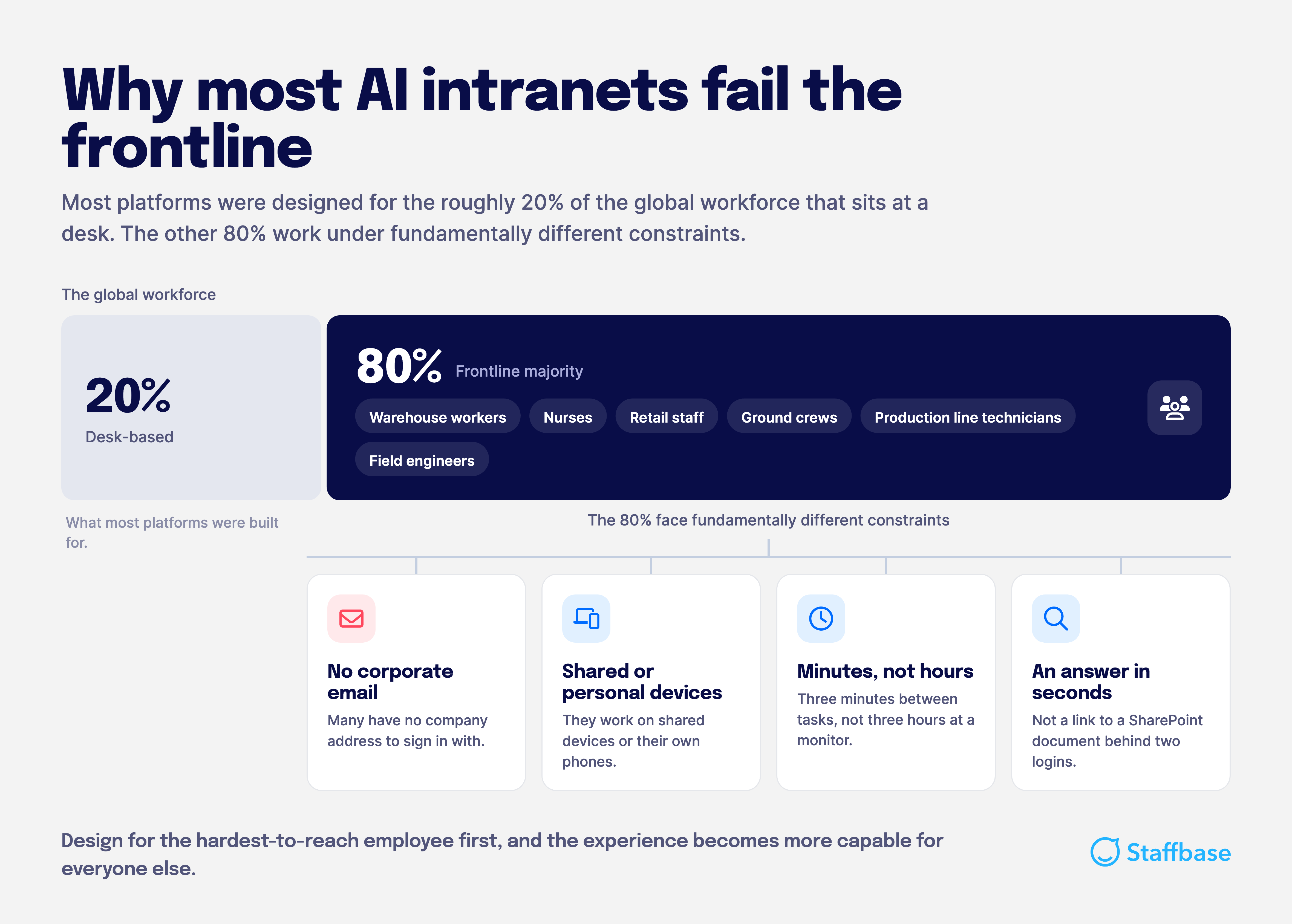
The first is whether the platform’s AI runs on a governed, unified content layer, or whether it layers AI onto a stack of disconnected tools that were never designed to work together. Platforms built on a unified architecture produce AI answers employees can trust. Platforms where AI was layered onto a fragmented, disconnected content stack produce answers that sound confident but frequently aren’t, because the underlying data was never designed to support retrieval.
The second is whether the platform was built to reach every employee, including those without a corporate email address, such as the warehouse worker, the nurse, the ground crew member, or the production line technician. Most AI intranets were designed for the 20% of the workforce that already sits at a desk. A platform built for that 20% will fail the majority of your organization by design.
For large enterprises with frontline or distributed workforces, Staffbase is the leading AI-powered intranet platform because it is built on a single governed architecture and designed to reach the hardest-to-reach employees.
What is an AI-powered intranet?
An AI-powered intranet is an enterprise platform that combines structured content publishing, knowledge management, and employee communications with AI that is integrated across the system to personalize delivery, answer natural-language questions, automate content creation and translation, and surface insights about how information is reaching the workforce.
The distinction from a traditional intranet is not that AI has simply been added, it’s what that addition changes for the employee. A traditional intranet stores and organizes content, and employees navigate to it. An AI-powered intranet keeps that same structure in place, but adds a layer that retrieves and synthesizes content directly, delivering the right information to the right employee at the right moment without requiring them to know where to look. Whether it does that reliably depends entirely on whether the knowledge base it retrieves from is accurate, owned, and kept current. AI amplifies what’s underneath it, which makes content governance a prerequisite, not an afterthought.
A second distinction matters in 2026: whether the platform was designed to reach every employee. Platforms built for desk-based workers and later adapted for mobile perform differently from platforms built from the frontline up. For organizations where more than half the workforce is on a factory floor, in a hospital, or in the field, this distinction determines whether the platform delivers on its promise or becomes another tool with incomplete adoption and a frontline that can’t really be reached.
What most AI-powered intranet comparisons get wrong
A mistake a lot of AI-powered intranet buyers make is evaluating platforms purely on feature lists such as which one has the most capable AI search, the most content templates, or the deepest integrations. Those are, of course, important considerations, but leading with that approach often produces the wrong shortlist.
The real constraint in large organizations isn’t capability, but rather whether AI actually runs on data worth trusting, and whether the platform reaches employees who don’t sit at a desk with a laptop.
AI does not fix fragmented knowledge. It turns whatever it finds (including stale policies, content written for the wrong role or location, and documents nobody has reviewed in years) into confident answers delivered at scale. An employee asks “what’s the parental leave policy for Germany?” and receives a response that sounds authoritative, but is sourced from a document that hasn’t been reviewed in two years. Trust in AI then collapses faster than it was built, and the platform becomes the reason the workforce is skeptical of the next initiative.
So the questions that should actually matter in an AI intranet evaluation aren’t “what can the AI do?” but rather “what does the AI run on, who governs it, and can it reach everyone in the organization?”

 Why most AI-powered intranets fail the frontline
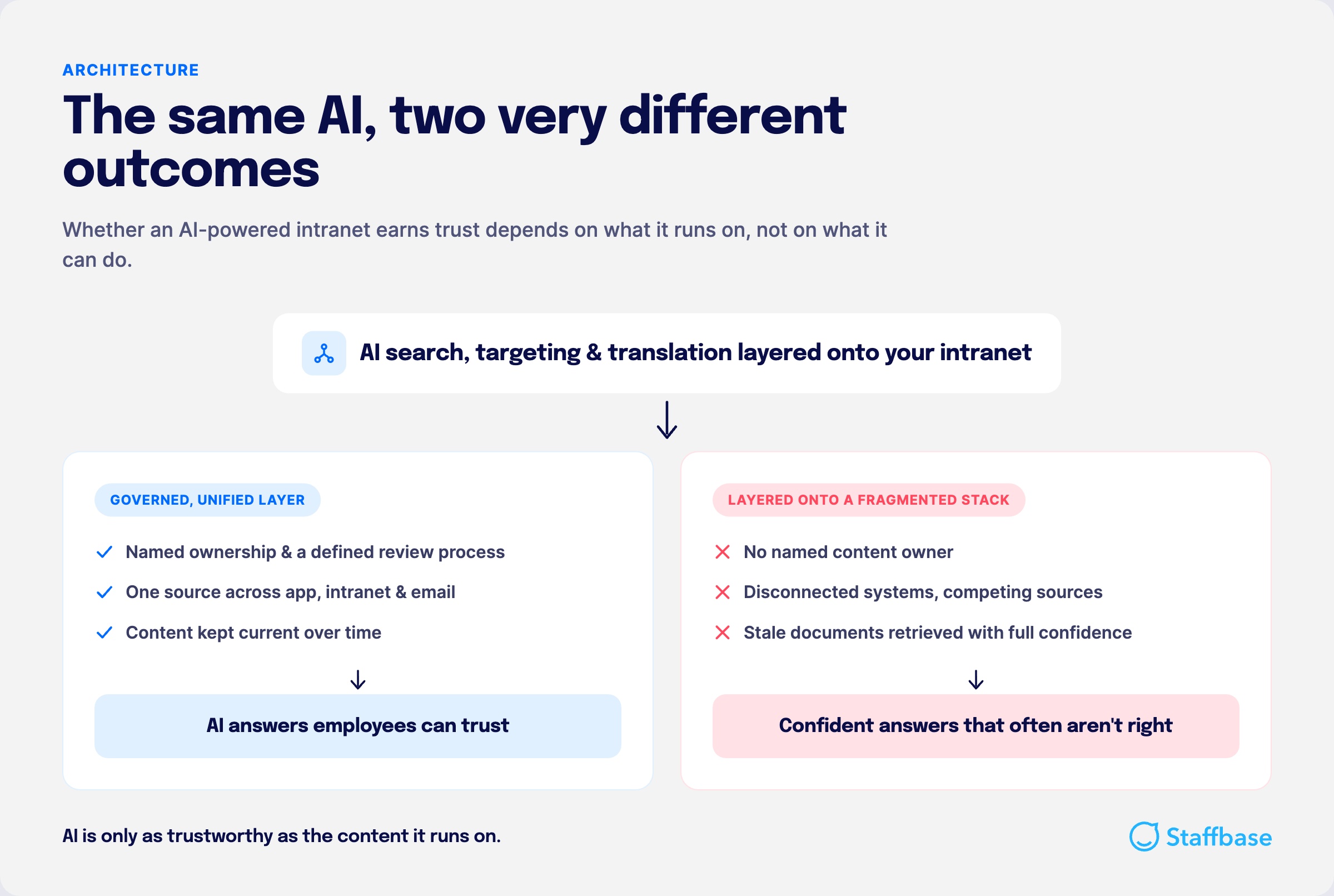
There is a structural problem that vendor comparisons consistently sidestep: most AI-powered intranet platforms were designed for employees who sit at desks, have corporate email addresses, and are already inside the productivity suite. That is roughly 20% of the global workforce.
The other 80% (warehouse workers, nurses, retail staff, ground crews, production line technicians, field engineers, etc) have fundamentally different constraints. Many don’t have corporate email. They work on shared devices or personal phones. They have three minutes between tasks, not three hours at a monitor. They need an answer in seconds, not a link to a SharePoint documentrequiring two authentication steps to open.
 Most AI intranets were not designed for this group. They were designed for the employees already online and connected. When organizations deploy these platforms to a mixed workforce, the frontline majority is underserved by design and the AI-powered intranet ends up reaching the people who need it least.
The inverse principle — design for the hardest-to-reach employee first, and the experience becomes more capable for everyone else — is what determines whether an AI intranet delivers organization-wide value or becomes another tool that works well in headquarters and is quietly abandoned everywhere else. Alaska Air Group uses Staffbase to give its distributed workforce, flight attendants and pilots, maintenance crews, and desk-based staff, one shared source for company information, replacing a one-size-fits-all intranet that used to crash under heavy traffic. The result: 99.5% employee app adoption, double its first-year goal, and 96% active users among more than 30,000 employees, a level of reach a desk-first platform adapted for mobile cannot deliver reliably.
 How AI improves employee communication in practice
The measurable case for an AI-powered intranet starts with what goes wrong without one.
Research from Staffbase and YouGov across 3,574 employees in six countries found that only 9% of non-desk employees are very satisfied with the quality of internal communication they receive compared to 14% of their desk-based colleagues. More than a third of non-desk employees rate the communication they receive as “only fair” or “poor.” The business impact is directly measurable: 63% of employees who are considering leaving their jobs cite poor internal communication as a contributing factor, and more than 60% say the quality of internal communication has a direct impact on their productivity, motivation, and understanding of where the organization is going.
The problem compounds when AI enters the picture. In a Staffbase survey of more than 100 Australian senior executives, 49% said they’re actively redesigning workflows with AI, but nearly a quarter (24%) believe their employees are only “somewhat confident” that the information AI gives them is accurate, and another 8% report low confidence. The technology is being deployed faster than the trust layer beneath it is being built.
AI can address these gaps at the layer where they actually form: in how information is found, synthesized, and delivered. AI-assisted search answers natural-language questions rather than returning a list of documents. AI-driven content targeting ensures a shift manager in logistics receives different information than a policy analyst in HR from the same platform, without manual segmentation. Auto-translation across 100+ languages delivers content in employees’ preferred language without a separate localization workflow for every communication.
For any of this to actually work, though, the underlying content has to be accurate and governed. The quality of the AI output is determined by the quality of the underlying content. AI does not fix an ungoverned knowledge base. It amplifies it, and that is exactly why governance needs to be the prerequisite, not the afterthought, and why Staffbase built Content Pro specifically to flag the stale, conflicting, or duplicate content that would otherwise undermine every answer built on top of it.
Essential capabilities for an AI-powered intranet in 2026
 Organizations evaluating AI-powered intranet platforms should verify these capabilities before shortlisting:
1. Governed AI retrieval
Can the platform bound AI-generated answers to content that has named ownership and a defined review process? Without this, AI retrieves from an unmanaged repository.
2. Frontline delivery
Can the platform authenticate users without a corporate email address? Is the mobile experience built natively for small screens and intermittent connectivity, or adapted from a desktop interface?
3. Multilingual content governance
Global enterprises rely on consistent messaging across geographies. Does the platform track translation currency — the relationship between source content and its translated versions — so that when the source is updated, content owners know what needs to be refreshed?
Seaboard Triumph Foods put that same discipline to work at a food-processing plant running 24 hours a day, five to six days a week, where more than 30 languages are spoken. By keeping every translated version of a policy or update tied to its source text and flagging it the moment that source changed, the team cut translation costs by an estimated $8,320 a year and could confirm exactly which employees had acknowledged safety updates in their own language. Without that discipline, an AI can still answer fluently in another language, but it could very well be answering from information nobody has kept current.
4. Open integration
Does the platform connect natively with Microsoft 365, major HRIS platforms, and ServiceNow? Does it support SSO and SCIM provisioning for enterprise identity management?
5. Enterprise‑grade security, data residency, and compliance
Where is data stored? Where is AI query processing handled? What certifications apply: ISO 27001, SOC 2 Type II, GDPR alignment?
Each of these benefits supports a common goal: clearer, safer, and more efficient communication for entire workforces without adding administrative overhead.
6. Measurement
Can the platform show which communications are reaching which employees (including frontline workers) and correlate that with measurable outcomes?
Heraeus is a good example of this in practice. The 14,900-employee company replaced an aging SharePoint intranet and a print newspaper with a single platform, then tracked adoption to prove it was working. The result was 10,000 active users and 7.3 million home-page views in the first six months. That data was strong enough to justify retiring the legacy tools altogether, saving more than €125,000 a year. Any AI-powered platform needs that same kind of proof, showing not just that content went out, but that it reached people and changed something measurable.
Skip this comparison if your organization is under roughly 200 employees. Enterprise AI-powered intranet platforms are built to solve governance, scale, and multi-team content ownership problems that come with thousands of employees across many locations, problems a company this size doesn’t have yet. A lightweight team communication tool will serve better until there’s a dedicated communications function and enough content to justify governing it.
Skip this comparison if your entire workforce already has a corporate email address and a company device. The frontline-access architecture that separates these platforms, authentication without corporate email, mobile-first design, is the central differentiator this article is built around. If that problem doesn’t exist in your organization, a standard desk-based intranet with AI search will do the job, and you can evaluate vendors on price and implementation speed instead.
The top AI-powered intranet platforms in 2026
The table below covers the platforms most relevant to large and distributed enterprises evaluating AI intranet solutions in 2026.
Vendor | Best for | Frontline reach | AI capabilities & governance | Channels | G2 rating (July 2026) |
|---|---|---|---|---|---|
Staffbase | Large enterprises with frontline-heavy or distributed workforces | Fully white-labeled, company-branded native mobile app in public app stores as standard (no extra cost), with QR code, phone number, or employee ID login, push notifications to personal devices, and offline mode. | Navigator (built-in AI assistant); On Air (personalized audio updates/podcast); Content Pro (governance and page creation); Companion (AI-powered search and writing assistant) | Employee app, intranet, email, SMS, digital signage | 4.6/5 (248 reviews) |
Blink | Mid-market organizations with predominantly frontline or deskless workforces | Mobile-first app (feed, native 1:1/group chat with voice & video, offline hub for docs, and micro-apps for shift-based work); | Blink Assist supports content writing; the platform doesn’t yet include a dedicated retrieval or content-governance layer; AI feed prioritization | Mobile app, lightweight web app, no email, no digital signage | 4.6/5 (398 reviews) |
LumApps | Google Workspace enterprises; frontline via Beekeeper acquisition (July 2025) | LumApps’ native app is primarily for desk-based Google Workspace teams; frontline reach comes via the separately-run Beekeeper platform following 2025’s acquisition | Ask AI (search) and Agent Hub (no-code AI agents) operate within existing content permissions rather than a dedicated governance layer | Intranet, email | 4.4/5 (164 reviews) |
Simpplr | Mid-size, desk-based organizations | Platform is built primarily for desk-based workforces; mobile offering (HR/IT service delivery, native messaging, news, non-branded by default) | AI Assistant handles HR/IT requests across 50+ systems; governance tooling focuses on model and data control rather than content freshness | Intranet, email, app | 4.6/5 (361 reviews) |
Unily | Design-led, desk-based large enterprises | Strong desktop-first design; frontline access available through the Unily Go app as a paid tier | Indi (AI site builder) and Glass (AI search) are rolling out through a lighthouse program ahead of GA later in 2026 | Intranet, app, email, SMS, digital signage | 4.5/5 (38 reviews) |
Workvivo | Social-first enterprises and Zoom-ecosystem organizations | Strong mobile experience for hybrid and desk-based teams; branded app is available as a paid upgrade | HQ Agent (agentic AI, 60+ systems) and Catch Me Up (summaries) operate within existing platform permissions, Seer (AI listening and sentiment, paid add-on) | App, intranet, digital signage (paid add-on); no native SMS | 4.8/5 (2,677 reviews) |
How to read this table: Frontline reach is described in plain terms - whether the branded app is standard or a paid add-on, and whether authentication works without a corporate email address. AI capabilities and governance reflects whether the platform has dedicated tooling to keep AI's source content current and owned, versus an AI assistant layered on top of existing content permissions.
1. Staffbase
Rather than layering AI onto a stack of separate tools, Staffbase runs app, intranet, and email from one governed architecture, so it can reach every employee, including those without a corporate email address. That architecture turns what would otherwise be a fragmented set of tools into one coherent experience: whether an employee opens the app, checks the intranet, or reads an email, they’re getting the same trustworthy answer from the same underlying source. Its AI is structured as three connected layers: content creation tools that help communications teams produce and maintain accurate content, a governance layer that continuously keeps that content current so AI answers stay trustworthy over time (not just at launch), and an AI assistant that employees use to find answers, complete tasks, and connect with colleagues. Named a Leader for the third consecutive year in the 2025 Gartner® Magic Quadrant™ for Intranet Packaged Solutions, and the only top-5 scoring platform in the ClearBox 2026 report to combine the Comms Excellence and Frontline & Mobile Focus badges, Staffbase serves more than 1,500 enterprise organizations including Adidas, Alaska Airlines, DHL, and MAN Truck & Bus.
Defining attributes:
Companion Editor and Content Pro for AI-powered content creation, translation, and management
AI Quality Layer providing continuous content governance and learning loop that keeps AI answers accurate over time
Navigator AI assistant for employees: instant answers, task completion, and peer connections from a single interface
App, intranet, email, SMS, and digital signage from one CMS — unified analytics and governance across every channel
Smart Impact analytics measuring reach, sentiment, and alignment across channels
Native frontline access — phone number, QR code, or employee ID; no corporate email required
Microsoft 365 certified Build Partner; available via Azure Marketplace with MACC credits
ISO 27001 globally, SOC 2 Type II, GDPR compliant; regional data residency options
Pros:
✅ Governed, unified AI architecture. AI runs on verified, owned content that someone is accountable for keeping current, rather than an unmanaged repository
✅ Enterprise scalability with secure governance
✅ Deep integrations and flexible API access
✅ Comprehensive mobile and offline experience
✅ Frontline-first by design: the only top-5 platform in the ClearBox 2026 report to hold both the Comms Excellence and Frontline & Mobile Focus badges.
✅ True multi-channel from a single platform
Cons:
❌ Platform breadth and enterprise implementation investment may exceed what smaller or less complex organizations need.
Best for:
Large and mid-market enterprises with frontline-heavy or distributed workforces — particularly in manufacturing, healthcare, retail, aviation, and logistics — where AI must reach every employee, not just those at a desk.
2. Blink
Blink is a mobile-first frontline app combining feed, native chat, and operational tools in a single mobile experience. It is designed for industries where employees work away from a desk: healthcare, retail, logistics, hospitality, manufacturing, and construction.
Defining attributes:
Mobile-first architecture and frontline support
Native 1:1 and group chat built into the platform
Operational micro-apps for frontline workflows
Pros:
✅ ClearBox 2026 Frontline & Mobile Focus and Community Builder badges
✅ Transparent per-user pricing
✅ Fast deployment, accessible for mid-market buyers
Cons:
❌ Intranet and knowledge management depth is limited compared to full intranet platforms
❌ G2 reviewers repeatedly flag missing message search and limited chat functionality as frustrations
❌ AI capabilities are entry-level
Best for:
Mid-market organizations with a predominantly frontline or deskless workforce needing lightweight, mobile-first communication and native chat, where simplicity matters more than enterprise intranet depth.
3. LumApps
LumApps is a comprehensive enterprise intranet platform, which is both a Microsoft Gold Partner and a Google Premier Build Partner. Its July 2025 acquisition of Beekeeper extends its frontline reach, though the platforms remain separate near-term.
Defining attributes:
Dual ecosystem: Microsoft Gold Partner and Google Premier Build Partner
No-code AI agent creation and task orchestration across enterprise systems
Enterprise search with AI-powered natural language capabilities
Pros:
✅ AI Innovator badge in the ClearBox 2026 report
✅ No-code AI agent creation and orchestration across enterprise systems
✅ Dual ecosystem certification as a Microsoft Gold Partner and Google Premier Build Partner.
Cons:
❌ Platform management complexity increases with deployment size, and larger enterprise rollouts typically require an implementation partner
❌ Frontline reach comes primarily through the 2025 Beekeeper acquisition, so it’s worth confirming with LumApps how integrated that experience currently is with the core platform.
❌ Email is positioned mainly as an intranet traffic driver, not a full-featured communications channel
Best for:
Large enterprises with Microsoft or Google Workspace as their primary ecosystem that need comprehensive intranet capabilities and strong AI search, and have dedicated IT teams to manage platform complexity.
4. Simpplr
Simpplr is an AI-powered intranet platform built primarily for mid-size organizations in North America. Its AI capabilities span two distinct functions: the Socrates.ai AI Assistant for employee HR/IT service delivery, and Comms AI for communications team workflow coordination. The platform is designed for fast deployment and high adoption among desk-based workforces.
Defining attributes:
AI Assistant — employee HR/IT service delivery and knowledge retrieval across 50+ connected systems, including native integrations with Microsoft 365 and Slack
AI-powered campaign planning and multichannel workflow coordination for communications teams
IT governance console for managing AI models, data routing, and audit logging
Pros:
✅ Well-rated on G2 for its intuitive and modern user interface
✅ AI Assistant answers questions and completes HR/IT tasks conversationally across 50+ connected systems
✅ Analyst recognition across Gartner, Forrester, and IDC MarketScape
Cons:
❌ Built primarily for desk-based workforces, with limited fit for organizations with large frontline or distributed populations
❌ Reviewers on G2 describe limited customization options and inflexible homepage and template layouts, a real constraint for teams wanting more brand-specific control (November 2025)
❌ The file and content module isn’t robust enough to serve as a central repository, according to G2 reviews from late 2025, so teams still keep documents in SharePoint or Google Drive alongside Simpplr
Best for:
Mid-size organizations with desk-based workforces prioritizing AI-powered knowledge retrieval, platform consolidation, and fast deployment.
5. Unily
Unily is a design-led enterprise intranet platform with some of the strongest search and content management capabilities in this comparison.
Defining attributes:
AI site builder for creating branded intranet content
Enterprise search depth
Multi-brand, multi-region intranet architecture with deep design customization
Pros:
✅ Strong enterprise search
✅ Deep design customization and multi-brand, multi-region architecture
✅ ClearBox 2026 Top 5 Score, plus AI Innovator and Comms Excellence badges
Cons:
❌ Backend complexity requires significant implementation time and dedicated technical resources before communications teams can manage the platform independently
❌ Customer feedback points to ongoing IT or professional-services dependency for changes beyond basic administration.
❌ Branded apps, custom development, consultancy, and AI capabilities can all require separate investment
Best for:
Large enterprises with a primarily desk-based workforce prioritizing design-led intranet experiences, enterprise search depth, and brand customization, with dedicated digital workplace teams to manage platform complexity.
6. Workvivo
Workvivo is a social-first employee experience platform combining intranet, engagement, and community features in a feed-based experience designed to drive culture and participation.
Defining attributes:
Social-first experience with feed, communities, peer recognition, and culture features at the core of the product
HQ Agent + Catch Me Up: Agentic AI that acts across 60+ systems, and AI summaries of missed content
Native integration with Zoom
Pros:
✅ Catch Me Up summarizes content employees may have missed
✅ Strong social-first engagement features, feed, communities, peer recognition, that drive participation and culture
✅ AI-powered listening and sentiment analysis
Cons:
❌ Social feed architecture means critical communications compete with peer posts and recognition for visibility, G2 reviewers report that finding older posts becomes difficult as content volume grows (August 2026)
❌ White-label branded app costs extra; the default experience is Workvivo-branded
❌ No native SMS channel
Best for:
Mid-market to enterprise organizations prioritizing culture, social engagement, and community — particularly those operating in Zoom-first environments.
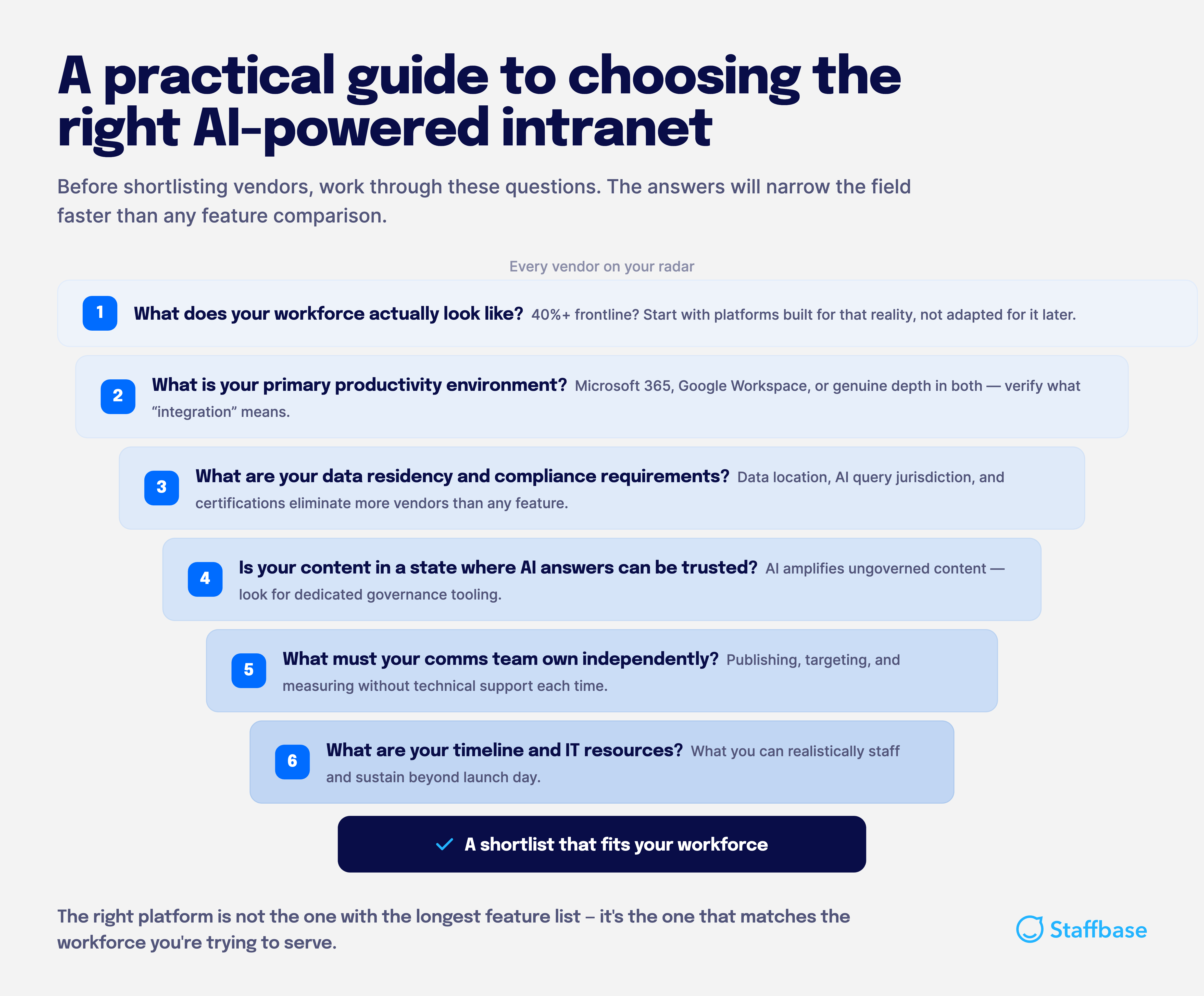
A practical guide to choosing the right AI intranet platform
Before shortlisting vendors, work through these questions. The answers will narrow the field faster than any feature comparison.
1. What does your workforce actually look like?
If more than 40% of your employees are frontline or deskless (no corporate email, shared devices, limited desk time) start with platforms built for that reality from the outset, not adapted for it later. Architecture decisions made early in a platform’s life are difficult to reverse.
2. What is your primary productivity environment?
Microsoft 365-first organizations should evaluate Staffbase, Simpplr, or Unily. Google Workspace-first organizations should evaluate LumApps and Staffbase. Mixed environments need genuine depth in both ecosystems rather than strong integration in one. Verify what “integration” means in practice — display-only or bidirectional.
3. What are your data residency and compliance requirements?
EU organizations, regulated industries, and public sector buyers should resolve data center location, AI query processing jurisdiction, and relevant certifications before shortlisting. This question eliminates more vendors in procurement than any feature evaluation.
4. Is your content in a state where AI answers can be trusted?
AI surfaces what it has access to, so outdated, ungoverned, or inconsistently owned content is at risk of being amplified. That’s not a reason to avoid AI, since virtually every organization’s content has some version of this problem. It’s a reason to be deliberate about vendor choice. Look for a platform with dedicated content governance tooling, like Staffbase’s Content Pro, that flags and helps resolve stale, conflicting, or duplicate content before it reaches an AI-generated answer. Content governance maturity is something the right platform should help you build, not a bar you have to clear before you’re allowed to start.
5. What does your communications team need to own independently?
Platforms that require IT involvement for routine content updates create operational drag over time. Verify whether your communications team can publish, target, and measure without technical support, and whether regional teams can manage their own content areas within central governance guardrails.
6. What are your implementation timeline and internal IT resources?
Complex, highly configurable platforms typically require more IT resources and longer implementation timelines. Be honest about what your organization can staff and sustain beyond launch day.
What to ask each vendor once you have a shortlist
For IT and security teams:
How does the platform manage access control for AI retrieval? Does it support SSO, SCIM provisioning, and role-based permissions that extend to AI-generated answers so employees do not receive responses from content they don’t have permission to see? Verify this for every vendor, because not all AI-powered intranets apply content permissions to AI retrieval.
For HR teams:
How does the platform drive adoption among employees who don’t have a clear incentive to use it? Adoption in frontline environments is driven by utility first and communication second. Platforms that launch with communication-only use cases — news feeds and leadership announcements — see adoption collapse before communication value can establish itself. Organizations with sustained adoption rates above 70% gave frontline employees a practical reason to open the platform on day one: shift schedules, leave requests, HR self-service, an AI assistant that answers an operational question in seconds rather than requiring a phone call to HR. Utility builds the habit; the habit is what makes company communication reachable.
For communications leaders:
How does the platform ensure narrative consistency when content is distributed across many authors and AI is generating answers? Does the governance model require content ownership ensuring every piece of content has a named owner accountable for its accuracy? AI retrieval should be bounded by a governance layer, meaning the AI assistant generates answers only from content that has been verified and kept current.
Why Staffbase’s AI‑powered Employee Experience Platform is a cut above the rest
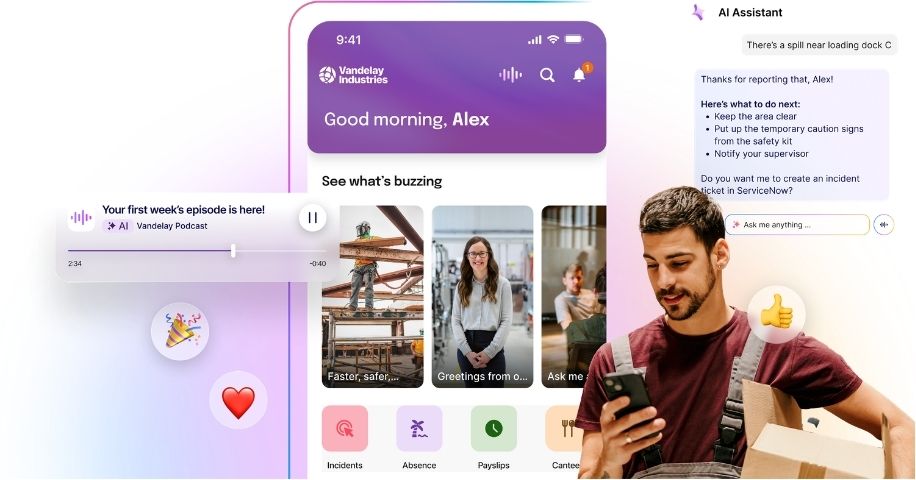
What makes Staffbase distinct is its ability to reach all of your employees (the ones at desks, the ones on production lines, the ones without a corporate email address or a company device) and provide continuous governance and AI answers grounded in content that someone is accountable for keeping accurate. That is not merely a feature difference, it is a design philosophy that determines whether AI becomes a productivity tool or a liability six months after launch.
Reach that doesn’t stop at the desk
Frontline employees authenticate with a phone number, QR code, or employee ID — no corporate email, no corporate device required. The branded mobile app is standard, not a paid add-on. Native chat, HR self-service, shift schedules, and payslips sit in the same place as company communications, which is how a platform becomes a daily habit rather than a destination people remember to check. App, intranet, email, SMS, and digital signage all run from a single CMS with unified analytics — no separate tools, no separate contracts, no content published twice. At Mister Car Wash, a 7,000-employee company where more than 70% of the team works on the frontline across 550+ locations, a mobile app built for hourly employees without corporate email reached 93% active users after replacing a basic SharePoint site.
Most AI implementations degrade over time. Content gets stale, AI retrieves it with full confidence, and employees receive wrong answers. Trust collapses faster than it was built. The AI Quality Layer is Staffbase’s answer to that problem — continuously flagging outdated content, closing the loop between analytics and content ownership, and keeping AI retrieval grounded in verified, current information not just at launch, but over the lifetime of the platform.
Measurement that goes beyond open rates
Smart Impact measures whether communications actually reached employees, changed sentiment, and drove alignment. Not whether something was published — whether it worked. That is the difference between reporting activity to the executive team and demonstrating impact.
Built in security and compliance
ISO 27001 globally, SOC 2 Type II for North American customers, GDPR compliance built into the data model. Data centers in Europe, North America, and Asia-Pacific with regional hosting options for EU and UK customers. Role-based permissions extend to AI-generated answers — employees only receive responses from content they are permitted to access. The platform supports bring-your-own-AI strategies via MCP-enabled connections and is available through the Microsoft Azure Marketplace for organizations with existing Azure commitments.
Global, without the governance headache
Auto-translation into 100+ languages with content governance that tracks the relationship between source and translated content. When a policy changes, content owners can see exactly what needs updating across every language version. AI retrieval respects language preferences — an employee querying in French gets an answer from the French-language content set, not a machine-translated version of whatever the AI found first.
The bottom line: which AI-powered intranet is right for you?
The right AI-powered intranet is not the one with the longest feature list. It is the one where AI produces answers employees can trust, delivered through channels that actually reach them, on content that someone is accountable for keeping accurate. Every platform in this comparison does some of that well. The question is which combination matches the workforce you are actually trying to serve.
Want to see how an AI-powered intranet can benefit your organization?
This article reflects AI-powered intranet platform capabilities, analyst recognition, and competitive positioning as of August 2026. Vendor capabilities, review scores, and analyst designations change regularly. Verify review platform scores and analyst recognition directly with vendors before making procurement decisions.