
What are the top AI tools transforming internal communications in 2026?


Emily Stanislaus in Internal Communication
AI tools empower internal communicators, automating repetitive work while unlocking deeper employee insights, better personalization, and stronger strategic impact.
Employee expectations have changed; people now expect consumer-grade experiences at work, including smart search, personalized updates, instant answers, and audio summaries.
AI-powered internal communications delivered through an AI-native employee experience platform drive real business ROI. This reduces wasted time, lowers risk, improves retention, cuts recruiting costs, and boosts productivity and revenue.
Frontline and deskless workers benefit the most from AI, with mobile-first, conversational, and always-available communication that meets them where they work.
Staffbase is leading the shift to AI-powered internal communications with an AI-native Employee Experience Platform, combining secure, enterprise-ready AI with practical innovation designed specifically for real-world comms workflows.
The short answer
Internal communicators need AI tools that reduce manual production work, improve content relevance for different employee groups, and give teams measurable visibility into whether messages are landing. The most useful categories are content creation assistance, AI-powered search and answers, personalized delivery, and impact measurement. Because these capabilities are most valuable when they share the same governance foundation — permissions, data isolation, content quality — they work best when integrated into a single platform rather than assembled from separate point tools.
A common mistake to avoid
Many organizations adopt standalone AI writing tools (ChatGPT, Copilot, Jasper) and paste the output into their existing publishing workflow. That approach can reduce drafting time, but it doesn't solve the deeper problems: employees still can't find answers quickly, communicators still lack visibility into impact, and AI-generated content still bypasses the governance that makes information trustworthy. Faster drafting on top of a fragmented system produces more content, not better communication.
Why the volume and complexity of internal communication has outpaced manual processes
Internal communicators aren't overwhelmed because they lack ideas or effort. They're overwhelmed because the volume and complexity of communication have outpaced what manual processes can handle.
Most organizations still rely on broadcast-style communication, sending the same message to everyone and hoping relevance emerges on its own. That model struggles at scale. Content volumes are rising. Audiences are more fragmented. Channels are multiplying. And expectations for clarity, speed, and personalization are higher than ever.
The result is predictable: information overload, declining engagement, and rising costs. When employees spend time searching, re-reading, or ignoring messages, communication stops supporting the business and starts slowing it down.
From broadcasting messages to delivering relevance
AI addresses the structural limits of traditional internal communication, helping internal comms teams shift from volume to precision. Instead of pushing everything to everyone, AI can route content based on role, location, language, and context. Instead of guessing what works, teams can see patterns in real time: what employees engage with, what they miss, and where questions keep surfacing.
This isn't about automating creativity or replacing judgment. It's about removing the manual work that prevents good strategies from scaling so that communicators can focus on narrative, alignment, and impact rather than redistribution and repetition.
The top AI tools every enterprise internal comms team needs
AI is changing internal communications in practical ways. It affects how teams plan content, create and publish messages, answer employee questions, measure impact, and reach people across different roles, locations, and devices.
For most internal communicators, the challenge is how to apply AI responsibly without adding more tools, risk, or noise. Used well, AI tools help reduce manual work, improve relevance, and support better decisions. Here's an overview of the main categories, followed by a closer look at each.
Category | Primary problem solved | Staffbase capability | |
|---|---|---|---|
1 | Content creation and editing | Slow drafting, inconsistent tone, translation overhead | Staffbase Companion; AI Email Generation; AI Page Generation |
2 | Search and knowledge discovery | Employees can't find information quickly | Employee AI search; unified search |
3 | Personalized digests and audio summaries | One-size-fits-all content ignored by busy employees | On Air; AI-powered personal digests |
4 | Sentiment tracking and impact measurement | No visibility into how messages land | Smart Impact |
5 | Content governance | Outdated, duplicate, or contradictory pages erode trust | Content Pro (AI Content Governance) |
6 | Communication impact analysis | Poor channel and timing decisions | Smart Impact (historical analysis) |
7 | Hyper-personalized content delivery | Irrelevant content reduces engagement | AI-powered recommendation engine |
8 | AI assistant for knowledge and service | Employees ask the same questions repeatedly | Navigator |
9 | Structured testing and optimization | Hard to know which message variant performs better | Smart Impact |
10 | Intelligent employee segmentation | Manual segmentation is slow and imprecise | Employee AI |
11 | Multi-channel publishing and automation | Inconsistent publishing across channels | Staffbase Companion; AI-native Employee Experience Platform |
12 | Video summaries and transcriptions | Employees miss long-form video content | Employee AI video summaries |
13 | AI chatbots and assistants | Repetitive HR/IT questions overload support teams | Navigator |
14 | Moderation tools for community conversations | Unstructured communities are hard to manage at scale | Staffbase Communities |
15 | Narrative mapping and consistency | Messages fragment across departments and channels | Smart Impact; Content Pro (AI Content Governance) |
16 | Crisis communication support | Slow reach in time-sensitive situations | Staffbase Employee App; Staffbase SMS |
17 | Compliance monitoring and tone checking | Inconsistent quality across decentralized teams | Staffbase Companion; Organization Voice |
18 | Translation and accessibility | Global workforce requires multi-language content | Auto-translation; Content Designer |
1. AI-assisted content creation and editing
Why this matters: When you're on a tight deadline or facing budget constraints, AI-assisted content creation and editing tools can help automate drafting, rewriting, tone-shifting, and summarization, reducing the time between brief and publish.
Several tools are commonly used for day-to-day comms:
ChatGPT — Useful for brainstorming headline ideas or repurposing content into shorter formats. You can configure a custom GPT with your company's brand tone and voice.
Gemini — Google's AI tool can process multiple content formats simultaneously, including video. It's connected directly to Google Workspace, which is useful if your organization runs on Google Docs, Sheets, or Gmail.
Jasper — Well-suited to storing and applying multiple tones and personas. If you need to ghostwrite for your CEO or keep content consistent across different brand voices, Jasper is worth considering.
Grammarly — An AI-powered grammar and tone check that works as a plug-in for most writing environments.
What Staffbase can do: Staffbase Companion is built directly into the Staffbase editor and supports core content tasks: drafting, editing, summarizing, and adapting content for different channels. Because it sits inside the platform, communicators can create and refine messages without switching tools or copy-pasting from external AI tools.
This is further extended by AI Email Generation and AI Page Generation. Communicators can describe a topic or upload a document and generate a fully structured, on-brand email or intranet page as an editable starting point. Organization Voice lets admins upload brand and tone-of-voice guidelines so that AI-generated content stays consistent with how your organization actually communicates — across page generation, email generation, Navigator, and On Air.
2. AI-powered search and knowledge discovery
Why this matters: According to research from Gartner, 47% of digital workers struggle to find information needed to do their jobs effectively. If employees spend too much time searching for basic information, productivity drops and frustration follows. AI-powered search can deliver fast, contextual answers and help address common intranet problems: outdated content, duplicate pages, and information silos.
What Staffbase can do: Instead of digging through folders, employees can ask a question (like "How much time off do I get?") and receive a summarized, verified answer. Employee AI search connects content across internal channels to surface the right information at the right time.
Staffbase also supports unified search, indexing external sources including Google, ServiceNow, Confluence, and Box alongside internal content, so employees don't need to know where an answer lives, only that they need it.
Both capabilities respect existing access permissions, so employees only see content they're authorized to view. One measurable outcome: reduced ticket volume for HR and IT teams, who spend less time answering repeat information requests.
3. AI-personalized employee digests and audio summaries
Why this matters: Employees are both overwhelmed by information and short on time. A weekly digest that treats a warehouse operative the same as a project manager in headquarters isn't useful to either employee. Hyper-relevant content that's tailored by role, location, and interest is more likely to be read and acted on.
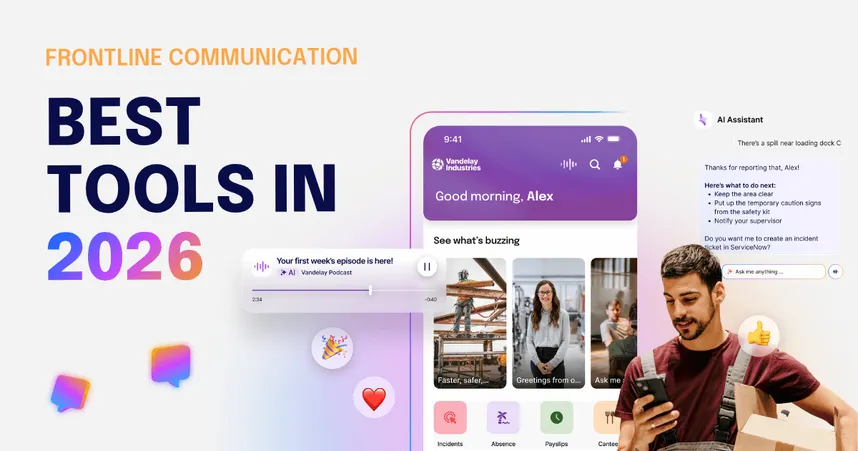
What Staffbase can do: Staffbase On Air generates personalized audio briefings from your internal content feed. Frontline employees like truck drivers, machine operators, and nurses who can't look at a screen while working can now listen to a briefing tailored to them instead.
AI-powered personal digests work in a similar way: a global workforce can receive a weekly email summary where each employee's version reflects their specific role, location, and interests. This helps reduce information overload while ensuring that priority updates reach the people who need them.
4. AI-powered sentiment tracking and impact measurement
Why this matters: Knowing that 80% of employees opened an email doesn't tell you whether they understood it, agreed with it, or found it relevant. To be a credible strategic partner to the C-suite, comms teams need to measure the emotional temperature of their workforce and not just delivery rates.
What Staffbase can do: Staffbase Smart Impact shows engagement trends over time, connects message quality to response, and surfaces patterns across different audience groups. With Smart Impact, you can:
Build campaigns tied to specific strategic initiatives and goals
Add surveys to measure whether employees agree with your campaign narrative
Generate the metrics you need to demonstrate communication value to leadership
Identify where engagement is lower and adjust your approach accordingly
5. AI-powered content governance
Why this matters: In large organizations, intranet content accumulates faster than it gets maintained. Outdated policies, duplicate pages, and contradictory information — like one page stating 30 vacation days and another stating 21 — quietly erode employee trust. At scale, this is nearly impossible to manage manually.
What Staffbase can do: Content Pro includes an AI-powered Content Governance tab that automatically scans published pages and flags issues including: duplicate content, contradictory information, broken links, pages not updated in over a year, and pages with no views in the last quarter.
For each flagged issue, the AI provides a short explanation of why the page was flagged, and editors can click straight through to fix it. Permission-based access means administrators see all pages, while editors and page owners only see the pages assigned to them.
6. Communication impact analysis
Why this matters: AI-driven impact insights help communicators understand which content types, formats, and timing have historically performed best. It informs decisions about what to publish, when to publish it, and where to publish it with data rather than instinct alone.
What Staffbase can do: Staffbase Smart Impact analyzes historical engagement data to surface patterns around optimal posting times, formats, and channels to help communicators make more informed decisions about what to publish, when, and where. By connecting past campaign performance to sentiment and alignment data, it gives teams a clearer picture of what has worked across different audience groups so future decisions are grounded in evidence rather than instinct.
7. AI recommendations and hyper-personalized content delivery
Why this matters: Employees now expect the same level of content relevance from workplace tools that they get from consumer apps. When everything looks the same and nothing feels targeted, important messages get lost.
What Staffbase can do: Staffbase Intranet uses AI-powered recommendation engines to suggest articles, training, or social posts based on an employee's previous interactions. A frontline worker who frequently checks safety updates will see those front and center; a project manager will see more content relevant to cross-functional collaboration. Content reaches employees based on their actual behavior, not a static role assignment.
8. AI assistant for knowledge, service, and voice interaction
Why this matters: Employees ask the same questions repeatedly: about benefits, policies, IT issues, onboarding steps. When those questions go to HR or IT inboxes, they create a backlog of low-complexity work that displaces higher-value tasks.
What Staffbase can do: Navigator is Staffbase's AI workplace companion for all employees. Employees can ask questions via text or voice, in their preferred language, and get answers drawn from real company pages, with links back to source content so they can verify what they're reading.
Navigator respects access permissions, so employees only receive answers based on content they're already authorized to view. Admins can also configure personality, knowledge scope, and conversation starters. The result is fewer repetitive tickets for HR and IT, and faster access to accurate information for employees without requiring them to know where that information lives.
9. Structured testing and optimization
Why this matters: Small changes in a subject line or call-to-action can produce meaningfully different engagement results. Manual testing is often too time-consuming for busy comms teams, and without a structured approach it's hard to know what's actually driving performance differences between sends.
What Staffbase can do: Staffbase Smart Impact supports structured testing and optimization, helping teams compare performance across message variants and apply insights to future sends. By tracking what resonates across different audience groups over time, it helps communicators build on what works rather than starting from scratch each campaign.
10. Intelligent employee segmentation
Why this matters: Sending the same content to every employee is one reason engagement rates are low. Effective segmentation requires knowing who your employees are and how they behave, which, at scale, is impractical to do manually.
What Staffbase can do: Employee AI identifies employee clusters based on behavior, preferences, and interests, and supports personalized communication without the manual segmentation work that typically takes up significant admin time.
11. AI for multi-channel publishing and automation
Why this matters: Whether you're a team of one or managing a global comms function, publishing consistently across channels like intranet, app, email, digital signage, or SMS requires coordination that manual workflows can't always sustain.
What Staffbase can do: Staffbase's AI-native Employee Experience Platform supports publishing across all major employee touchpoints from a single workflow. Staffbase Companion helps optimize content for each channel by summarizing, adapting length, and improving clarity. Additionally, Smart Impact improves send timing using engagement data and is expanding toward broader orchestration across channels.
12. AI-powered video summaries and transcriptions
Why this matters: Not every employee has an hour to watch a recorded town hall. Without summaries and transcriptions, long-form video content reaches only a fraction of the intended audience.
A few standalone tools are useful here:
Otter.ai — Real-time transcription and shareable summaries for Zoom, Microsoft Teams, and Google Meet. Includes speaker identification and searchable transcripts.
Zoom AI Companion — Built into Zoom; generates automatic meeting summaries, transcriptions, and highlights after every call.
Loom — Screen recording with AI-generated titles, summaries, chapters, and action items. Well-suited for tutorials and async updates.
What Staffbase can do: Employee AI generates AI-powered video summaries, auto-captions, and highlight reels, and produces multilingual versions so every employee can access content in their preferred language. This is particularly useful for frontline workers who may not be able to watch full-length recordings during their shift.
13. AI chatbots and assistants
Why this matters: Employees need quick, accurate answers to common questions about policies, procedures, benefits, and IT issues. Routing all of those to human support is inefficient for both sides.
What Staffbase can do: Navigator functions as Staffbase's built-in AI assistant, providing employees with source-based answers drawn from governed intranet content. It's designed to:
Pull answers only from approved, up-to-date content
Cite sources so employees can verify what they're reading
Reduce repetitive HR and IT questions by improving self-service
Route employees to the right next step when a direct answer isn't available
The goal isn't to remove humans from the loop; it's to reduce the noise so HR and comms teams can focus on more complex, people-centered work.
14. Moderation tools for community conversations
Why this matters: As internal communities grow, keeping conversations productive and on-brand requires more structure than most organizations have in place. Without clear ownership and controls, moderation becomes reactive rather than managed.
What Staffbase can do: Staffbase Communities gives organizations a dedicated space for employees to discuss shared interests and build connections across the organization,with moderation controls built in from the start.
Community managers can edit posts from other users to maintain a respectful environment. Combined with granular notification settings and a clear discovery page that admins control, Communities is designed so that the right conversations reach the right people, and off-brand or inappropriate content can be addressed quickly without requiring platform-wide admin access.
This is human-led moderation with structure, not automated detection, which means your organization stays in control of how standards are enforced and applied.
15. AI for narrative mapping and consistency
Why this matters: In a large organization, it's easy for the corporate narrative to fragment. One department communicates one thing; leadership communicates another. Without visibility into how key messages are landing across channels and audiences, misalignment spreads quietly.
What Staffbase can do: Staffbase Smart Impact connects communication activity to sentiment and alignment data over time, making it easier to see whether priority narratives are resonating or drifting across different audience groups. AI Content Governance, part of Content Pro, adds a complementary layer by detecting pages with contradictory information, so factual inconsistencies can be caught and corrected before they create confusion at scale.
16. Crisis communication support
Why this matters: In a crisis, communicators need to draft accurate messages quickly, check tone under pressure, and reach every employee — across languages and channels — without delay.
What Staffbase can do: In a crisis, the core challenge is reaching every employee quickly regardless of whether they're at a desk, on a shop floor, or between shifts. The Staffbase Employee App supports push notifications in 70+ languages, works without a corporate email address, and reaches frontline and deskless workers on their own devices.
For employees who aren't reachable by app, Staffbase SMS provides a direct fallback channel, with no internet connection or login required. Together, the app and SMS mean a critical message can reach your entire workforce through a single send, not a series of manual steps across disconnected tools.
17. Compliance monitoring and tone checking
Why this matters: Decentralized communication — where local managers, HR partners, and department heads all publish content — introduces quality and compliance risk. Without a consistent standard, the signal-to-noise ratio across the platform deteriorates.
What Staffbase can do: Organization Voice gives admins a central place to define their organization's tone, formality, preferred wording, and communication style, either by typing guidelines directly or uploading an existing brand document.
That context then applies automatically to Navigator and AI Page Generation, so AI-generated content reflects how your organization communicates rather than producing generic output. Guidelines are defined per space, so regional teams can maintain their own tone within a broader brand framework.
Staffbase Companion supports this at the individual content level, helping communicators check and adjust tone before publishing, directly within the editor.
18. AI-powered translations and accessibility
Why this matters: Equitable access to information matters, especially in global organizations where employees speak different languages and where safety-critical updates need to be understood by everyone, not just those who read English fluently.
What Staffbase can do: Staffbase Auto-translation within the Content Designer lets communicators publish content once, with employees automatically seeing it in their preferred language with no separate copies to manage. Pages built with structured layouts and drag-and-drop blocks support auto-translation natively, so multilingual publishing is part of the same editing flow rather than a separate step.
Furthermore, Navigator handles multilingual interaction on the employee side: employees can ask questions in their preferred language and receive answers drawn from the same governed content, reducing the barrier for non-English speakers to access accurate information quickly.
What's the real impact of AI-powered internal comms?
Employee expectations have changed. People are used to finding answers quickly through search, chat, summaries, and audio. When internal tools feel slow or disconnected, employees disengage.
This gap is widest for frontline and deskless workers. Staffbase and YouGov's 2025 International Employee Communication Impact Study found that only 9% of non-desk employees are very satisfied with internal communication, while 38% rate it as only fair or poor. That dissatisfaction directly affects trust, safety, retention, and performance. Communication strategies that work well for headquarters often fall short at the frontline.
AI-powered internal comms can help close that gap by making information easier to access, understand, and consume without requiring employees to adapt to more tools or more noise.
Reaching employees where communication actually happens
AI helps reduce friction by delivering frontline workers information through mobile-first, conversational, and always-available channels. Instead of watching a one-hour town hall recording, an employee can get a personalized audio summary of the moments most relevant to their role.
AI isn't about replacing communicators. It helps teams work more efficiently and reach employees more effectively and focus on the communication work that actually moves the organization forward.
What happens if you don't adopt AI?
Choosing not to adopt AI doesn't preserve the status quo. It locks teams into manual processes while content volume and employee expectations continue to rise.
Without AI, comms teams spend more time redistributing information, answering repeat questions, and chasing engagement, with limited visibility into whether messages are understood. Leaders assume alignment that may not exist. During moments of change or crisis, slow or inconsistent communication increases risk.
Organizations that adopt AI thoughtfully are communicating with more clarity, reaching more employees, and adapting in real time. Over time, that gap compounds.
The costs add up quietly
Without AI, communication stays manual. Teams spend time chasing updates, reposting information, and answering the same questions repeatedly. Employees lose time searching for information they know exists somewhere, which pulls focus away from real work.
There's also a visibility problem. When messages go out, leaders often don't know whether people understood them or missed them entirely. Gartner reports that 38% of managers report feeling overwhelmed by information overload. Without insight into sentiment or engagement, it's easy to assume alignment that isn't there.
Generic, one-size-fits-all communication compounds this. When everything looks the same and feels irrelevant, employees tune out. And in urgent situations, slow or inconsistent communication can have real operational consequences.
What's the ROI of AI in internal communications?
If you're building a business case for an AI-powered platform, here's how the return on investment typically breaks down.
Reduce organizational risk. AI-powered platforms help make critical information clearer, more accurate, and easier to find. Automated checks flag outdated or contradictory policies before they reach employees. Mobile delivery reaches workers who've historically been hard to engage. Fewer compliance gaps, fewer avoidable mistakes.
Improve employee communication and customer satisfaction. When frontline workers get timely, relevant information, they serve customers better. Strong employee communication and customer experience are directly linked.
Reduce wasted time. Gartner reports that 43% of employees’ work days are spent consuming information. AI assistants can redirect that time toward higher-value work: more productivity, less admin, fewer repeat questions.
Improve retention. The 2025 International Employee Communications Impact Study found that when employees rated communication as "Excellent," 76% said they were very likely to stay with their company, with an additional 14% reporting they were somewhat likely to stay. Better retention reduces churn-related costs including onboarding, lost productivity, and knowledge gaps.
Reduce recruiting costs. Engaged employees stay longer and refer others, which means fewer open roles to fill and less spent on job boards, agencies, and interviews. When an employee leaves voluntarily, recruiting and onboarding can often cost 30-50% of their annual salary according to research.
Ready to build your case? Staffbase's team can show you how an AI-native Employee Experience Platform supports your internal comms goals — from reaching frontline workers to proving the value of communication to leadership.

This article reflects the state of the Staffbase platform and the broader AI tools market as of Q2 2026.