


How can organizations close the AI gap and create real impact?
A strategic guide to transforming AI adoption in the modern workplace


Ramak Salamat in AI
Organizations are investing unprecedented capital in artificial intelligence, an estimated $1 trillion annually by 2027. Yet despite this massive investment, fewer than 5% of companies are actually realizing value from their AI initiatives. This fundamental disconnect between technological readiness and organizational capacity represents one of the most pressing challenges facing leaders in 2026.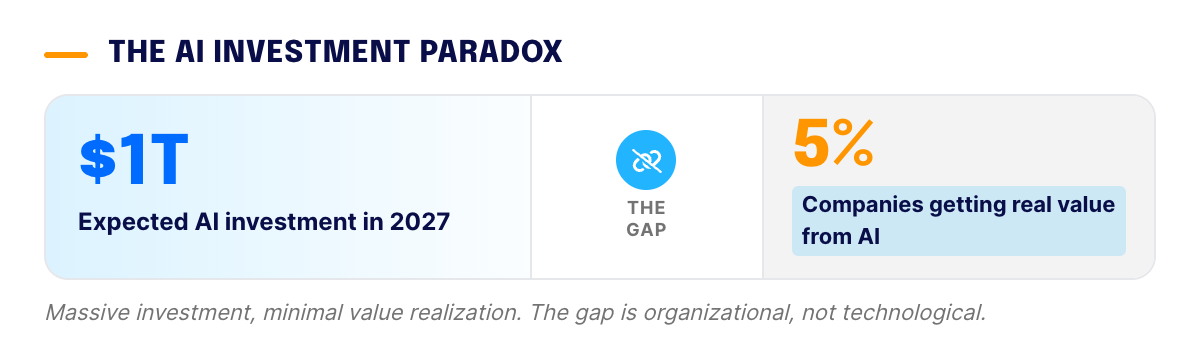 This article examines why AI adoption is failing in most organizations and provides a strategic framework for moving from hype to measurable impact. Based on research from leading organizations and real-world case studies, we identify three distinct approaches to AI integration that, when balanced strategically, enable sustainable AI value creation.
Key findings
Critical insights from research
Organizational readiness has 2.1x greater impact on AI success than individual capability
48% of employees use AI against company policies; 57% rely on output without verification
96% of HR leaders believe workforce is AI-ready vs. <50% of employees who agree
The hidden cost: AUD $1.64M per 1,000 employees annually
Internal communications leaders are uniquely positioned to shape AI adoption success
This article is designed for HR leaders, internal communications professionals, employee experience leaders, and organizational transformation executives seeking practical, evidence-based strategies to get real value from AI.
Why AI adoption is failing: the organizational readiness gap
The fundamental paradox of AI in 2026 is not technological. The technology works. Leading organizations such as Commonwealth Bank, Telstra, and Bunnings have deployed AI successfully at scale. Yet the vast majority remain trapped in the messy middle, where pockets of capability exist without organizational support, resulting in fragmentation, risk, and unfulfilled potential.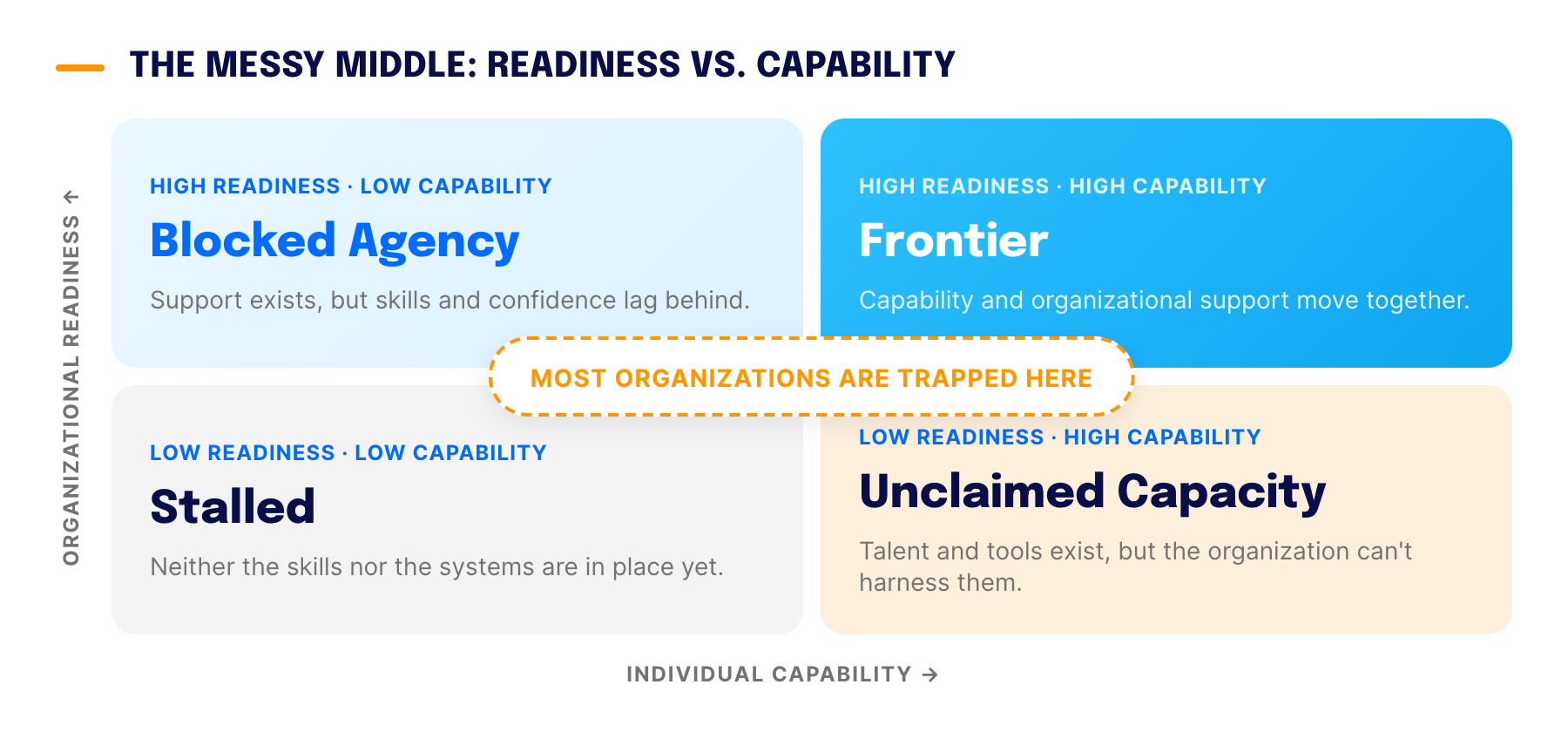
“ The technology is ready. Our organisations are not.
Consider this parallel: when line-calling technology first arrived at Wimbledon, the technology was proven and reliable. But the organizational elements, including player psychology, spectator confidence, fair play perception, and governance frameworks, required years to align. The technology did not fail. The organization did.
The core problem: three critical disconnects
1. The trust paradox
Organizations are experiencing high-profile AI failures, including incorrect references in consulting reports, hallucinated legal citations, and fabricated data in government analyses. At the same time.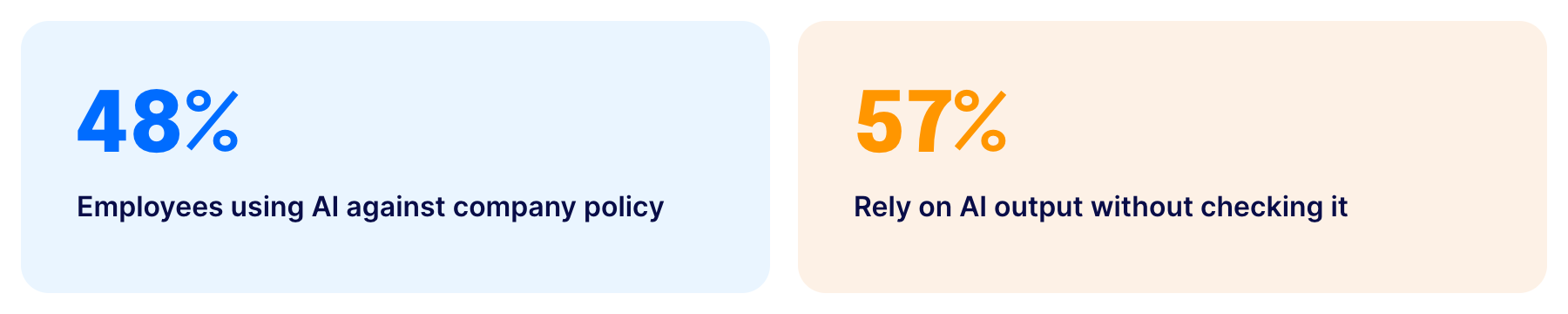
This erodes trust at every level, including with customers, employees, and stakeholders.
2. The skills gap as a commercial imperative
Research conducted across Australia’s largest organizations reveals a striking and costly gap: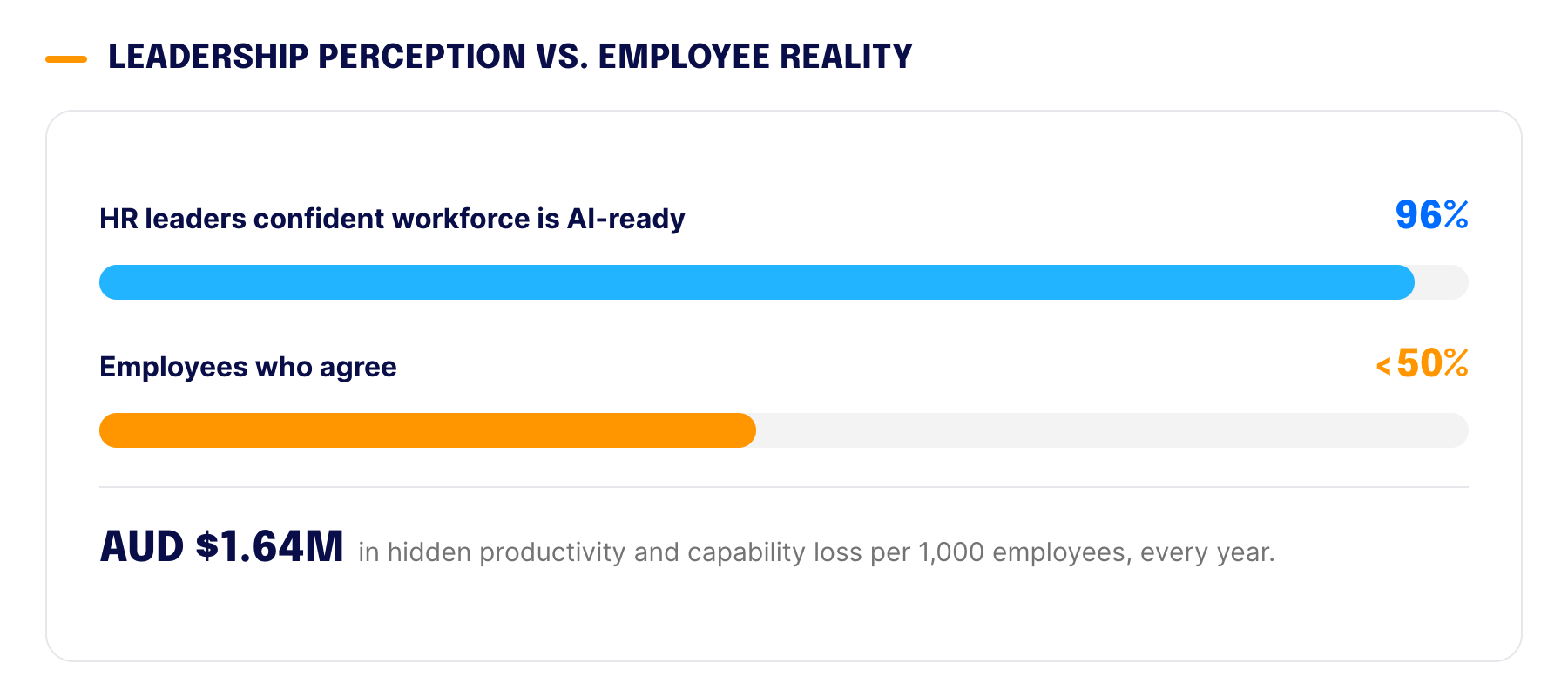
This is not a perception problem. It is a performance problem. For organizations with 1,000 employees, this gap translates to approximately AUD $1.64M in hidden productivity and capability loss annually, making workforce readiness a board-level commercial issue, not an HR initiative.
3. The strategy-delivery divide
Most organizations have AI strategies. Most lack practical frameworks for translating strategy into organizational change. Executives struggle to move from pilots and experimentation to scaled, sustainable value creation. The result: organizations invest heavily in tools, training, and technology while neglecting the organizational systems, governance, and change management required to realize value.
Moving from hype to real value: the three approaches framework
Organizations that get real value from AI do not rely on a single approach. Instead, they balance three complementary strategies, each addressing different organizational needs, risk profiles, and outcomes. All three are necessary. The key is understanding when, where, and how to deploy each.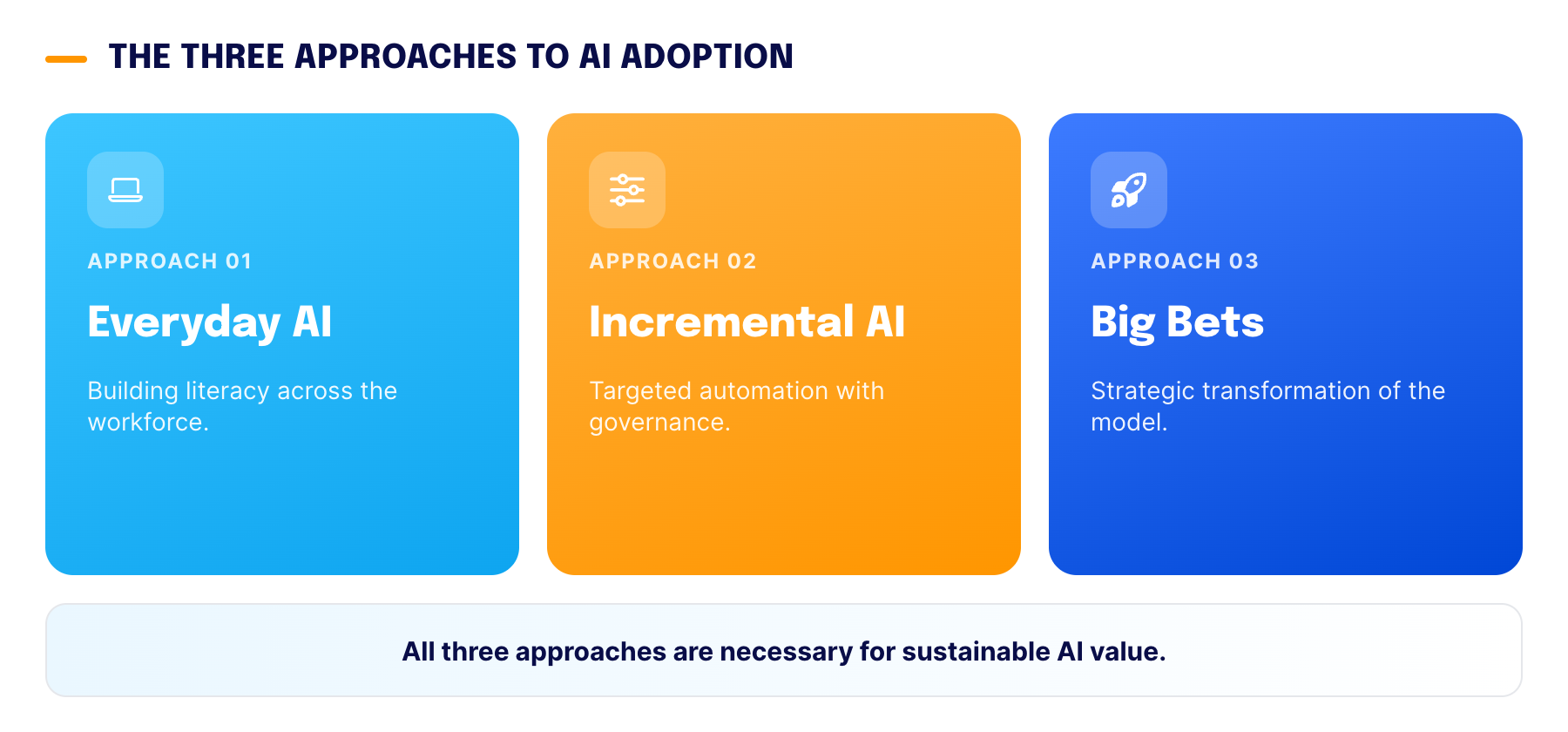
Approach 1: Everyday AI – Building organizational literacy
Everyday AI is the foundation. This is the democratization of AI, with tools like Copilot, ChatGPT, Claude, and Gemini embedded in daily workflows. The goal is not efficiency optimization. The goal is organizational AI literacy.
Why literacy matters: organizations that wait for perfect governance will fall behind. The skills gap will only widen. Organizations leading now are building confidence, experimenting safely, and creating the cultural conditions for sustainable AI adoption.
Eight practical uses of Everyday AI this week. Quick wins for immediate implementation.
Summarize Extract key points from long emails, meetings, and documents | Draft Generate first versions and overcome blank-page paralysis |
Find Surface specific information from unstructured data | Create Generate ideas, scenarios, and content variations |
Coach Improve writing, thinking, and approach through iterative feedback | Advise Weigh options through structured decision-making frameworks |
Check Verify accuracy, tone, compliance, and quality | Test Scenario plan and stress-test decisions before implementation |
“Make safe use easy. Bring AI use into the open. Help people change the way they work. Build confidence before any skills gap widens.
Approach 2: Incremental AI: Automation with governance
Incremental AI is where AI does the job, not just helps with it. This is targeted automation, with AI handling specific, high-volume, lower-risk processes while humans focus on judgment, strategy, and exception handling.
HR Policy & Employee Query Assistant
AI structures incoming requests and answers common policy questions (~80% of inquiries)
HR teams focus on judgment calls and complex scenarios
Result: Faster response times, reduced backlogs, higher employee satisfaction
IT Service Desk Triage
AI routes common issues to self-service and escalates complex problems to specialists
IT teams move from reactive ticket-clearing to proactive problem-solving
Result: Reduced resolution time, improved employee experience, strategic capacity
The three guardrails for Incremental AI.
Fix your process first — Do not automate broken workflows. Understand what the ideal process should be before adding technology.
Get governance in place — One unmanaged agent spirals into 1,000 unmanaged agents. Decide what gets automated, by whom, with what controls.
Do not stop at efficiency — You cannot cut your way to growth. Use AI-enabled capacity to serve customers better, enter new markets, or deepen employee support.
Approach 3: Big Bets: Transforming the business model
Big Bets represent strategic reinvention, rebuilding core processes or business models with AI at the center. The most compelling opportunity in 2026 is enabling frontline staff with AI-powered tools.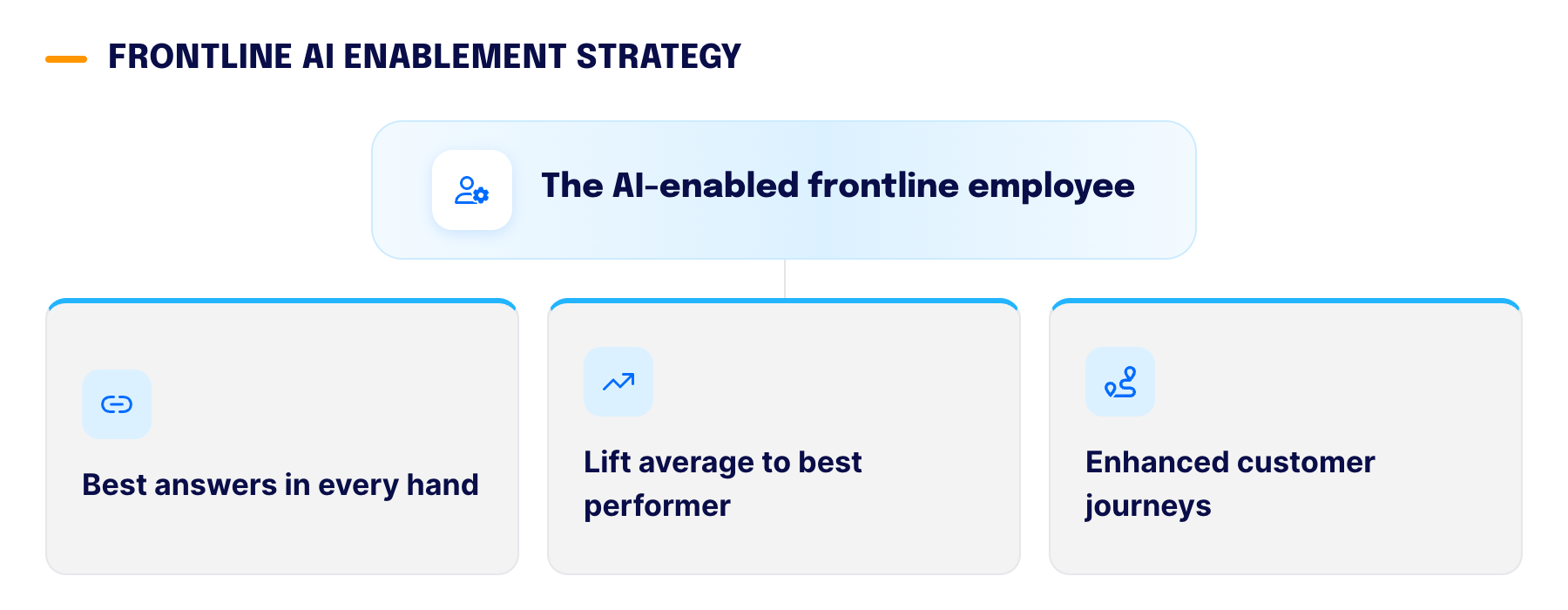
Why frontline enablement matters
Frontline employees, whether in stores, contact centers, or field operations, represent your largest workforce, interact directly with customers, and are best positioned to improve customer experience. When you equip them with AI.
The strategic value of frontline AI
Put the best answers in every employee’s hands, standardizing quality across your workforce.
Lift the average experience closer to your best performers, reducing variability and risk.
Enhance more customer journeys, multiplying impact at scale.
Create competitive advantage through experience, not just price.
Leading examples: Telstra and NBN have deployed AI-powered assistance to frontline teams. Bunnings is using AI to enhance in-store support. Commonwealth Bank invested over 10 years building AI capabilities across customer-facing operations. These organizations are competing on experience, not price.
Critical success factors for Big Bets
Keep strategy in the business
Do not outsource your AI ambition to vendors. Own your strategic visionCreate patience for meaningful change
Commonwealth Bank invested 10+ years establishing governance, building capabilities, and earning trust.Focus on adoption, trust, and operating model
Technology is the easy bit. The hard part is changing how people work and ensuring they trust the system.
The human side of AI: trust, communication, and change
Technology is necessary but not sufficient. Organizations succeed with AI when they address three overlapping human challenges: building trust, managing anxiety about job security, and enabling sustained behavior change.
Trust in AI adoption operates at three distinct levels: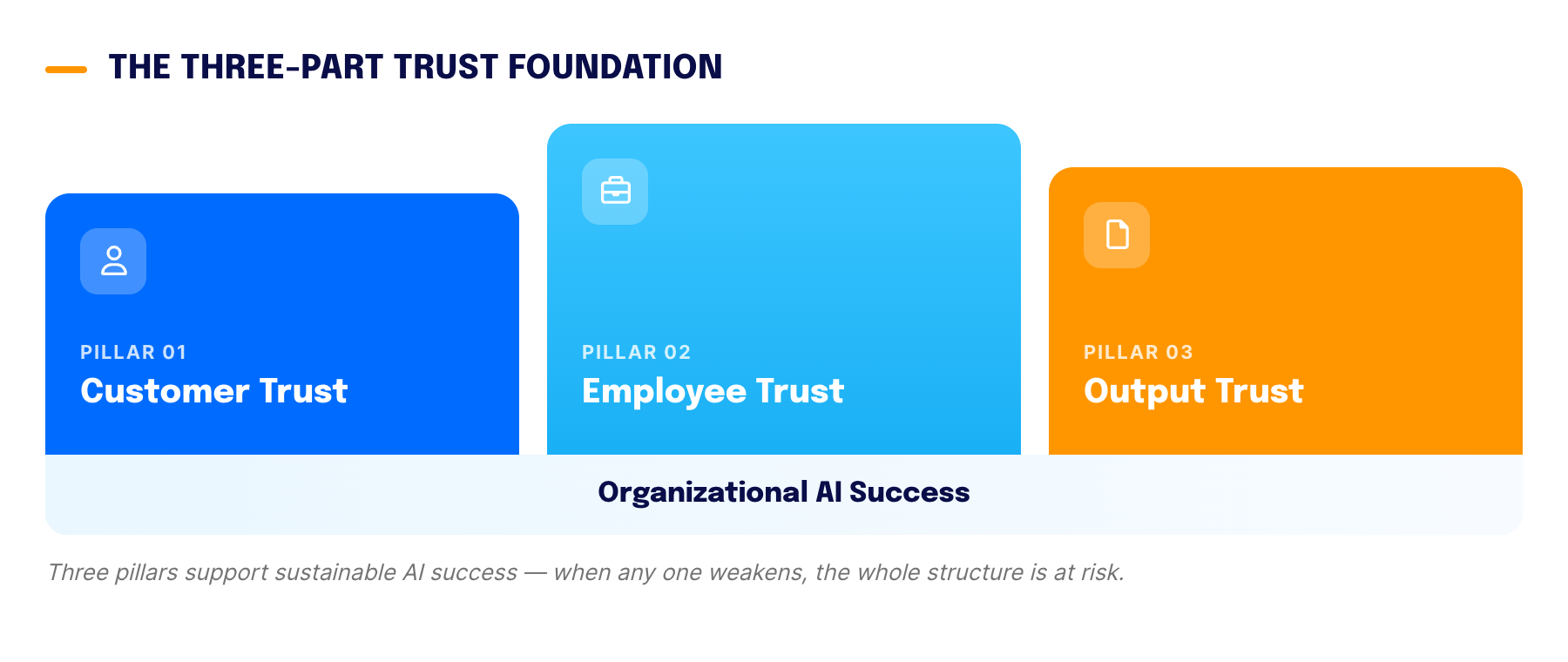
Trust with customers
Do customers know they are interacting with AI? Do they know how their data is being used? Privacy law requires transparency, but business success demands it even more, because customers remember betrayal far longer than they remember good service.
Trust with employees
Employees need to believe that AI augments their work, not replaces them. They need psychological safety to experiment and fail. They need to see leadership using AI confidently, because the skills gap widens when executives say to use AI but do not use it themselves. And they need honest conversations about what is actually changing, rather than reassurance that everything will be fine.
Trust in AI outputs
Set clear expectations. What are people allowed to use AI for? What should they always verify? What triggers escalation to a human? The most successful organizations have explicit, communicated standards, not because they do not trust AI, but because they trust transparency more.
“ The people in this room are highly well placed to shape how AI is used in your organizations. Your IT team needs you. Reach out to them.
The critical role of internal communications leaders
Internal communications and employee experience leaders hold an outsized influence over AI adoption success because they shape narrative, build credibility, and drive behavior change. Communications leaders shape how AI is understood, trusted, and adopted across the organization.
Why communications leaders are critical to AI success
You shape how your organization perceives AI, whether as a threat or opportunity, confusion or clarity.
You build the cultural conditions where people feel safe experimenting, failing, and learning.
You translate technical concepts into business relevance for every employee.
You work across silos, connecting IT governance with HR capabilities and operational leaders.
You know how to drive behavior change, not just technology rollouts.
The most effective AI adoption campaigns do not sound like AI campaigns. They focus on what employees care about: clarity, fairness, opportunity, and recognition.
Practical recommendations for leaders
Getting value from AI is a shared responsibility. The actions below give HR, internal communications, and IT & operations leaders a concrete place to start.
For HR leadersHR priority actions
|
For internal communications leadersCommunications priority actions
|
For IT & operations leadersIT & operations priority actions
|
A practical 90-day roadmap
Momentum beats perfection. This phased roadmap moves an organization from understanding its current state to proving that AI creates value without chaos.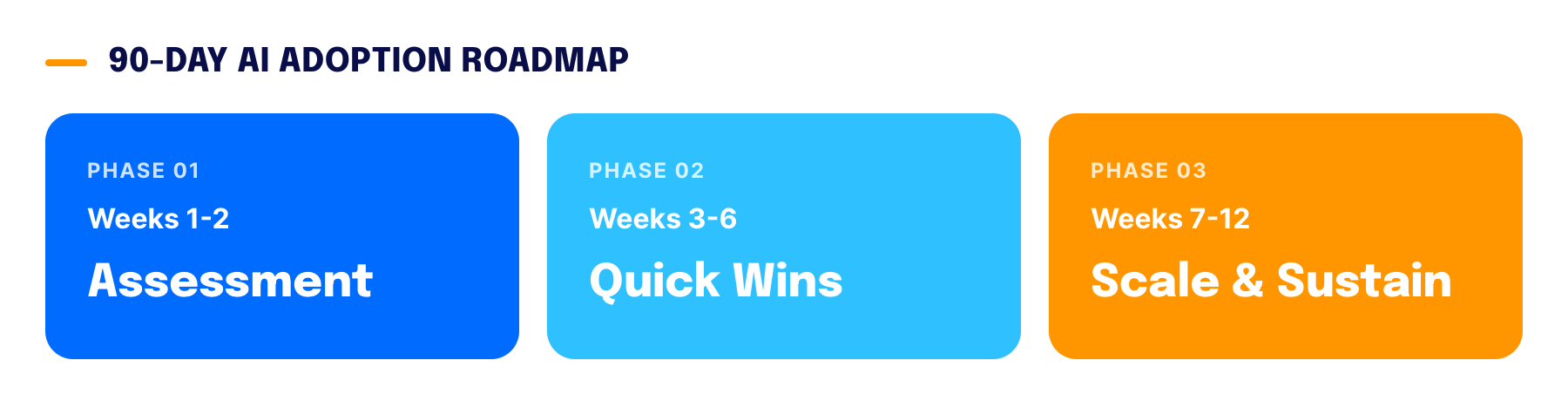 Week 1-2: Assessment
Map current AI use (both informal and formal across the organization)
Identify shadow AI usage and policy violations or compliance gaps
Assess organizational readiness across governance, skills, culture, and leadership
Week 3-6: Quick Wins
Establish clear Everyday AI guidelines and safe-use practices with IT and legal
Launch peer-to-peer learning programs and encourage safe experimentation
Identify one Incremental AI pilot (HR assistant, IT triage, or intake process)
Week 7-12: Scale & Sustain
Launch Incremental AI pilot with clear success metrics and feedback mechanisms
Build governance framework and establish regular communication cadence
Identify next 2–3 Incremental AI opportunities based on pilot learnings
Celebrate successes and share lessons learned across the organization
"The goal is not perfection by week 12. The goal is momentum, learning, and organizational proof that AI creates value without chaos.
Conclusion
The central insight of this article is deceptively simple: technology is not the bottleneck. Organizational readiness is.
Organizations investing in governance, leadership clarity, skills development, and cultural alignment are realizing AI value. Organizations treating AI as a technology problem rather than an organizational transformation are struggling despite identical investments. Organizations that win with AI treat it as a collaborative, human transformation, not just a technology rollout.
Three key takeaways
1. Balance your approach
Do not choose between Everyday, Incremental, and Big Bet AI. You need all three. Everyday AI builds literacy and confidence. Incremental AI delivers near-term value and proves governance works. Big Bets enable strategic transformation. The most mature organizations have all three in motion simultaneously.
2. Invest in the human side
Budget for change management, communication, and upskilling. These typically represent 20–30% of AI program cost but generate 70%+ of impact. Your IT team will buy the tools. Your communications team will shape whether employees use them.
3. Make trust tangible
Set explicit expectations. Communicate governance clearly. Share examples of successful AI use. Acknowledge failures and what you are learning from them. Trust is not built through reassurance. It is built through transparency, competence, and consistency.
“The window is open in Australia, but it will not stay open forever. Organizations making strategic AI decisions now will lead. Organizations waiting for perfect conditions will fall behind.
Strategy alone does not create value. Execution does. Three actions you can take this week:
USE AI on a new task: Apply one of the eight Everyday AI approaches and share your learning
SHARE knowledge: Teach a colleague something you learned and listen to their approach
SHAPE the conversation: Reach out to IT, comms, HR, or operations to explore one AI opportunity
The difference between organizations that win with AI and those that do not is not innovation. It is execution. It is a willingness to move from hype to help, from technology pilots to organizational value. When AI Is Not the Answer
AI-powered employee experience solutions can do a lot, but they can’t do everything. Knowing the difference is what separates a successful deployment from an expensive misstep.
Ready to take the conversation further?
See what Australian leaders and industry experts have to say about turning AI investment into real impact.