


How can an intranet best support employee onboarding success in 2026?
Learn how a governed intranet creates clarity, trust, and confidence for new hires, especially on the frontline, as AI becomes the first point of contact for modern employees.

The short answer
An intranet best supports employee onboarding in 2026 by serving as a governed, mobile-first system of record where new hires can always find the official answer, not just on Day 1, but throughout their first 30 to 90 days. Onboarding fails when guidance is scattered across emails, chats, and PDFs. It succeeds when employees know exactly where to go for verified, current information they can safely act on.
This challenge is amplified for frontline employees without desks or corporate email. When onboarding lives in fragmented systems, new hires rely on managers or coworkers to interpret policy, increasing inconsistency and compliance risk. AI strengthens onboarding only after this foundation exists. Without governance, it scales confusion instead of clarity.
What most onboarding advice gets wrong — and how the Place, Push, Pull model fixes it
Most onboarding programs focus almost entirely on Push: sending welcome emails, publishing content, and checking boxes. Place and Pull get ignored. The result is onboarding that looks complete on paper but breaks down in practice.
Effective onboarding is a system, not a publishing exercise. For a new hire to move from confused to productive, three things need to be in place:
Place → A single, trusted entry point employees recognize as the home for official information
Push → Guided onboarding that tells employees exactly what to do and learn right now
Pull → Ongoing access to reliable answers when questions surface weeks after Day 1
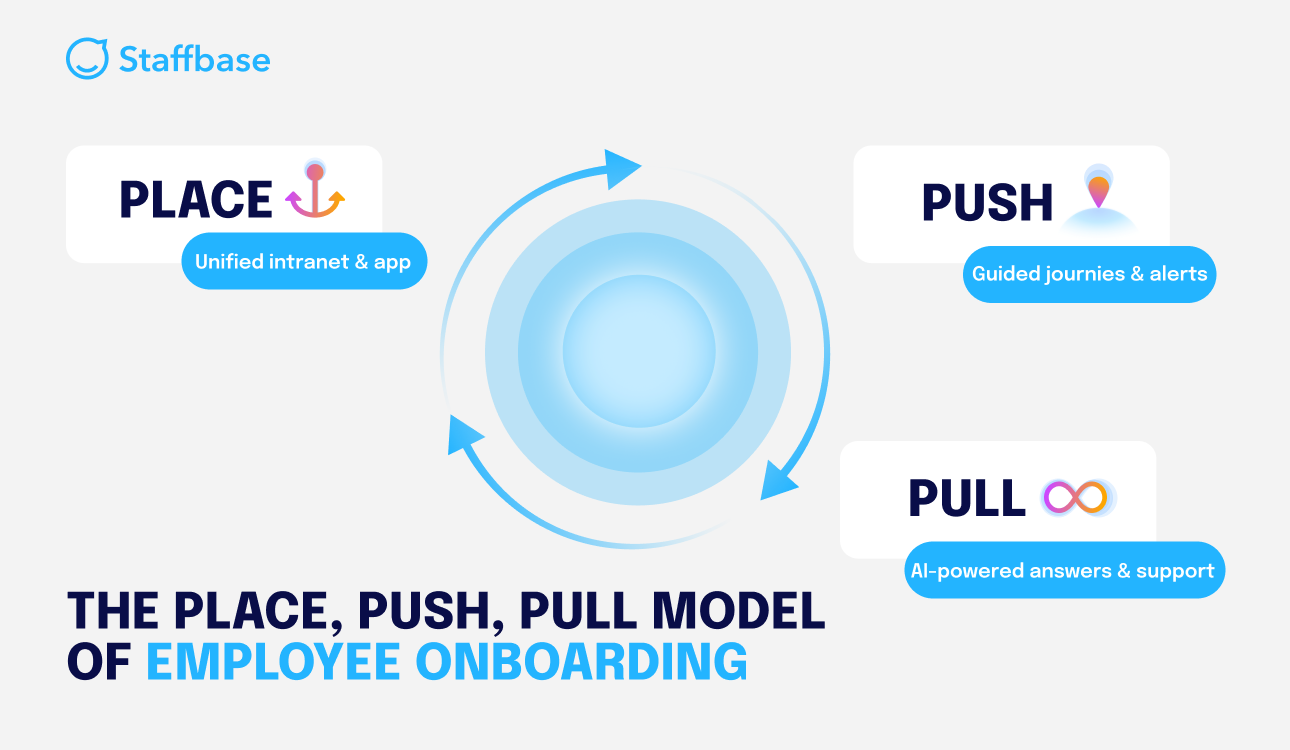 Each part of the model breaks down in a predictable way when it's missing, causing many organizations to lose new hires.
Why does content volume hurt onboarding?
The default response to onboarding friction is to publish more: longer emails, larger Day 1 portals, more PDFs, and links. But content volume creates noise, not confidence. When everything looks equally important, nothing feels safe to act on. Strong onboarding shifts focus from publishing more to clearly signaling what's official, what matters now, and where answers live.
Why is Day 1 completion an unreliable success metric?
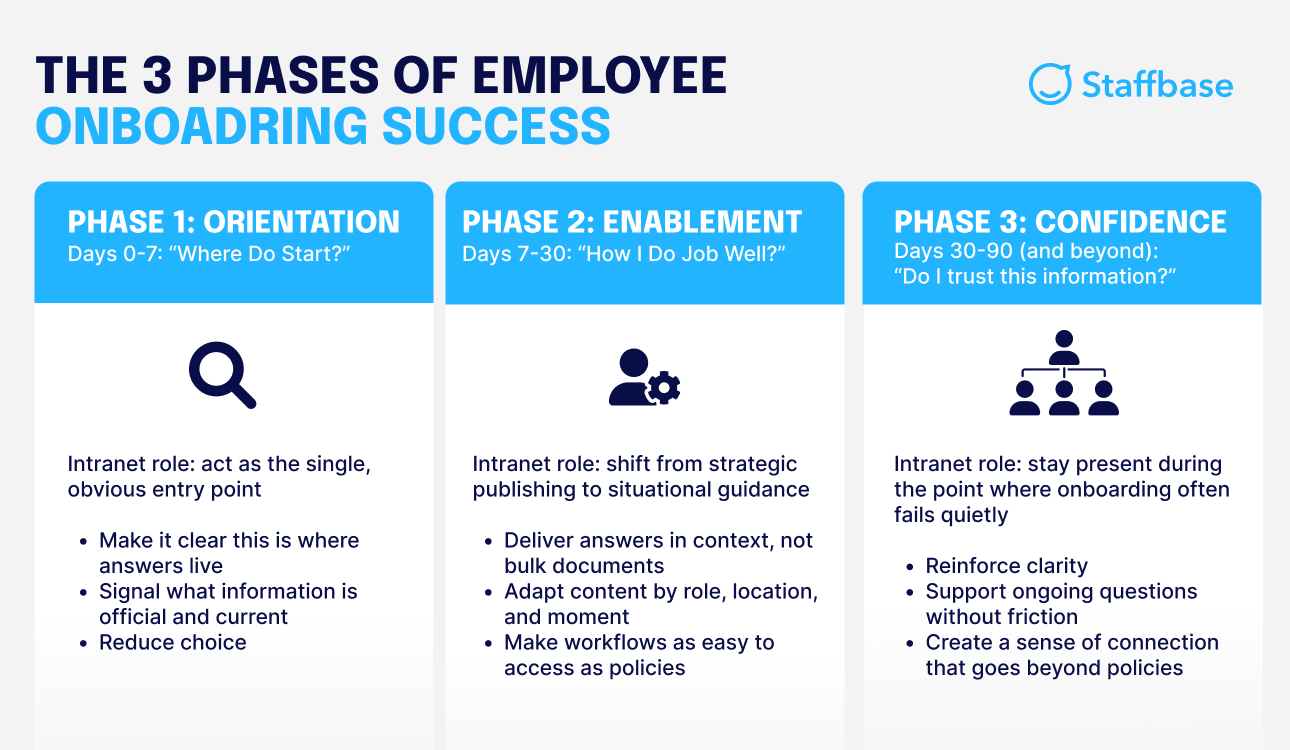
Onboarding rarely fails on Day 1. It fails in the weeks that follow, when employees hesitate, double-check, or wait for a manager to confirm what they already read. That hesitation signals whether the organization has built a culture of clarity and trust. Onboarding success should be measured by sustained confidence over the first 30 to 90 days, not checklist completion.
The frontline stress test: Why traditional onboarding fails non-desk workers
The limits of the Push-only model show up fastest on the frontline. Frontline onboarding doesn't fail because information is missing. It fails because new hires can't tell what is official or where to find it without a desk or a company laptop.
A 2025 Staffbase and YouGov study found that only 9% of non-desk employees say they are very satisfied with their company's internal communication, while 38% rate it as fair or poor.
These employees typically experience onboarding through fragments: verbal handoffs, printed flyers, or shared links. The fix isn't more tools. It's fewer places. When onboarding is anchored in a single, mobile-first Place, it stops being a one-time event and becomes a daily tool for success.
5 benefits of AI-supported employee onboarding with an intranet
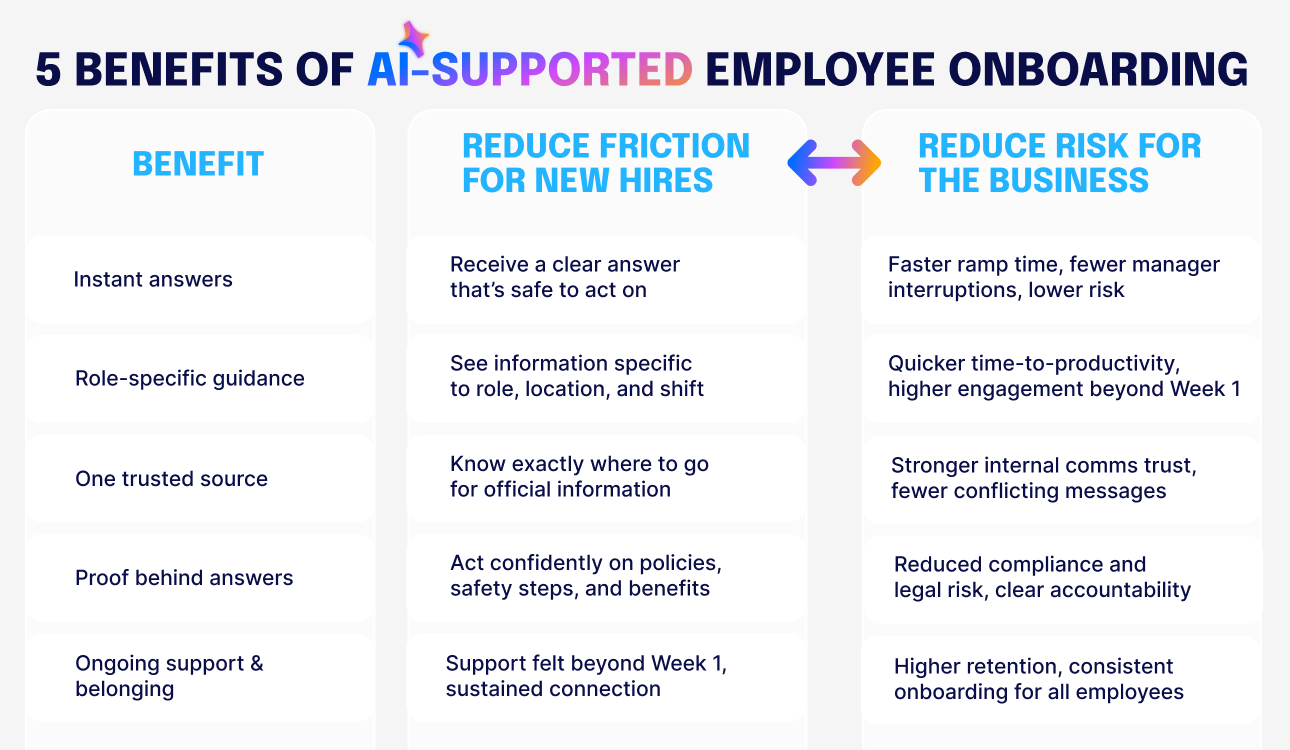 If onboarding is the moment employees decide whether they can trust the company's information, the intranet has one job: make the right answer easy to find and hard to miss. Using the Place, Push, Pull model, these five conditions separate effective onboarding from fragile onboarding.
1. Enabling employees to solve problems when managers aren’t there (Pull)
Frontline employees don’t have time to search portals or poll coworkers. When questions come up on the shop floor or in the clinic, they need one official answer — fast. AI improves onboarding only when it is restricted to verified, governed content. When that foundation exists, employees can ask questions in plain language and act with confidence instead of relying on guesswork.
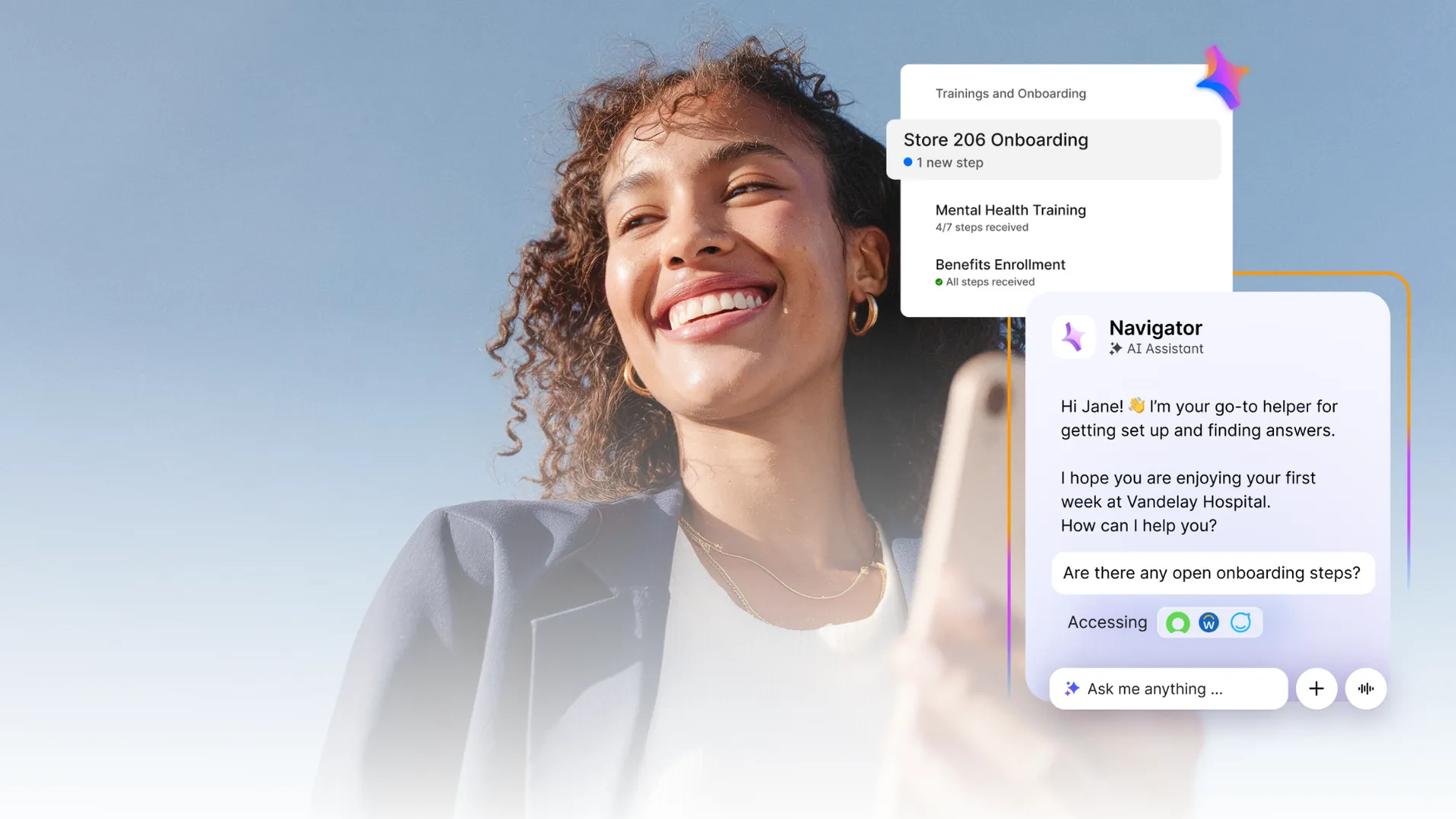
With Staffbase Navigator, a new hire can ask “Who is my HR contact?” or “Where do I find my first payslip?” and get an answer that links back to where it came from. They can check the source instead of asking a coworker.
Why it matters: Employees get answers they can safely follow without waiting for a supervisor.
Business impact: Fewer repeat interruptions for managers and HR. AI reduces friction instead of scaling confusion.
2. Eliminating Day 1 overwhelm with role-specific journeys (Push)
Most onboarding fails by showing everyone everything at once. A warehouse hire, a nurse, and a finance analyst require different knowledge at different intervals. Effective onboarding delivers precise guidance targeted by role, location, and stage, ensuring employees learn faster without experiencing information fatigue.
Why it matters: Faster time-to-productivity through relevant learning.
Business impact: Higher early-stage retention as onboarding remains useful beyond the first week.
3. Establishing a single source of truth to end conflicting guidance (Place)
Onboarding breaks down when new hires find information but can’t tell whether it’s current or approved. That uncertainty pushes them toward informal workarounds, which are often wrong. An intranet supports onboarding best when it’s the one official source, not one of many. An AI assistant like Staffbase Navigator builds on that: When a new hire asks a question, Navigator can route it to a Navigator Expert set up for onboarding. That Expert answers only from the sources HR has approved for it and links back to where each answer came from.
Why it matters: Employees know exactly where to go for the final word.
Business impact: Stronger alignment and fewer conflicting answers from peers.
4. Reducing compliance risk through built-in accountability (Place + Pull)
When guidance is spread across unmanaged tools, organizations can’t verify what was told to whom, or when it was approved. This creates significant compliance and legal risk. Onboarding becomes defensible only when content has clear ownership, review cycles, and permissions enforced before answers are surfaced to humans or AI.
Why it matters: Proof of communication for HR, IT, and Legal.
Business impact: AI answers that protect the organization instead of creating liability.
5. Building long-term confidence that lasts beyond the first 90 days (Pull + Place)
Onboarding rarely fails during the welcome lunch; it fails weeks later, when employees have new questions but no longer know where to ask them. The most effective intranets transition from an orientation tool to a daily utility, remaining a trusted Place employees return to as they encounter real-world challenges.
Why it matters: Eliminates the cliff where support disappears after the first week.
Business impact: Sustained employee performance and a lower long-term workload for HR.
How can an intranet ensure onboarding sticks beyond Day 1?
When onboarding is treated as a one-time event, it breaks. Confidence doesn't disappear overnight. It erodes gradually as real-world questions arise and employees no longer know where to find reliable answers.
AI works best as a long-term support layer, not a Day 1 shortcut. That only works if there is a clear place to return to when questions evolve from "Where do I park?" to "How do I handle this specific compliance issue?"
 Why you can't add AI before fixing the foundation
AI can't reliably distinguish what's official unless the organization has defined it first. When policies and guidance are scattered across shared drives, emails, and chat threads, there's no way to establish which answer is correct.
This is why many AI onboarding pilots stall. The issue isn't the technology. It's the lack of trust in the underlying data. Without a governed single source of truth, AI scales risk instead of reducing friction. In frontline environments where accuracy is a safety requirement, that's not a minor defect.
Is AI safe for onboarding data?
It can be, if it’s constrained. AI answers should come only from approved sources with defined ownership, review cycles, and permissions, whether that’s an intranet page or a connected HR system. The system shouldn’t invent guidance or interpret undocumented information. Every answer should be traceable back to an approved source. In Staffbase Navigator, Scoped Knowledge lets admins decide which content counts as approved and set a freshness window, so last year’s onboarding checklist can’t resurface in an answer.
Adoption holds when the platform has daily value beyond onboarding. When employees return for operational essentials like schedules, shift updates, and workplace notices, onboarding guidance stays visible instead of fading after the first week.
From manual gaps to digital clarity
Before rolling out their employee app, Bethany Children's Health Center struggled with fragmented onboarding. Information was spread across departments, updates didn't reach staff consistently, and managers had to fill the gaps manually, pulling time away from patient care.
By establishing a single, mobile-first entry point with Staffbase, new hires were given a clear place to go from Day 1. Department-specific hubs improved findability, while shared visibility reduced uncertainty about what information was current and official. Within six months, 100% of employees had registered, 80% had completed onboarding, and engagement remained high. This wasn't because more content was added, but because clarity improved.
Is your organization ready for AI-supported onboarding?
Before deploying AI for onboarding, determine whether you're facing a clarity problem or a scale problem. If onboarding guidance is scattered across unverified files, AI will automate that chaos, not fix it. If you have a governed single source of truth, AI becomes a practical tool for ensuring every new hire, especially on the frontline, gets consistent answers from Day 1.
When is AI-supported onboarding the wrong move?
AI-supported onboarding is not a shortcut for broken foundations. Without established governance, it surfaces conflicting guidance and erodes trust. It's also a poor fit for organizations that haven't reached operational complexity. When answers live in people's heads and decisions change weekly, AI adds overhead without improving clarity.
It also fails when onboarding is treated as a one-time event. AI-supported onboarding works best as a 30 to 90-day journey where questions evolve. If success is measured by Day 1 completion alone, AI introduces complexity without improving outcomes. The sequence is simple: establish clarity first, then use AI to scale it.
Do not deploy AI for onboarding if:
There is no agreed system of record for official information
Content ownership and review cycles are unclear or inconsistent
Onboarding is treated as a Day 1 checklist rather than an ongoing process
The organization is small enough that managers already provide fast, consistent answers
AI is positioned as a replacement for managers rather than a support layer
Why organizations turn to Staffbase for employee onboarding
Staffbase structures onboarding inside a governed, mobile-first communication platform, so the foundation, content ownership, review cycles, and permission-aware access are already in place before AI is enabled. That means every answer a new hire receives, whether at a desk or on the shop floor, is traceable back to an approved source.
Navigator also keeps context within a conversation and suggests follow-up questions. A new hire can go from “What do I need for my first shift?” to “Where do I pick up my safety gear?” without starting over, and pick the conversation up again the next day.
Build an onboarding experience that lasts. Explore how a governed intranet supports new hires from Day 1 through their first 90 days.

Validity Note: This article reflects the Staffbase POV and enterprise market conditions as of September 2026.
Frequently asked questions (FAQs)
As AI becomes the first place employees go for answers, these FAQs clarify what intranets and AI-native employee experience platforms can — and cannot — be trusted to do in 2026. They separate speed from safety, automation from clarity, and explain what must be in place before AI improves onboarding instead of introducing risk.