


Staffbase vs Unily: Which enterprise intranet platform is better for large companies in 2026?
Staffbase and Unily both went AI-native in 2025 and 2026. They placed very different bets, and the right one for your company depends less on features than on how you think about AI reaching the whole workforce.

The decision in one sentence: Choose Staffbase if you want enterprise AI to work for every employee, not just the ones who already navigate complex tools well. The reason: Staffbase was built from the start to be simple enough to reach and operate across the whole workforce, and that simplicity turns out to be exactly what makes AI quality scale. Choose Unily if your workforce is largely desk-based, you have a dedicated digital workplace team, and your priority is centralized intranet site-building speed with deep configurability.
Key insights
Both platforms are AI-native, for different problems. Unily launched Unily Futures in October 2025 with Indy (an agent that builds branded intranets from intent) and Unily Glass (a conversational interface for tasks across systems). Staffbase launched the AI Quality Layer in April 2026, the trust spine of a broader source-of-truth strategy that activates trusted answers across the whole workforce.
The next enterprise AI risk is output quality. Gartner has named “AI slop” as the dominant 2026 risk, following oversharing (2023), attack vector (2024), and agent sprawl (2025). The defensive layer most platforms built last year does not address it.
Simplicity is now a governance argument. AI answers are only as good as the content behind them. The platform whose operating model lets local teams keep content current is the platform whose AI answers stay trustworthy at scale.
Choose Staffbase if your priority is reaching the whole workforce, trusted AI answers grounded in governed content, and an operating model where Comms and HR can run the platform alongside IT.
Choose Unily if your priority is centralized site-building speed for a primarily desk-based workforce, and a dedicated digital workplace team is ready to operate a configurable CMS.
AI is changing the intranet. But not all in the same direction.
In 2026, every intranet vendor is being forced to answer the same question: what does an intranet become when AI enters the workplace?
The hard part is not adding AI features. The hard part is choosing what to focus on. Do you optimize for faster site-building, deeper configurability, stronger governance, simpler ownership, better reach, or trusted answers employees can actually use? Every choice means saying no to something else.
That is why this comparison is not just about Staffbase vs Unily as two platforms. It is about two different bets on where enterprise intranets are going. Since this is a Staffbase-authored article, our perspective is clear. But the goal is to make the trade-offs transparent enough that buyers can ask better questions.
AI can’t transform what it can’t reach.
That is the question this whole comparison turns on. In most large companies, AI is currently working well for one kind of employee. The one with a desk, a corporate laptop, time to figure out new tools, and a job that already lives inside Microsoft 365 or Google Workspace. For everyone else (the technician on the plant floor, the retail manager between shifts, the financial services employee buried under 300 alerts a day, the nurse jumping between three systems, the new joiner who doesn’t yet know what they don’t know), AI so far has mostly meant another tool layered on top of an already overwhelming digital experience.
Define “hard to reach” narrowly and you end up talking about frontline. Define it the way it actually shows up in the data and it covers most employees in most companies. The strategic question behind any 2026 intranet evaluation is which platform makes enterprise AI work for the whole company, not just the part of it that was already comfortable with the digital workplace.
This article is a working answer to that question, drawing on independent analyst research from ClearBox Consulting and Forrester, market data from Gartner and McKinsey, and the public product positioning of both vendors as of May 2026.
Why is the old intranet RFP outdated in 2026?
Most intranet evaluations still reward the platform that can build the most pages, configure the most layouts, and tick the longest feature checklist. That misses the real shift. In the next five years, most employee questions will not be answered by browsing static pages. They will be answered through assistants in mobile apps, Teams, intranets, email, and other conversational interfaces. The buying criteria need to change with that shift.
Traditional intranet evaluation | AI-era employee experience evaluation |
|---|---|
How many page types and widgets can we configure? | Can AI give employees trusted answers from governed sources? |
How flexible is the CMS? | Can business owners keep knowledge current without IT bottlenecks? |
How strong is enterprise search? | Can the assistant answer with context, source attribution, and permissions? |
How beautiful is the homepage? | Can the same truth reach app, intranet, email, Teams, signage, and assistants? |
Can the platform serve HQ employees? | Can it reach the whole workforce, including the hard-to-reach majority? |
Can central admins control the experience? | Can local teams own content within central guardrails? |
What is the real difference between Unily and Staffbase on AI?
Unily is using AI to help teams build employee experiences faster. Staffbase is using AI to activate trusted employee truth across the whole workforce. Both bets are real product investments. They lead to genuinely different platforms.
What Unily is building
Unily announced Unily Futures at Unite 2025 as the AI-native evolution of its platform, with two named capabilities. Indy is “the world’s first employee experience agent that turns intent into governed, on-brand experiences in minutes.” A creator describes the intent (“create a campaign hub for safety week”), and Indy designs the structure, drafts the content, and produces a branded experience ready for approval. Unily Glass is a conversational single-pane-of-glass interface that lets employees ask questions and execute tasks across enterprise systems. Unily has also publicly positioned an Agent Orchestrator and a Bring-Your-Own-Agent model.
Indy entered a customer Lighthouse program in January 2026, with broader availability planned for H1 2026. ClearBox called the approach promising while flagging open questions on information architecture quality and content accuracy.
The strategic pattern is clear. Unily is betting that the bottleneck in employee experience is the time it takes to build and ship internal experiences, plus the friction of working across an increasingly busy AI stack.
What Staffbase is building
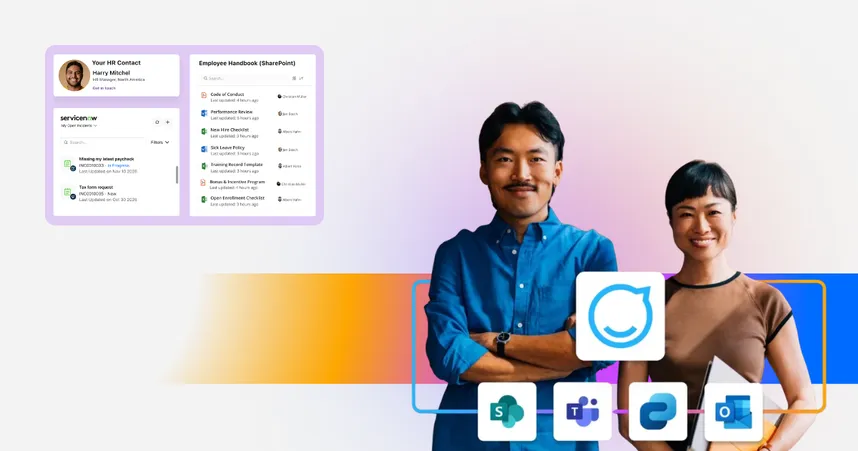
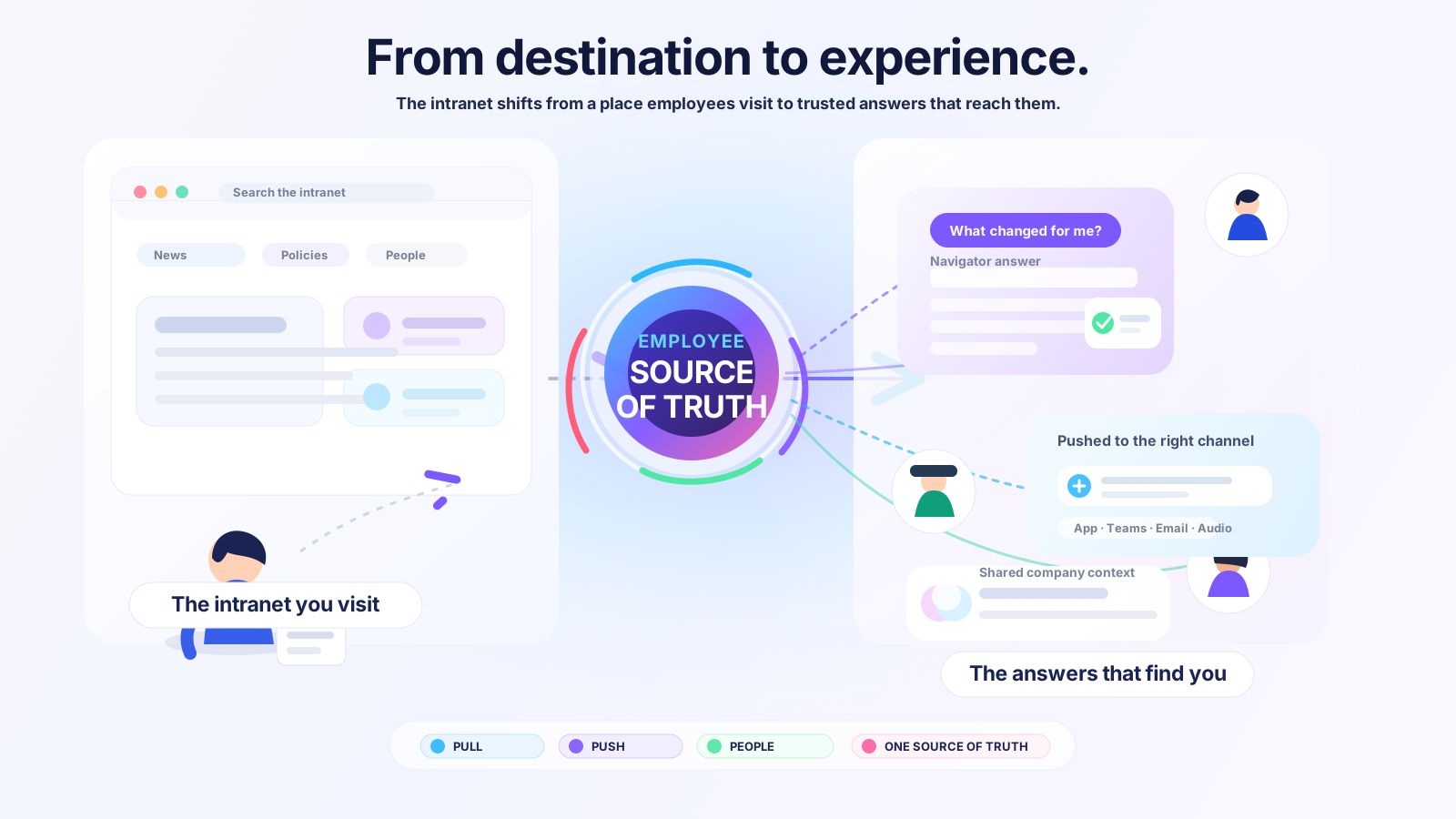
Staffbase has made a broader bet. The starting point is an AI-ready employee source of truth: a governed employee-facing layer that connects to authoritative systems like SharePoint, ServiceNow, and Workday, and makes the employee-relevant content available wherever employees actually work. Content gets curated by the people closest to it, validated through source attribution, scoped by permissions, and kept current by tooling that knows when it goes stale.
On top of that source of truth, Staffbase is building three modes of AI-powered employee experience.
Pull. Navigator is the AI experience layer where employees ask questions and get trusted, contextual answers. It understands who is asking, respects permissions, draws from scoped knowledge, reflects the organization’s voice, cites trusted sources, and gets better with use.
Push. Conversational AI has a built-in limit. Employees only ask for what they already know they need. Push orchestration solves that by proactively surfacing what matters: role-relevant updates, “what did I miss” briefings, operational alerts, personalized digests. The information finds the employee across app, intranet, email, Teams, digital signage, and audio.
People. As AI gets more personalized, shared truth risks disappearing. Leadership communication, culture, common priorities, and transformation narratives still matter. Staffbase keeps the shared layer alive alongside the personalized one.
The AI Quality Layer is the trust spine that makes all three modes work. It governs every AI-powered interaction through five dimensions: Employee Context (who is asking), Scoped Knowledge (what the AI draws from), Organization Voice (how it sounds), Content Quality (whether the source is reliable), and a Learning Loop (how it gets better over time). It sits on top of the AI Trust Hub, which provides the safety foundation (permissions, data controls, T.R.U.S.T. principles) that has become standard for any serious enterprise platform.
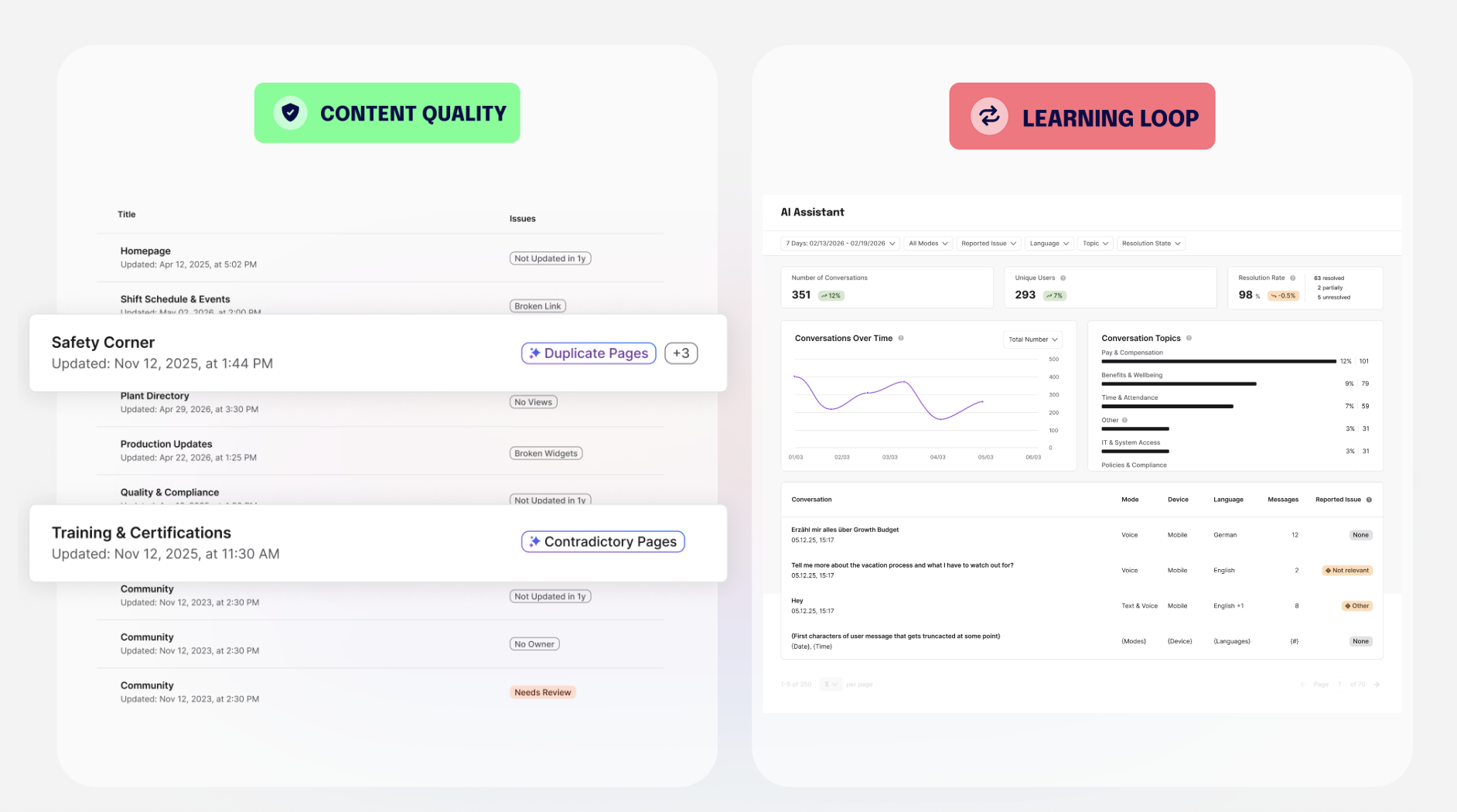 The image shows how the Staffbase AI Quality Layer keeps employee knowledge trustworthy over time. Content Quality acts like automated intranet gardening: finding duplicate, outdated, broken, or contradictory content and helping editors resolve it. The Learning Loop turns AI conversations into governance insight, showing what employees ask, where answers fail, and what content teams need to improve next.
Dimension | The question it answers | What it controls |
|---|---|---|
Employee Context | Who is asking? | Role, location, language, and history shape every answer |
Scoped Knowledge | What should the AI draw from? | Purpose-built assistants with curated, approved content |
Organization Voice | Does it sound like us? | Terminology, tone, and language rules set per space |
Content Quality | Is the source actually reliable? | Continuous monitoring, flagging, and cleanup of published content |
Learning Loop | Is the system getting better? | Feedback and analytics that improve answers over time |
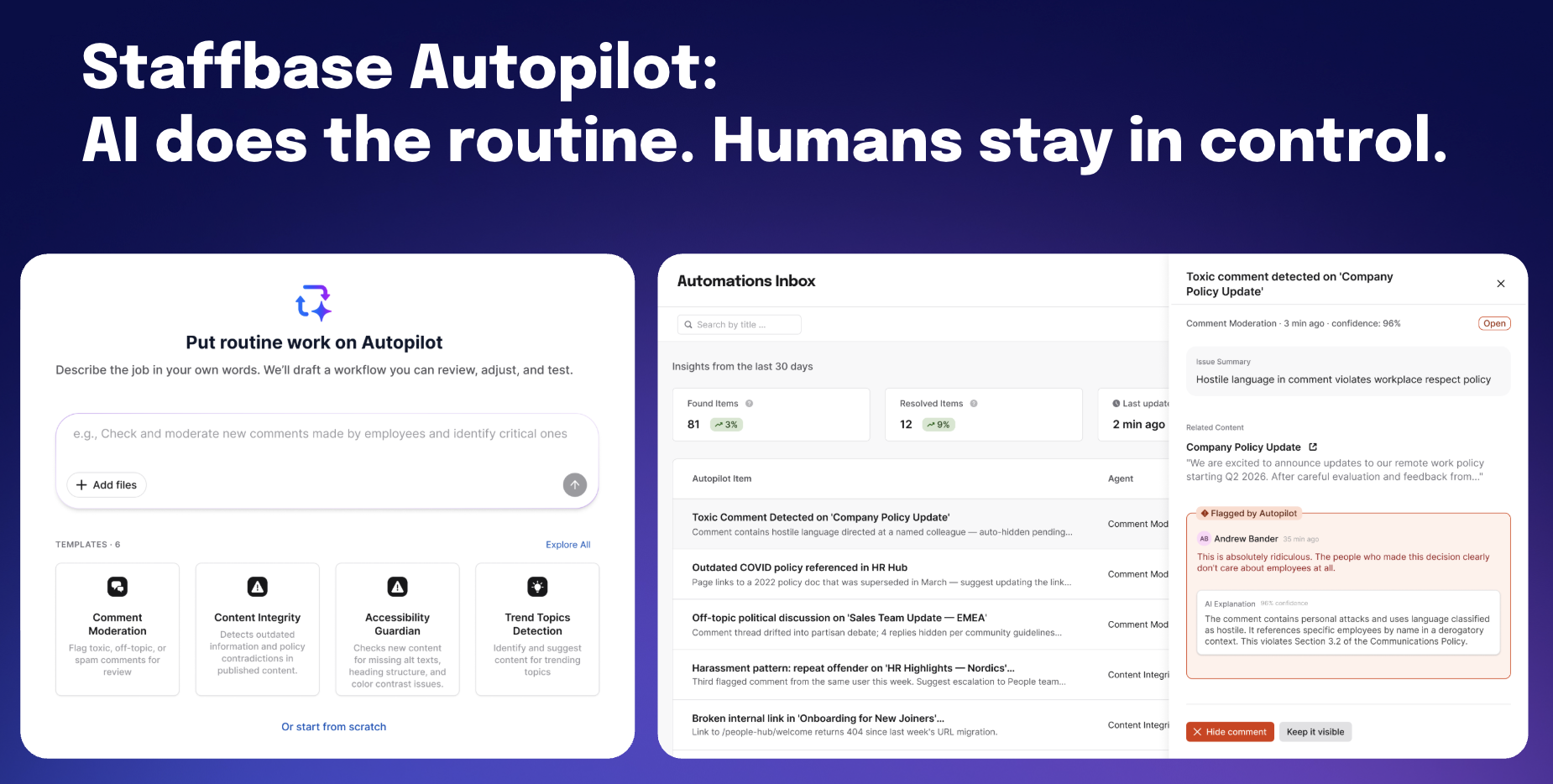
Around all of this, Autopilot keeps the source of truth healthy by detecting outdated, duplicated, contradictory, or missing content. Autopilot turns recurring content, governance, and moderation tasks into reviewable AI workflows, so AI can do the routine work, while humans stay in control.
Co-creation tools help teams write inside Staffbase and inside external AI environments like Claude, ChatGPT, and Copilot. MCP capabilities let Staffbase plug into the broader enterprise AI ecosystem, both as a place where external AI can publish governed content and as a source other agents can consume.
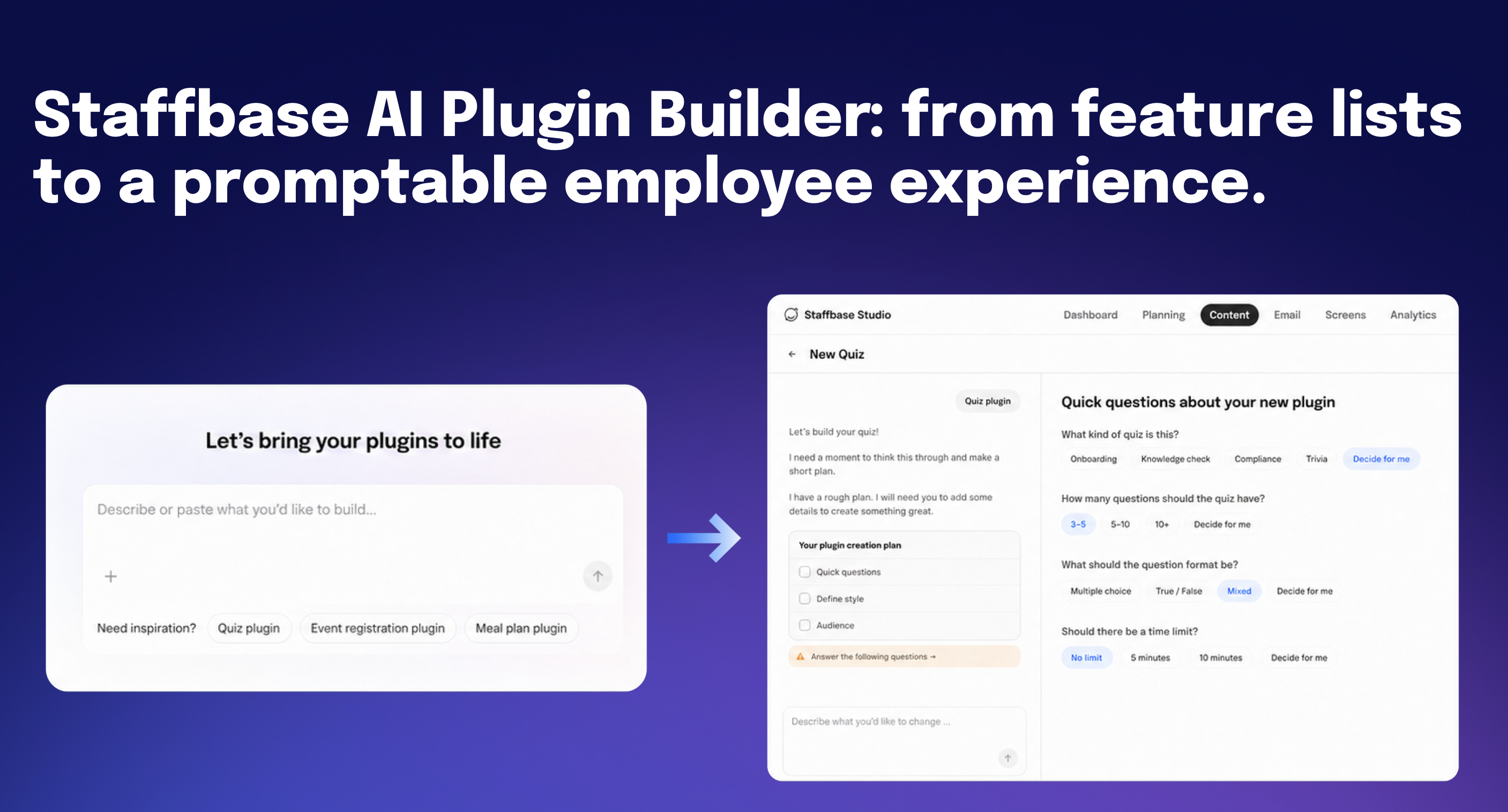
Staffbase is also moving from a fixed feature list to a promptable employee experience. Instead of waiting for a roadmap item or a custom development project, teams can simply describe the plugin, widget, or workflow they need and create a governed experience that fits their exact use case.
What is the dominant enterprise AI risk in 2026?
Output quality, not access. Gartner has charted the evolving risks of AI in the organization as a four-step progression: oversharing in 2023, AI as a new attack vector in 2024, agent sprawl in 2025, and AI slop in 2026: a mass of poor-quality AI content flooding the enterprise, resulting in bad decision-making and productivity drain. The defensive layer most platforms built for the first three risks does not address the fourth.
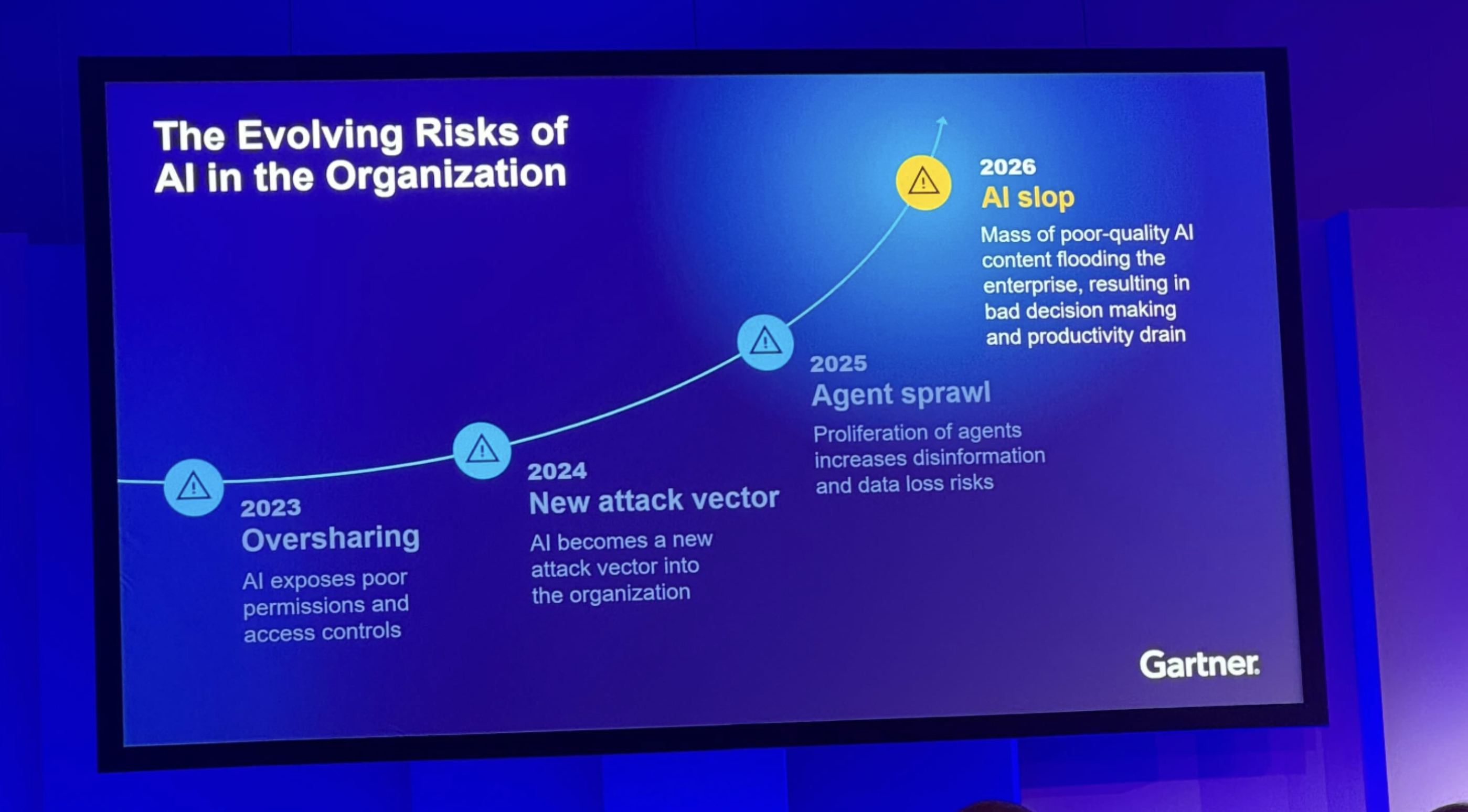 AI Slop was pictured as the top evolving AI risk in organizations in 2026 at the Gartner Digital Workplace Summit London in April 2026. More here.
The data tells the same story. McKinsey reports 88% of organizations now use AI in at least one function, but only a third have begun scaling it across the business. Gartner projects that organizations operationalizing AI transparency, trust, and security will see a 50% improvement in AI adoption and business outcomes by 2026 compared to those that do not.
For employees, the cost of “almost right” is concrete. An HR answer that references last month’s policy version. A safety procedure that confidently cites the wrong document. A translated town hall that uses the model’s generic term instead of the company’s established one. None of this is a security failure. None of it triggers a permission alert. It is the new failure mode: trustworthy-sounding output that quietly erodes confidence until employees stop using the system.
This is the gap the AI Quality Layer is designed to close, and the gap a build-faster strategy alone does not address. Faster creation is valuable, but if the underlying source of truth is noisier and harder to govern, AI will confidently amplify the contradictions already buried in the content estate.
Why does Staffbase’s simplicity matter more in the AI era?
Because AI answers are only as good as the content behind them, and the platform whose operating model lets local teams keep content current is the platform whose AI answers stay trustworthy at scale. Staffbase’s heritage forced a discipline of simplicity that turns out to be exactly the right architecture for AI quality.
Staffbase was built for employees who could not navigate a traditional intranet. Frontline workers in factories, on shop floors, in hospitals, on the road. That audience forced a specific design discipline: the platform had to be simple enough for someone with 90 seconds of attention to use, and simple enough for a local HR or comms team to keep current without a ticket to IT. The result is Spaces, semi-autonomous workspaces where local teams publish, target audiences, and build their own user groups within central guardrails. ClearBox’s 2026 review notes that Staffbase administrators “will largely be able to look after their platform with limited (or no) technical knowledge required.”
Unily took the opposite path. The platform is built around a configurable central CMS that gives a small administrator team significant control. ClearBox describes the back end as comprehensive but notes that it “can feel overwhelming and complex, particularly for those who aren’t used to website CMS approaches.”
For most of the last decade, this debate was about ease of use and adoption. In 2026 it is about something bigger. The Scoped Knowledge dimension of the AI Quality Layer only works if there is actually someone keeping the scope current. An HR assistant for the DACH region works because someone in that region owns the content. A facility assistant for Plant 3 works because the plant team owns its operational pages. In an AI-ready intranet, ease of use stops being a usability talking point and becomes a quality control mechanism for the system AI runs on.
The frontline heritage was not just about reach. It forced a discipline of simplicity that is the right architecture for the AI era regardless of how much of your workforce is on a plant floor versus a desk. Financial services, professional services, healthcare administration, public sector. The same pattern shows up everywhere: AI works when content owners can actually own their content.
What do real users say about Staffbase and Unily on G2?
The headline ratings are close. Staffbase 4.6 across 247 reviews, Unily 4.5 across 38 reviews (May 2026). The more useful signal is the pattern behind the ratings. In G2’s direct comparison, reviewers found Staffbase easier to use, easier to set up, easier to administer, and preferred doing business with Staffbase overall. Reviewers preferred Unily for the direction of its product roadmap and the pace of feature updates.
That tracks the broader trade-off. Unily is perceived as broad and ambitious. Staffbase is perceived as easier to operate at scale across business teams. The relevant question for any 2026 evaluation is which pattern matters more after launch, when the platform is being run by communications, HR, and operational teams across the organization rather than by the original implementation team. The six-to-one difference in review volume also reflects that pattern.
How do Staffbase and Unily fit into a Microsoft 365 environment?
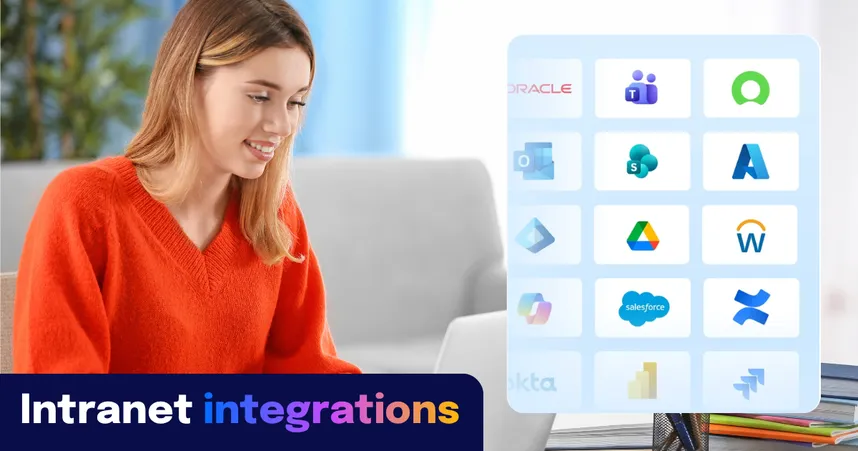
Both vendors integrate with Microsoft 365. The more important question is whether the intranet strategy extends the Microsoft environment, or whether it introduces a parallel digital workplace destination that lives alongside it.
Unily is strongest when an organization wants a substantial employee experience platform in its own right: a configurable intranet destination with its own experience model, AI agents, knowledge and search layer, and digital workplace architecture. The strategic posture is platform-first.
Staffbase is strongest when an organization wants to preserve Microsoft as the productivity and document foundation while adding what Microsoft does not solve well on its own: governed employee communication, multi-channel reach, frontline access, editorial workflows, and an AI-ready employee source of truth. The strategic posture is extension-first.
For Microsoft-centric enterprises, this distinction adds up over time. A platform-first posture means two AI layers, two content repositories, two governance models, and two analytics surfaces to reconcile. An extension-first posture preserves Microsoft as the system of record and adds an employee-facing layer on top, in phases if needed. Staffbase’s Studio Publisher even provides a headless option for organizations that want a strong employee experience CMS while keeping their existing SharePoint front end.
Which platform reaches the whole workforce better?
Staffbase, by a meaningful margin in independent evaluations, because its architecture started with the hardest-to-reach employees and the rest of the platform was built outward from there.
Both vendors invest in mobile and frontline today. The difference is origin and operating DNA. Staffbase started as a frontline mobile employee app and expanded into intranet. Unily started as a configurable intranet and expanded into mobile. ClearBox’s 2026 Choice Awards recognize Staffbase for “Frontline and mobile focus.” Unily is recognized for “Comms excellence,” “Strong knowledge and search,” and as an “AI Innovator.” In ClearBox’s scenario-based scoring, Staffbase scored 4.5 out of 5 in Mobile and Frontline Support. Unily scored 3.75.
The 2026 ClearBox report documents that Unily currently offers two different experiences within a single mobile app: a fully-featured version on par with the desktop, and a separate lightweight interface for frontline workers with reduced functionality. Unily’s public positioning highlights significant ongoing mobile investment. Buyers should validate which features are generally available today versus in preview or planned, particularly around shift-based task management.
And “hard to reach” is not just a frontline question. It also describes the financial services employee getting 300 emails a day, the professional services consultant in client mode, the retail manager with 15 minutes for admin, and the new hire who does not yet know which system holds the answer. The architecture that reaches frontline workers well, simple enough to use without training, fast to surface what matters, reaches all of these other employees well too. That is why the heritage matters even for customers with no frontline at all.
What does each platform actually cost to run after launch?
Staffbase is cheaper to operate over a 3-year horizon. The four-month average implementation (Source: G2) typically ends with a fully operational deployment that business teams can run on their own. Unily’s five-month average implementation (Source: G2) typically ends with an MVP largely configured by professional services, with internal teams continuing to learn the back-end CMS over the following 6 to 12 months. ClearBox notes a “significant learning curve” for Unily administrators. Heavily customized environments become harder to evolve over time, and adopting new platform capabilities can require additional projects.
For IT leaders, the practical question is whether IT has to be involved in every routine change. The Staffbase model lets IT define the guardrails and audit the system without becoming a bottleneck for routine content, audience, or workflow changes. The Unily model typically requires either dedicated administrator capacity or sustained IT involvement.
When Unily is the stronger choice
When your priority is a highly configurable digital workplace with strong intranet depth, rich experience design, knowledge and search capability, and a central team ready to manage a broad employee experience environment. Unily’s strength in central design consistency, structured information architecture, configurable governance, and agent orchestration is real. Indy’s AI-driven site-building, in particular, can save weeks of build time for intranet program teams that have historically been under-resourced.
When Staffbase is the stronger choice
When your priority is reaching the whole workforce, consolidating channels into one operating model, enabling business teams to operate within IT-defined guardrails, and building an AI-ready employee source of truth that keeps answers trusted, contextual, current, and reachable across every channel. Staffbase aligns particularly well with organizations preparing for AI-driven knowledge environments, because the AI Quality Layer focuses on what Gartner has named the dominant 2026 risk. For Microsoft-centric enterprises, the extension model preserves your SharePoint investment rather than building alongside it. And Staffbase is one of the few platforms recognized as a serious solution across desktop intranet, employee email, and frontline mobile, which means it can replace two or three separate vendors with one operating model.
Six questions to take into every vendor demo
When an employee asks an AI assistant a policy question, how does the platform decide which sources are allowed, and how does the answer change by role, location, language, and permissions?
How does the platform detect outdated, duplicated, or contradictory source content, and what happens when an employee flags a bad answer?
Can local HR, comms, and operational teams maintain their own knowledge without IT involvement, while central governance is preserved?
How does the AI preserve company terminology, tone, and approved language across every interaction, including translations and AI-generated content?
Can the same trusted content reach employees through app, intranet, email, Teams, digital signage, and AI assistants, or does each channel duplicate the work?
How does the platform serve employees who do not navigate complex digital workplaces well, whether that is frontline, shift-based, mobile, multilingual, or simply overwhelmed by their inbox?
A vendor whose architecture answers these with specifics, not just safety controls but actual mechanisms for output quality and operational reach, is aligned with where enterprise AI is going.
The question worth asking yourself
Where will most employee questions be answered in five years? Through static intranet pages, or through AI assistants in mobile apps, Teams, and conversational interfaces?
If the answer is AI assistants, then the platform that makes those answers trustworthy, reachable, and proactive across every employee, including the ones who never had a great digital workplace experience in the first place, is the platform that ages well.
Unily makes it faster to build employee experiences. Staffbase makes it possible to move the whole company through AI-driven change with one trusted employee source of truth that reaches everyone.
Validity: This comparison reflects publicly available product positioning and independent analyst research as of May 2026. Both platforms are evolving quickly. Verify current capabilities with each vendor before final selection.
About the author
Frank Wolf is co-founder and Chief Strategy Officer of Staffbase. Before founding Staffbase in 2014, he spent more than 12 years as an independent intranet and employee communication consultant. He is the author of Social Intranets (2012), the first book worldwide on social and collaborative intranet design, and The Narrative Age (2024), on strategic communication and change management.
Staffbase was founded out of a specific frustration. Classical intranets worked well for a narrow slice of the workforce. The rest, frontline workers, shift workers, distributed teams, and over time also the desk employees overwhelmed by fragmented tools, were excluded from the digital workplace not because the technology could not reach them, but because nobody had built it for the way they actually worked. That gap was the founding motivation for Staffbase, and it turns out to be exactly the gap that enterprise AI now has to close to deliver on its promise.
Frank speaks regularly on the future of employee experience platforms in an AI-driven world, including at the Ragan AI Horizons conference, the IABC World Conference, and Staffbase VOICES. The views in this article reflect his assessment based on direct market experience, customer deployments, and independent analyst research.