


What are the main features of intranet platforms for secure scaling in highly regulated sectors?
Highly regulated organizations must protect sensitive systems while still reaching every employee with critical information. The key features of intranet platforms for highly regulated sectors determine whether you can do both — or end up compromising one for the other.


The short answer
The essential features of intranet platforms for highly regulated sectors make compliant behavior structurally enforced and not dependent on individual discipline or manual oversight. They are:
Identity-first access
Embedded governance workflows
Permission-aware AI
Secure enterprise integrations
Frontline and multilingual delivery
Those features exist to solve a structural dilemma most regulated organizations face in 2026. They must protect sensitive systems and data, while still reaching every employee — especially frontline workers without corporate email or desk access — with the critical information required to do their jobs safely and compliantly.
The right intranet architecture resolves that tradeoff by acting as a secure front door. Employee experience platforms like Staffbase provide a governed communication layer where employees access what they need to know, while sensitive systems remain protected. That's the difference between internal communication that scales securely and compliance that breaks down when pressure hits.
What do most organizations get wrong about intranet security in regulated industries?
The most common mistake is over-investing in access restriction while under-investing in communication reach. Certifications, encryption, firewalls, and access controls are necessary, but they only address one side of the challenge. They don't prevent the communication breakdowns that lead to compliance failures in regulated industries, such as outdated policies circulating, critical updates not reaching frontline workers, and ungoverned AI surfacing conflicting guidance.
A platform can be technically secure while still allowing all of this to happen, because technical security and communication governance are different problems that require different solutions. Locking down sensitive systems matters, but regulated organizations also need communication tools that reach every employee with the information required to act compliantly. Solving for one while ignoring the other leaves the organization exposed.
The organizations that get this right understand that secure internal communication platforms for regulated industries require governance architecture in addition to infrastructure security.
Why is secure internal communication a critical infrastructure in regulated industries?
In regulated industries, the communication layer is what determines whether a policy update reaches the employee who needs to act on it, regardless of role, location, or device. The gap between a policy update and the moment it's actually followed is where compliance risk lives.
Consider a hospital that issues an urgent update to a sanitation protocol. The alert goes out by email and gets posted to a portal. A nurse without desktop access never sees it, follows the old procedure, and unknowingly creates a patient safety risk. The hospital faces potential penalties. It wasn't that the policy was wrong. The communication system simply couldn't reach the person who needed it.
The bottom line: When employees can't access compliance updates because they lack a corporate email or a desk, the platform has already failed its core function.
When operational updates can't afford to miss their audience
In aviation, a missed operational update is an operational risk. Brussels Airlines, Belgium's largest airline, had a workforce of more than 3,000 employees, most of them non-desk and traveling globally. Without a governed communication platform, employees filled the gap with external social networks like Facebook that the company couldn’t govern.
Staffbase replaced that fragmented approach with role-based delivery. Now, cockpit crews see flight operations content, ground staff receive airport-relevant updates, and no group is sent content outside their scope. Everyone gets what they need without the noise of irrelevant updates.
The result was 90% registration among cockpit crew, 75% among maintenance and engineering staff, and 94% monthly active users. This level of employee engagement reflects what becomes achievable when the platform is built for the people it's supposed to reach.
What are the essential features of intranet platforms for highly regulated sectors?
Secure scaling in highly regulated industries is achieved through architectural capabilities. The key features — identity-first access, embedded governance, permission-aware AI, secure integrations, and frontline/multilingual delivery — don’t exist to demonstrate compliance on paper while the gaps remain operational. Their purpose is to prevent communication breakdown when regulatory pressure increases, which is why each one addresses a specific failure point.
Capability | What breaks without it | What it enables |
|---|---|---|
Identity-first access | Blanket restrictions or access gaps | Role-appropriate access across the full employee lifecycle |
Embedded governance | Reactive, manual compliance | Defensible, traceable publishing at scale |
Permission-aware AI | Misinformation at machine speed | Governed retrieval within need-to-know boundaries |
Secure integrations | Shadow processes and duplication | Centralized, low-exposure connectivity |
Frontline & multilingual delivery | Governance that stops at the desk | Compliance reach across every employee |
1. Identity-first access
In regulated industries, identity-first access is the foundation that determines whether every other governance control actually works. Without it, organizations are forced to choose between broad access that creates risk or blanket restrictions that block the employees who most urgently need access to the information. With identity-first access:
Employees see only what they're authorized to access, based on role, location, department, or employment status, without manual gatekeeping from IT.
Access updates automatically across the full employee lifecycle (onboarding, role changes, and offboarding) through connected provisioning such as SCIM.
Frontline workers without a corporate email can log in via QR code or employee ID, removing the access barrier without compromising security controls.
Granular permission levels (global admin, space admin, editor, contributor) allow local teams to manage their own content without touching global settings.
In practice: Staffbase supports SSO, access code, and username/password login, removing the corporate email barrier for frontline workers. The platform connects to identity providers, including Microsoft Entra ID via SCIM 2.0, so access permissions update automatically as employees join, change roles, or leave the organization.
If this is missing: Permissions drift as employees change roles. Frontline workers will likely fall back on WhatsApp. Auditors ask who had access to what, and there's no clean answer.
2. Embedded governance workflows
Governance added on top of secure internal communication — a final review step, an approval email, a shared policy document — tends to break down as regulatory pressure increases. When the workflow depends on individual memory and manual coordination, compliance becomes reactive by default. With embedded governance workflows:
Content ownership is assigned so specific teams are accountable for keeping information current and initiating review cycles.
Blocking approvals prevents sensitive content like safety updates, financial disclosures, and policy changes from being published without explicit sign-off from legal, compliance, or leadership.
Automated audit trails record who published what, when it was approved, and who has read it, keeping the organization audit-ready without manual record-keeping.
Content lifecycle management surfaces expiring or outdated material before it becomes a liability.
In practice: Staffbase Content Pro continuously scans the intranet to flag outdated, duplicate, or abandoned pages. It identifies missing ownership and surfaces governance gaps before they become a liability. That means content owners are accountable at each stage, and sensitive content doesn’t go live without the required review.
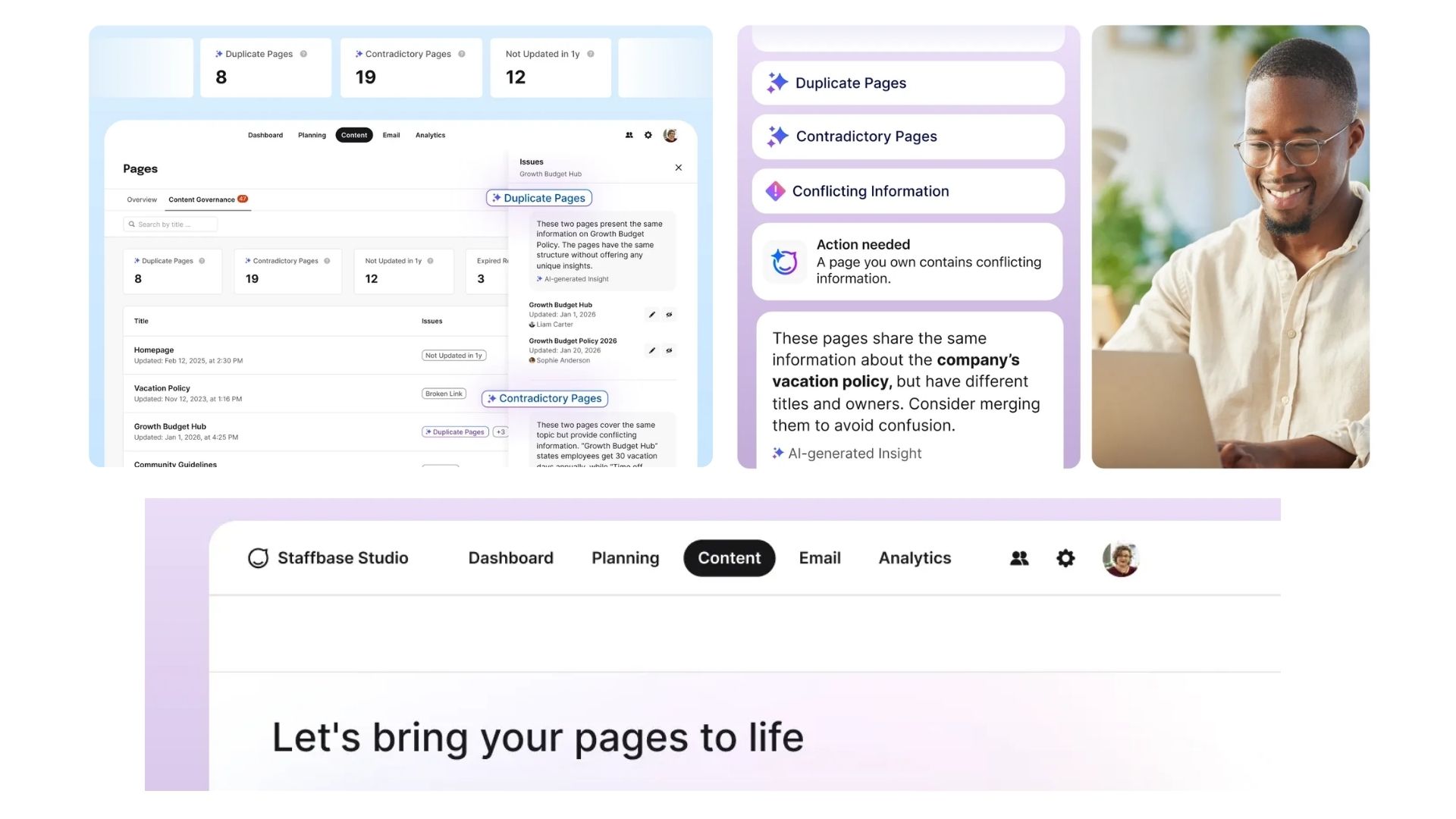 If this is missing: Outdated policies circulate because no one owns the review cycle. Content gets published without required approvals. Audit responses depend on reconstructing a paper trail that was never kept.
3. Permission-aware AI
AI inherits the problems of the content it retrieves from. AI features built on ungoverned, unstructured knowledge are more likely to surface outdated or conflicting guidance, often without signaling uncertainty to the user. In regulated environments, that becomes a critical compliance failure. Frameworks like the EU AI Act require organizations to document and demonstrate how AI systems retrieve and surface information, but that's only possible if the AI operates inside defined permission boundaries from the start. With permission-aware AI:
AI assistants and chatbots retrieve answers only from content the specific user is already authorized to see, preserving the need-to-know principle in each interaction.
Responses cite the source directly, so employees can verify the answer and trust the output.
Interactions are logged, keeping AI usage auditable under regulatory review.
AI retrieves only from governed content that has gone through ownership, review, and approval workflows.
Admins define the knowledge scope and a content-freshness window, so superseded material can’t reach an answer, even if it still sits in a folder.
In practice: Staffbase's AI-powered assistant, Navigator, is built on this model. With Scoped Knowledge, admins choose exactly which Spaces, pages, news channels, and connected systems Navigator can draw from, and set a freshness window that keeps outdated content out of every answer. Navigator cites its sources, never surfaces content outside the user’s permission scope, and keeps conversation logs inspectable for review, with an option to anonymize message content.
If this is missing: An AI intranet chatbot can confidently cite a safety protocol that was superseded months ago. Employees act on guidance drawn from content they weren't authorized to see.
4. Secure enterprise integrations
In large regulated organizations, employees fill integration gaps themselves, turning to WhatsApp groups, personal email threads, and informal workarounds that sit entirely outside governance controls. These workarounds can become invisible, ungoverned, and difficult to audit. With secure enterprise integrations:
Pre-built, maintained connectors for HRIS systems, Microsoft 365, ServiceNow, and CRM platforms reduce the need for custom API builds and ongoing developer maintenance.
Integrations operate on least-privilege access, connecting at the lowest access level necessary. That way, a misconfigured or compromised integration doesn't expose the broader system.
HR data flows automatically into the communication platform, keeping user profiles and permissions accurate without manual updates.
In practice: Staffbase has pre-built connections to systems like Workday, SAP, and Microsoft 365. The Microsoft 365 integration goes both ways: Staffbase content can surface in Teams and SharePoint for desk workers, and Microsoft data flows into the Staffbase app for frontline workers. Through Navigator, these connections also work in the other direction: Employees can check a leave balance or raise a ServiceNow ticket from the chat. Navigator always acts as the signed-in employee, within that person’s permissions, which keeps the least-privilege principle intact at the moment of action.
If this is missing: Employee data falls out of sync, misdirecting updates and creating access gaps. Operational coordination migrates to unmanaged channels. Shadow processes become difficult to govern and reliably audit.
5. Frontline and multilingual delivery
Governance that stops at the office door isn't governance. In regulated industries, the employees most exposed to compliance risk are often the furthest from a desktop, such as nurses, warehouse operatives, drivers, and field technicians across distributed teams. Best practices for secure internal communications in distributed teams start with ensuring the platform can reach these employees as reliably as it reaches anyone at a desk. With frontline and multilingual delivery:
QR code and employee ID login removes the corporate email barrier for frontline workers, without compromising access controls.
Offline mode ensures content is accessible even without a live data connection.
Auto-translation delivers content in each employee's preferred language automatically, without creating separate content copies that fragment governance.
A single approval chain, ownership record, and audit trail cover all language versions of a piece of content, so multilingual publishing doesn't multiply governance complexity.
In practice: Staffbase delivers on-demand content translation powered by Azure AI Translator. That means a compliance update can be published, and employees can trigger a translation to automatically have it available in their preferred language.
If this is missing: Compliance updates were technically published but never reached the nurse, the driver, or the warehouse operative on the frontline. Multilingual content fragments into unmanaged copies with no clear owner and no audit trail.
What does secure scaling look like as a complete system?
The key features of intranet platforms for highly regulated sectors don't operate independently. Identity determines access. Governance determines what gets published. AI retrieves within those boundaries. Integrations keep the system accurate. And frontline delivery ensures none of it stops at the office door.
Staffbase is built around all five, not as separate add-ons, but as a unified architecture designed for regulated environments. When they're aligned, compliant behavior isn't the result of individual discipline. It's the default. But understanding why these features work together requires understanding something more fundamental: the role of an intranet in a regulated environment, as well as its limitations.
What is the role of the intranet in a regulated technology environment?
In a regulated technology environment, the intranet functions as the secure front door, meaning it's the layer that sits between employees and more sensitive backend systems. It gives employees access to what they need to know without requiring organizations to open up their most protected environments.
ERP platforms, clinical databases, and knowledge repositories retain their own access controls. The intranet handles communication, awareness, and direction, pointing employees to the right resources without lowering the wall around sensitive data.
This is what makes the intranet a distinct layer in a regulated technology environment, not just another system. It doesn't replace backend security. It makes backend security compatible with organization-wide reach.
How one global manufacturer solved the reach problem without compromising security
Heraeus, a global technology group with 14,900 employees across more than 40 countries, faced the challenge of protecting sensitive systems while still reaching a workforce that had never had access to corporate content before. Half of its workforce is non-desk, based in production, logistics, and lab environments. That meant the challenge wasn't just security; it also involved participation.
Their Staffbase-powered intranet, Heraeus touch, became the single access point where employees could find critical updates and jump directly to the tools they needed, HR portal, security log, Microsoft 365, without those backend systems being opened up to the broader workforce. As René Weiß, Head of Content & Editorial, put it: “Now, for the first time, everyone has a digital communications platform right in their hands.”
The bottom line: Staffbase’s approach embeds a governed communication layer between employees and sensitive systems, so experiences are secure without sacrificing usability.
What should an intranet for regulated industries not do?
An intranet for regulated industries should not try to do everything. Most intranet feature lists treat consolidation as a virtue: the more you can do in one place, the better. In regulated environments, that logic often creates risk rather than reducing it.
Consider how SharePoint evolved: it started as an information-sharing platform and grew into a sprawling workspace filled with team sites, document libraries, draft versions, version histories, with Microsoft Teams layered on top. For most industries, that consolidation is useful. For regulated ones, it can become a liability.
When your intranet is also your workspace, the boundaries between what's published, what's draft, and what's sensitive blur by design, making employee touchpoints a potential audit point.
At Staffbase, we believe the smarter architecture is separation. A front door intranet has two jobs: get the right information to the right people, quickly and reliably, and serve as the secure gateway to the systems where sensitive work actually lives. It manages communication channels — publishing, surfacing, linking — but sensitive work doesn't happen there. Backend systems handle that, with their own access controls and compliance posture.
The bottom line: The more an intranet tries to do, the harder it becomes to govern what it does.
Why do legacy intranets fail in the 2026 regulatory environment?
In 2026, compliance is no longer a periodic task. It's now a constant, complex, and cross-border operating condition. Unfortunately, most legacy intranet software wasn't built for it. Designed for simpler environments, these platforms tend to solve only one side of the challenge: protecting systems, not reaching people. Three specific pressures explain where they break down.
1. Global rules demand architectural control.
Rising data residency laws and cross-border transfer restrictions mean that data protection — how information is stored, accessed, and governed — has become a compliance requirement in itself. Allied Market Research projects the global regulatory data market to grow from $1.8 billion in 2023 to $9.1 billion by 2033. This is a signal that regulatory monitoring is becoming a permanent infrastructure investment. Platforms that can't enforce regional data controls or identity-based access by default create exposure at the architecture level.
2. AI governance turns ungoverned content into a liability.
Frameworks like the EU AI Act now require organizations to document how AI systems retrieve and surface information. According to PwC's 27th Annual Global CEO Survey, 64% of CEOs view regulation as a barrier to AI adoption. In many cases, the barrier isn't the regulation itself but the state of the underlying content it would govern. Deploying AI on top of unstructured, ungoverned knowledge doesn't reduce risk. It accelerates it.
3. Manual communication creates compounding operational risk.
Deloitte reports that compliance costs have risen more than 60% for retail and corporate banks compared to pre-financial crisis levels. A significant portion of that burden comes from slow publishing cycles, fragmented updates, and the manual rework triggered when a regulation changes. When governance depends on human coordination rather than structural workflows, each regulatory shift creates a new round of delays, and each delay is a window where employees may be acting on outdated guidance.
What does secure scaling actually require?
Secure scaling is the operating model that resolves the tension between protection and participation. It achieves this by building systems where compliant behavior is the default, so teams don't have to choose between moving fast and staying within regulatory boundaries.
In regulated industries, that means an intranet can't function as just another collaboration platform. It has to operate as a governed communication layer where access, publishing, AI retrieval, and integrations are structurally controlled rather than manually managed.
The practical test is simple: When a regulation changes, does your platform absorb the update systematically, or does it trigger a manual scramble? When an employee searches for policy guidance, does the system surface verified, permission-appropriate content or whatever happens to be indexed? When a frontline worker without a corporate email needs a compliance update, does it reach them?
Those aren't feature questions; they're architectural ones. The difference between a yes and a no is the difference between governance that holds under pressure and governance that depends on someone remembering to act. Those are exactly the questions the Staffbase platform is built to answer, as well as what separates a communication platform designed for regulated industries from one that was simply adapted for them.
What does secure scaling look like across regulated industries?
Compliance requirements vary by sector, but the underlying problem is consistent: governed information needs to reach all employees who act on it — across distributed teams, regions, and roles — with a reliable delivery and a traceable record. Several industries illustrate where that breaks down most visibly and what changes when the architecture is right.
Construction: where safety compliance depends on reaching workers in the field
In construction, the communication gap between a policy update and the person who needs to act on it can be a safety incident. A workforce that's 70% non-desk, traveling between sites, and often without reliable connectivity, represents exactly the kind of environment where governance that lives only on a desktop fails in practice.
SAK Construction turned to Staffbase to give field crews mobile access to digital safety handbooks, incident report forms, and emergency push notifications directly on their phones, without requiring desk access or a corporate email address. With 97% of the workforce registered and 91% active monthly, the platform became, in the words of Marketing Manager Scott Linke, "a vital tool for our crews to perform their jobs daily."
The bottom line: In construction, secure scaling means safety information reaches the worker on the site, not just the manager in the office.
Financial services: when internal communication becomes an audit control
In banking and financial services, regulatory frameworks — including MiFID II in Europe and SEC recordkeeping rules in the United States — require institutions to maintain documented records of employee training, policy acknowledgment, and internal communications relevant to compliance obligations. That turns internal communication into audit control.
For financial institutions operating at scale, email distribution lists and manual confirmation can't meet that bar. When a regulatory update affects how advisors document a client interaction or how tellers handle a specific transaction, organizations need to prove the right employees received current, approved content and that no one acted on guidance they weren't cleared for.
The bottom line: For any intranet for regulated financial entities, identity-first access, blocking approvals, audit trails, and permission-aware AI aren't optional features. They're the controls auditors expect to see.
Healthcare: when a communication gap becomes a patient safety risk
In healthcare, the primary compliance risk isn't a data breach. It's operational drift, the gap between a protocol update and the moment each nurse, technician, or support worker acts on it. Governance that lives only on the desktop fails the moment a frontline worker without a corporate email needs to act on a critical update.
Bethany Children's Health Center faced that gap directly. With over 1,000 employees and 90% of its workforce non-desk, departments were siloed, and critical information wasn't reaching the right people at the right time. The platform also had to meet strict security standards to protect patient information. After implementing the Staffbase-powered employee app Buzzcom, Bethany achieved 100% registered users and 80% active users, with 80% of staff onboarded in under six months.
The bottom line: In healthcare, secure scaling means governance that follows the employee into the ward.
How do you evaluate secure internal communication platforms for regulated industries?
Evaluating secure communication platforms for regulated environments means assessing architecture, not certifications. SOC 2 and ISO 27001 are necessary, but they confirm infrastructure security, not communication governance. They don't tell you whether the platform enforces compliant behavior structurally or depends on human discipline to stay compliant under pressure.
The more useful question isn't "Does it have certifications?" It's "Does this platform make compliant behavior the easiest path forward for all employees?" If the answer depends on manual oversight, approval chains, or individual vigilance, the model breaks the moment a regulation changes, and everyone needs to act at once.
Is your platform built on architecture or administration?
Use the framework below to move from a high-level vendor conversation to a practical architecture assessment. For each pillar, the checklist question is what most procurement processes ask. The architecture question is what actually determines whether secure scaling is achievable.
Evaluation pillar | The checklist question | The architecture question | Why it matters |
|---|---|---|---|
User access | Does it have SSO? | Can non-desk workers log in via QR code or employee ID without a corporate email? | If frontline employees can't get in, governance never reaches them, regardless of what the platform supports on paper. |
Governance | Can I approve posts? | Does the system enforce ownership, review cycles, and blocking approvals structurally, or does it rely on editors remembering to ask? | Manual approval processes slow down under pressure and get bypassed. Structural enforcement doesn't. |
AI safety | Does it have a chatbot? | Does the AI retrieve only from content the specific user is authorized to see, log those interactions for audit, and let admins set a freshness window that excludes superseded content? | An AI that surfaces unauthorized or outdated content creates compliance exposure at machine speed. |
Frontline reach | Is there a mobile app? | Does it work offline and on personal devices without compromising access controls? | A platform that doesn't work for the hardest-to-reach employee doesn't work for the organization's compliance posture. |
Integration | Do you have an API? | Are there pre-built, maintained connectors for HRIS and M365, or does every integration require internal developer resources? | Custom integrations create maintenance risk. Pre-built connectors reduce it. |
When does a secure platform still fail?
Platform architecture reduces compliance risk, but it doesn't eliminate the organizational conditions that create it. Even well-designed communication systems fail when the people and processes around them aren't ready. This approach works best in large, distributed organizations that need structured communication, auditability, and consistent control across regions. It's less likely to deliver value in four situations:
Governance ownership is missing. If no team owns content accuracy, lifecycle management, and policy oversight, a governed platform will still fill up with outdated or unverified information. The system enforces the process, but it doesn’t replace the people responsible for it.
Compliance and business units operate in silos. If regulatory teams define rules separately from the operational teams who need to follow them, no communication platform can bridge that misalignment on its own.
The organization is too small for enterprise architecture. In smaller organizations with direct communication lines and lower regulatory complexity, a full enterprise intranet may add more overhead than it removes.
The organization isn't ready for AI. If content ownership, governance workflows, and permission structures aren't defined, deploying AI surfaces the disorganization faster (and at greater scale) than the platform was meant to solve.
How does a secure intranet address the priorities of IT, HR, and comms?
Secure scaling in regulated industries requires the three key stakeholder groups — IT, HR, and comms — to move from competing priorities toward shared ownership of the communication layer. Each brings a different concern. A well-architected platform addresses all three without asking any of them to compromise.
For IT: The core tension is protection versus participation. An identity-first platform with QR code login, BYOD support, and SCIM-connected provisioning gives IT a governed, auditable alternative to unmanaged messaging apps. It reaches each employee without requiring organizations to open up their most sensitive systems.
For HR: The core tension is reach versus compliance. HR needs the entire workforce, including frontline staff without corporate email, to receive critical policy updates and safety training. A platform with role-based targeting, multilingual delivery, and read confirmation removes the dependency on desk access without creating a separate ungoverned channel.
For comms: The core tension is speed versus governance. Automated approval workflows and permission-aware AI allow communications teams to move quickly on regulatory updates. The platform enforces the review process, rather than relying on a manual chain that stalls when regulatory updates need to move fast.
Is your intranet a business accelerator or a compliance bottleneck?
Regulated organizations don't have to choose between protecting sensitive systems and reaching all employees. But that balance doesn't happen by default. It requires a communication architecture designed to hold both at once: a secure front door that gives employees what they need to know, while more sensitive systems remain protected behind it.
The organizations that continue to innovate under rising regulatory pressure don't remove guardrails. They redesign the systems that the guardrails live inside.
When the features of a secure internal communication platform are structurally aligned — governance, identity, AI permissions, and communication workflows — compliance is far less likely to be a bottleneck. Regulatory complexity gets absorbed by the architecture rather than passed down to employees, comms teams, and IT as extra process overhead.
For leaders evaluating the features of intranet platforms for highly regulated sectors, the question isn't whether regulation will increase. It will. The question is whether your communication architecture is built to absorb that pressure — and still reach every employee who needs to act on it.
See how Staffbase helps regulated enterprises scale securely without slowing down.

Validity Note: This article reflects the Staffbase point of view and enterprise market conditions as of September 2026.
Frequently asked questions for secure intranet scaling (FAQs)
These FAQs address common questions about evaluating, selecting, and deploying intranet platforms in regulated industries, including finance, healthcare, and global enterprise environments.