
Why is AI intranet search no longer optional for enterprises in 2026?
Traditional intranet search struggles when knowledge is complex and distributed. AI search can close that gap — but only when the governance foundation is already in place.

The short answer
AI intranet search is no longer optional for enterprises with more than roughly 1,000 employees, because traditional keyword search often struggles when knowledge is distributed, inconsistently maintained, and expressed differently across teams.
AI search can close that gap, returning source-backed answers in natural language instead of a list of documents to sort through manually. In large organizations, that difference shows up in employee productivity, compliance confidence, and the speed at which frontline workers can access the information they need to do their jobs.
The technology itself is ready. The harder question is whether your content governance is. Organizations that connect AI to an ungoverned knowledge base don't get better answers. They get confident misinformation, delivered faster.
Why keyword search stopped being enough (and why it matters now)
AI intranet search is no longer optional for large enterprises because three conditions arrived at the same time: frontline reach demands, consumer AI expectations, and measurable search costs. Together, they made the old model difficult to defend.
1. Frontline and distributed workers became a primary audience for enterprise knowledge.
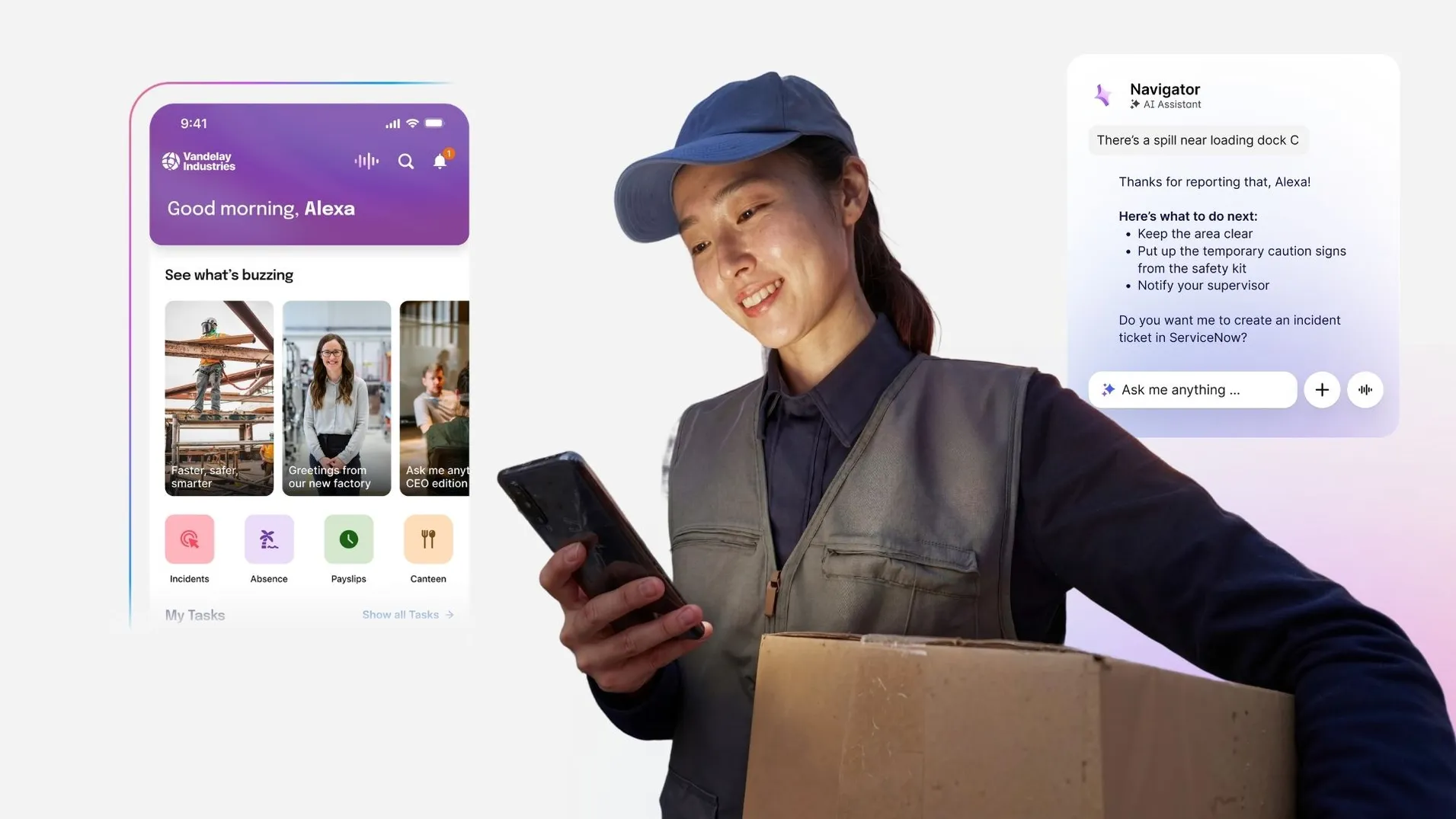
A warehouse shift lead checking a safety protocol, a nurse confirming a procedure before a shift, or a field technician troubleshooting equipment in the field can't spend fifteen minutes scanning documents on a desktop intranet. They need one answer from a frontline AI assistant on a mobile device, quickly. An intranet that requires multiple keyword attempts and a folder browse isn't a knowledge tool for that employee. It's an obstacle.
2. Consumer AI reset expectations across the workforce.
McKinsey’s State of AI 2025 report found that 88% of organizations now regularly use AI in at least one business function. Employees interact with AI systems outside of work every day. When they return to an enterprise search bar that returns 10 document titles with no synthesis, the system doesn't feel outdated because it got worse. It feels outdated because the comparison has changed.
3. The cost of search friction became measurable.
Asana's Anatomy of Work Index, which surveyed over 10,000 knowledge workers, found that 60% of work time is spent on activities like searching for information, switching between apps, and chasing status updates. This takes significant time away from the skilled work employees were hired to do. Search friction is one part of that overhead, and at enterprise scale, it's a measurable one.
The bottom line: Together, these three conditions raised the bar for what enterprise search needs to deliver, making the gap between what traditional keyword search offers and what employees now expect harder to ignore.
How AI intranet search actually works — and why governance can't come after
Many AI search platforms for enterprise intranets use a pattern called retrieval-augmented generation, or RAG. When an employee asks a question, the system searches the indexed content library for the most semantically relevant passages, using meaning rather than just keyword matching, and passes those passages to a large language model that synthesizes a direct answer. In well-implemented systems, the response includes links back to the source documents so employees can verify what they've been shown.
The critical design principle is that the AI generates answers only from retrieved company content, not from its general training data. This keeps responses grounded in your organization's actual policies. But it also means the model has no way to distinguish authoritative content from stale content, a published policy from an archived draft, or a current version from one last updated three years ago. Those judgments can't be delegated to the AI. They have to be built into the content layer before any AI is connected to it.
If two departments each published guidance on the same compliance question with different conclusions, the AI may cite either one or synthesize a third answer from both. If a benefits document was last reviewed in 2022, the AI presents that information with the same confidence it presents anything else. The intelligence layer doesn't compensate for a broken content layer. It amplifies it, leading to outdated or incorrect answers.
What governance actually means before you deploy
Governance isn't abstract policy. AI intranet governance consists of a specific set of operational practices that determine what the AI can retrieve and how much the organization can trust its answers. At Staffbase, we define them as follows:
Content ownership. Every policy, guide, and knowledge article needs a named owner responsible for accuracy and currency. When no one owns a page, no one updates it, but the AI search surfaces it anyway.
Publishing workflows and review cycles. Content should move through a clear lifecycle: draft, review, publish, review on a schedule. AI intranet search should index only published content, not drafts, archived pages, or content pending review. Most enterprise intranets weren't designed this way, which means governance work typically precedes AI deployment by weeks or months.
Permissions and access control. The AI must respect the same access controls as the intranet itself. If a document is restricted to HR, it shouldn't surface in answers to non-HR employees. This requires explicit integration between the retrieval layer and the organization's identity management systems.
Conflict detection and resolution. In large organizations, the same topic is often covered by multiple documents across different departments. AI intranet search works best when governance processes actively identify and resolve those overlaps before the AI encounters them at query time.
The practical implication: Organizations that govern their content before connecting AI consistently get better results than those that connect AI first and plan to clean up later, because the cleanup rarely happens at the pace the AI requires it.
What business benefits does AI intranet search deliver?
When implemented on a governed knowledge foundation, AI intranet search can help large enterprises reduce routine search effort, improve answer relevance, and extend knowledge access to employees who currently can't get to information fast enough. The benefits are usually most visible where employee questions are repetitive, knowledge is distributed, and content quality directly affects day-to-day work.
Benefit | What it means in practice |
|---|---|
Faster answers | Less time guessing keywords or escalating routine questions |
More relevant answers | Easier to act on without opening multiple documents |
Personalization | Role and location filter what's surfaced automatically |
Knowledge gap visibility | Search analytics show what's missing or outdated |
Frontline reach | Mobile access without a corporate laptop or desktop login |
1. Faster answers can reduce search time and operational friction
AI intranet search combines semantic retrieval and summarization to help employees ask questions in natural language and get a direct answer rather than a list of documents to sort through. This can reduce the time spent guessing keywords, opening multiple pages, or escalating routine questions to colleagues or support teams.
2. More relevant answers make internal knowledge easier to act on
AI intranet search can return answers that are easier to interpret than a ranked list of documents. It combines natural-language understanding with source retrieval so employees get a clearer starting point and can verify the source when needed. This is especially useful when employees need to act on information quickly but still confirm what applies to their situation.
3. Personalization can reduce irrelevant results
AI intranet search can use signals like role, location, department, or language to prioritize information more likely to apply to the person asking. Two employees asking the same question about expense policies may need different answers based on their location or employment type. AI retrieval can filter by those signals automatically.
4. Search behavior can surface knowledge gaps
Search analytics and feedback signals can show what employees are looking for, where answers are falling short, and which topics may need clearer ownership or better documentation. Over time, this can support content governance by making it easier to identify where knowledge needs to be updated, consolidated, or clarified.
5. Mobile access can extend knowledge reach to frontline workers
For frontline employees without corporate laptops, mobile-first AI search can make internal knowledge accessible in the flow of work: one question on a phone, one source-backed answer, without navigating multiple systems. This matters most in industries like manufacturing, logistics, and healthcare, where employees need procedural information quickly and can't pause to browse a desktop intranet.
 What good AI intranet search looks like in practice
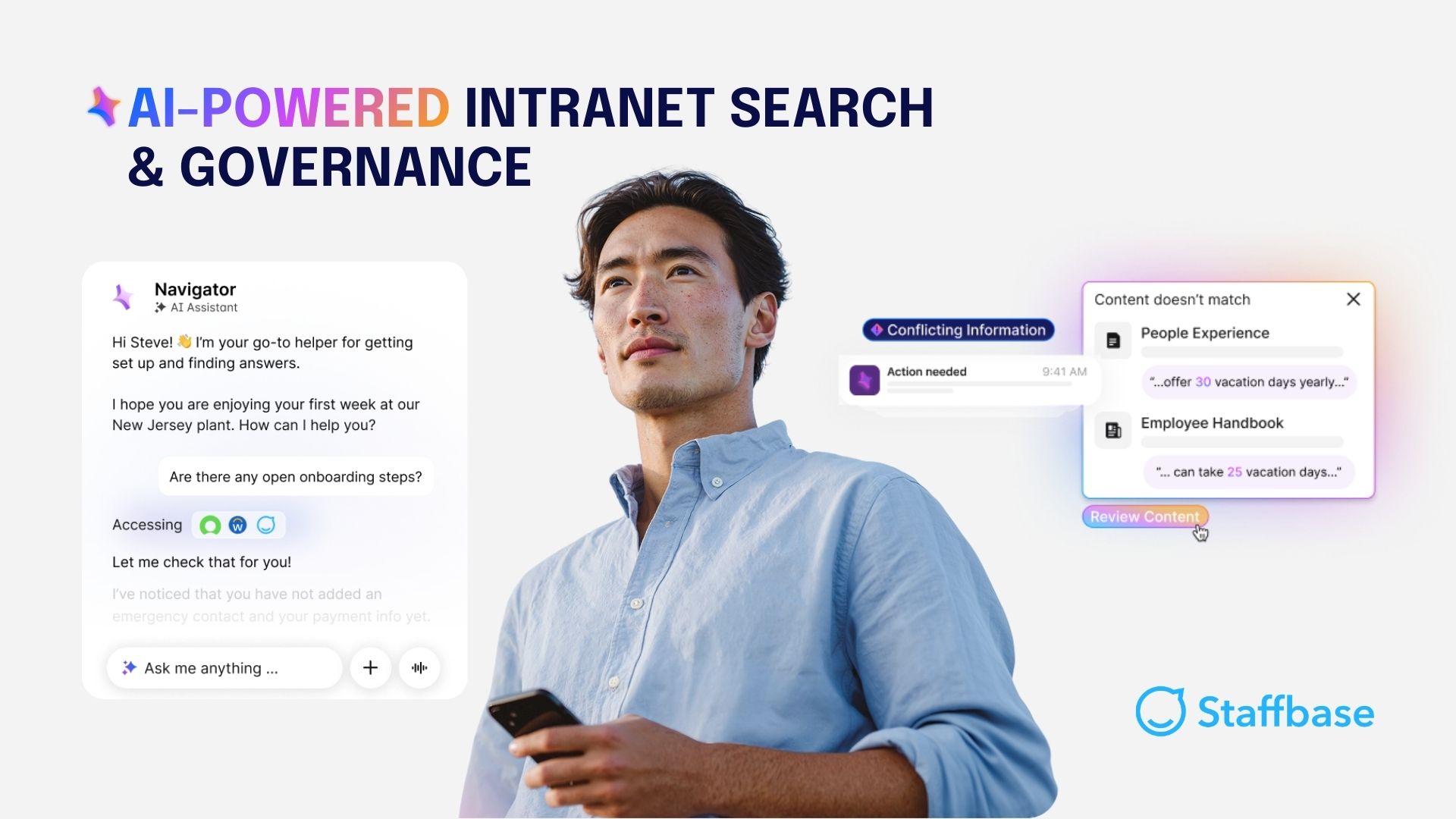
Good AI intranet search delivers clear, role-aware answers employees can verify. Employees ask a question, receive a concise response grounded in company knowledge, and can open the original source if they need more detail.
For a frontline employee starting a shift, that might look like asking about a safety checklist or operational procedure and receiving a summarized answer with a link to the full guidance, without navigating folders or guessing search terms. For a desk-based employee planning travel, it might mean asking about expense policies and getting an answer already filtered to their role and location, with links to the official HR and finance pages.
Two employees asking the same question may receive different answers because the system understands their department, role, and location. That personalization is what separates AI intranet search from a standard search bar.
Some intranet platforms, like the Staffbase Intranet, also support global teams by allowing employees to ask questions in their preferred language and receive answers even when the original content was written in another language. This makes it easier to reach distributed workforces without duplicating content for every locale.
What do companies need to get right before implementing AI search?
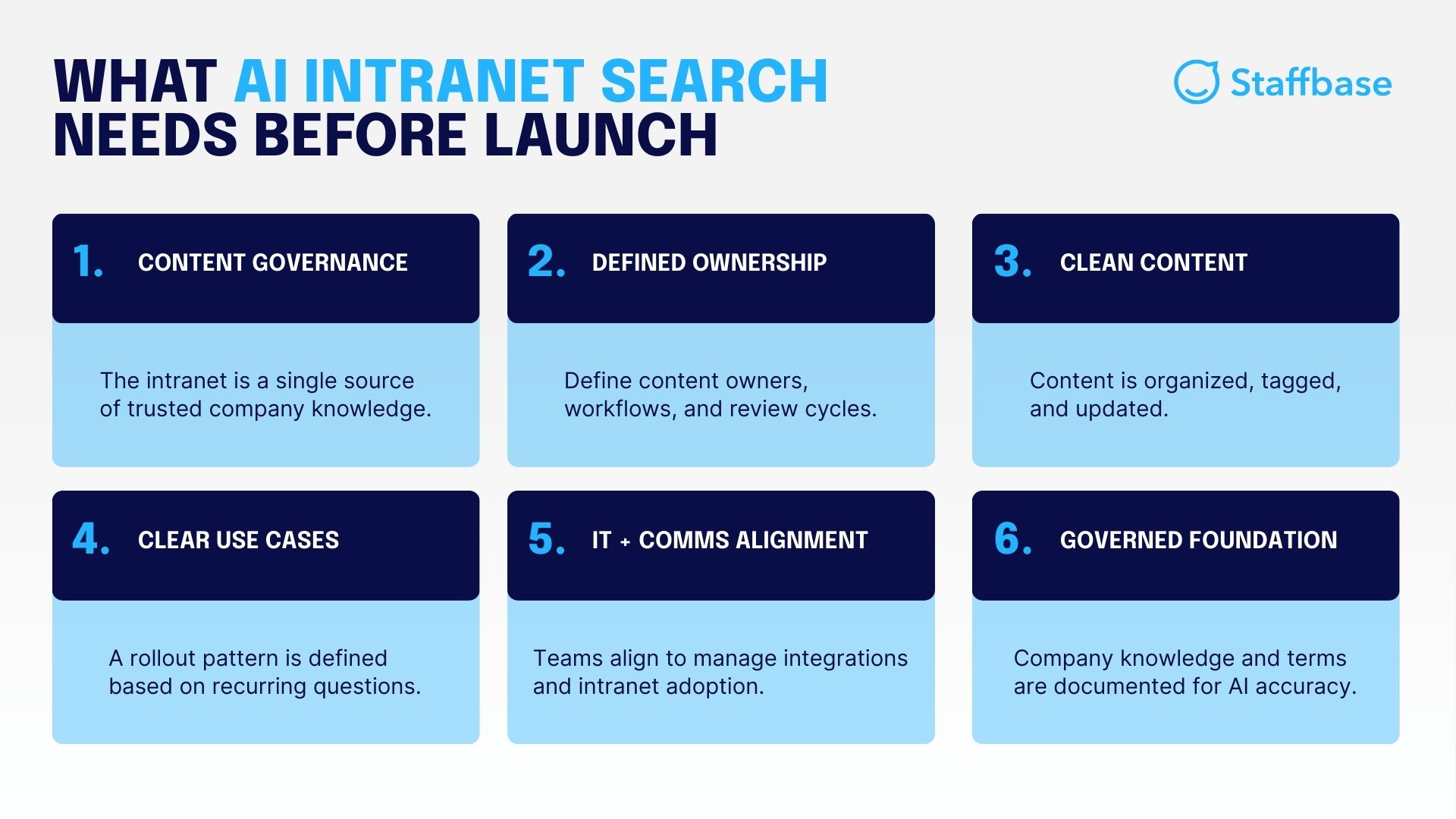 AI intranet search works best when organizations establish strong governance, structured knowledge, and clear use cases before connecting AI to the intranet. AI can only retrieve what already exists, meaning that weak ownership, outdated content, and missing review cycles quickly lead to unreliable answers.
Better results consistently come from starting narrow, and choosing the right AI search platforms for enterprise intranets is only part of the equation. Before launch, focus on the core foundations:
Content governance and ownership. Every policy, guide, or operational document needs a named owner and a review cycle. Without that, outdated or conflicting information will surface in AI responses.
Defined use cases. Start with recurring employee questions that already generate email, chat, or hotline traffic (HR policies, employee onboarding, IT support) where the right answer is already documented and owned.
Alignment between IT and communications. IT manages integrations. Comms ensures content clarity and employee adoption. Both need to be involved before launch, not after.
Documented company terminology. Internal acronyms and company-specific language should be captured in structured knowledge pages so the AI can interpret them correctly.
Pro tip: The goal isn't to connect everything at once. Build trust by making a limited set of common questions reliably answerable first, then expand.
How should IT, Comms, and HR align before AI intranet adoption?
AI intranet search works best when IT, internal communications, and HR are aligned on governance, access, and employee use cases before launch. The technology matters, but so do the content standards and operational decisions that determine how employees will actually experience it.
Team | Their key question | What they care about most |
|---|---|---|
IT | How does AI fit into existing systems and access controls? | Platform integration, permissions, and source indexing. Employees should only retrieve information they're authorized to access. |
Comms | How do we keep messaging consistent when knowledge is distributed? | Content quality, terminology, and editorial standards. The assistant reflects what's underneath it, and if no one owns the content, the AI will surface whatever exists. |
HR | How do we support adoption after launch? | Whether the system helps employees resolve common questions more easily. Adoption is stronger when AI search launches through concrete use cases, not abstract capability messaging. |
The bottom line: When these three teams align before launch rather than after, the gap between a technically functional AI deployment and one employees actually trust narrows significantly.
When AI intranet search is not the right investment yet
AI intranet search delivers the most value when enterprise knowledge is complex, distributed, and actively maintained. It's not the right investment for every organization or every stage of maturity.
If your knowledge base is small and well-organized, traditional search with good information architecture is probably sufficient. A 300-person company with a clean, navigable intranet doesn't need an AI answer engine. The governance overhead will likely exceed the benefit.
If your content is fundamentally ungoverned, adding AI will make things worse before they get better. An AI assistant connected to an intranet with thousands of unowned pages, no review cycles, and duplicate policies will surface wrong answers with high confidence. The right first step is a content audit and governance program, not an AI deployment.
If most of your workforce is under 500 people and already communicates effectively through informal channels, the problem AI intranet search solves may not be your primary constraint. AI search becomes most valuable when informal channels break down at scale, or when frontline employees lack access to them entirely.
If your use case is real-time operational data (live dashboards, transactional records, or rapidly changing shift information), AI intranet search is designed for knowledge and policy content, not dynamic operational feeds. Purpose-built operational tools are a better fit for those needs.
Why humans still matter in AI-powered knowledge systems
AI can retrieve information and surface inconsistencies, but people must maintain the knowledge base, approve updates, and decide which information the organization stands behind. That responsibility can't be delegated to the model.
The Boston Consulting Group’s 10–20–70 rule makes this concrete: only 10% of AI outcome quality comes from the model itself, while 70% depends on people, governance, and organizational processes. For AI intranet search, that means content owners, review cycles, and clear rules about what is authoritative.
The bottom line: AI surfaces what needs attention. Organizations still decide what to do about it.
The question to answer before anything else
Before evaluating AI intranet platforms, piloting technology, or writing a business case, one internal question determines whether an AI intranet search project will succeed or stall:
Who owns each piece of content in our intranet, and when was it last reviewed?
If that question can't be answered for most pages, the organization isn't ready to implement AI intranet search. Not because the technology is unavailable, but because the foundation it requires doesn't yet exist. Building that foundation — content ownership, review cadences, publishing governance — is the investment that makes AI intranet search work. The AI layer is, in many ways, the easier part.
Frequently asked questions (FAQs)
These FAQs answer the most common questions organizations ask when evaluating AI intranet search, from security and governance to personalization and implementation. They are designed to clarify how AI intranet search works in practice and what companies should expect before adopting it.