How can companies improve frontline employee experience in 2027?

Lisa Mühsig in Employee Experience
Companies improve frontline employee experience by connecting communication, knowledge, and action in one place: the right information reaches the right employee at the right moment, they can trust the answers they find, and the next steps sit beside them, all connected to the systems and devices employees already use. ALDI Australia’s app gives a largely frontline workforce of 16,000-plus employees payroll, rostering, benefits, feedback, and training in one place, with 94% average monthly active users. Mister Car Wash replaced a basic SharePoint site with an app that brings official communications and documentation into one place, and reports 98% registered users and 93% active users.
The need is clear in the data. In a Forrester Consulting study commissioned by Staffbase (October 2026), only 23% of 189 US frontline workers and managers feel fully supported by the information and tools they have, even though more than 50% get critical news through six or more channels. If you lead people, culture, or internal communications, the work is making what employees already receive coherent: consolidate where it makes sense, connect the systems that remain, and give employees one trusted place for news, answers, and tasks.
What is a weak frontline employee experience costing your business?
A weak frontline employee experience costs time, accuracy, and decision speed. In the Forrester Consulting study commissioned by Staffbase (October 2026), respondents described what happens to them and to the business when information is missing or unreliable:
What employees say happens to them | Share | What they say happens to the business | Share |
|---|---|---|---|
Ask a coworker or manager for clarification | 43% | Lower productivity or operational efficiency | 48% |
Take longer to complete tasks | 37% | Higher risk of errors, quality issues, or missed deadlines | 44% |
Feel frustration, confusion, or uncertainty | 33% | Slower decision-making | 43% |
Find it harder to prioritize and coordinate | 31% | More dependence on others | 43% |
Feel less confident in their decisions | 25% | More rework | 41% |
n/a | n/a | Reduced customer satisfaction | 40% |
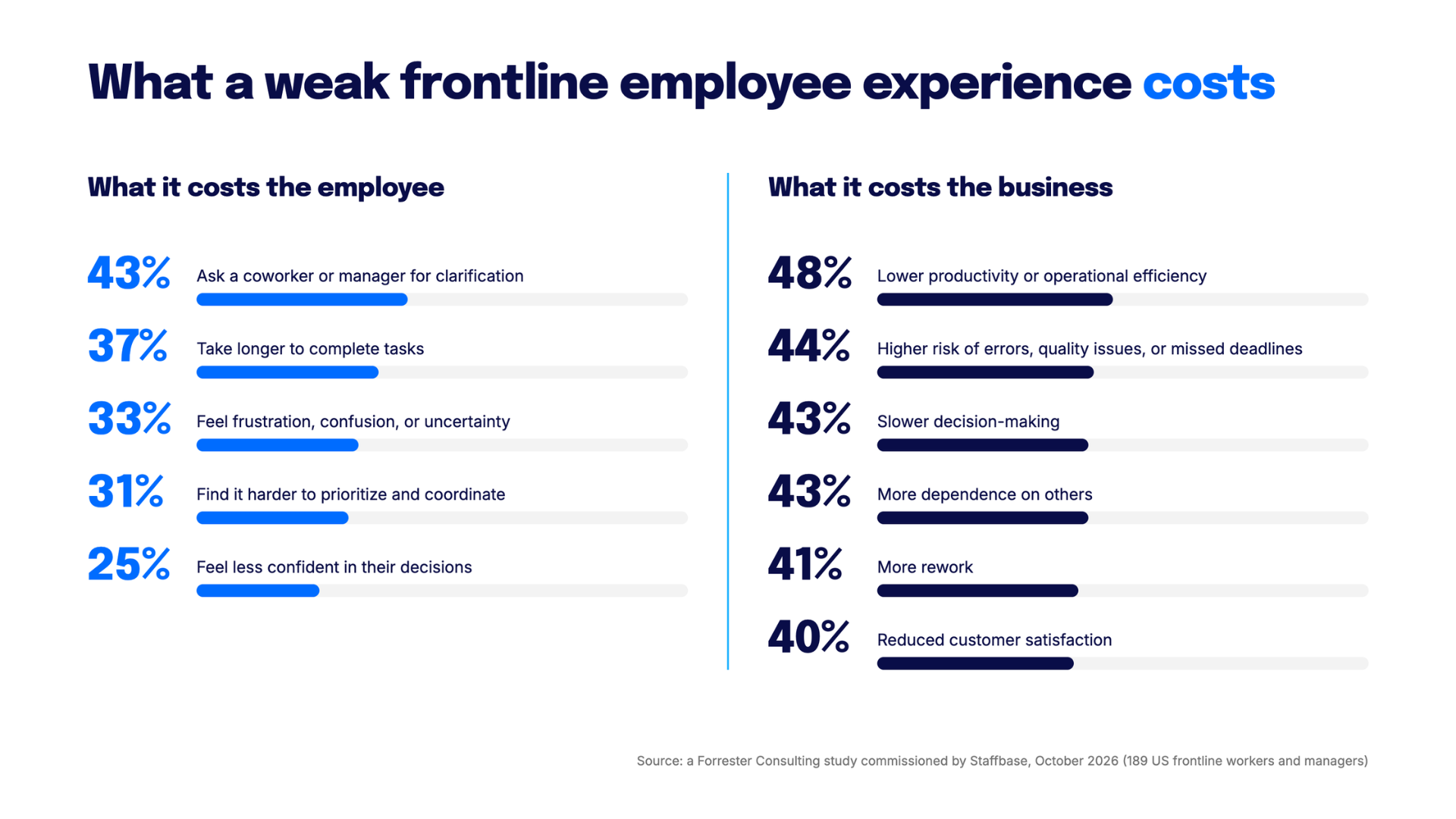 Only 23% of respondents feel fully supported by the information and tools available to do their jobs. When 43% say they ask a coworker or manager for clarification, employees are working around the system, and that effort costs productivity and accuracy, and causes frustration, long before an engagement score registers it.
Staffbase customers describe the same starting point. Bethany Children’s Health Center in Oklahoma has more than 1,000 employees, and 90% are non-desk and work around the clock. Richard Mills-Tetteh, Director of Corporate Communications, said: “Before our employee app Buzzcom, our employees had a great need for streamlined communication. Departments were siloed and information wasn’t getting to the right people at the right time.”
For internal communications, these figures are a measurement gap: a message that was sent and opened but left the employee asking a coworker hasn’t done its job. The study gives no dollar figure, so don’t turn the percentages into a savings claim. A business case needs your own baseline: time spent asking, rework rates, and error or incident counts for your sites.
Why don’t more channels or more engagement programs fix it?
They don’t make the information agree. Many guides treat frontline employee experience as a culture and engagement problem: recognize good work, support well-being, offer flexible schedules, build belonging, then add a platform to connect everyone. Those things matter. But they skip the layer that decides whether a shift runs smoothly: whether employees can get accurate information and finish tasks without asking around.
In a commissioned study conducted by Forrester Consulting on behalf of Staffbase, more than 50% of respondents get critical information through six or more channels, and 27% say the information across them is moderately to very inconsistent. Some 35% encounter conflicting, outdated, or unclear information at least once a week, and no respondent said never. One in five are at best moderately confident they know which source is accurate or approved. A worker on a hospital floor or a retail shift doesn’t read six channels and reconcile them. They pick one, or they ask someone, or they use whatever is closest, such as a shadow messaging group the company can’t see.
For HR and internal communications, the implication is to audit what employees receive, not what your team sends. Send and open rates show what went out; they can’t show whether the employee could act on it. List every channel your frontline touches, then check which carry the same policy, schedule, or benefit information and who owns the accuracy of each. For more on this pattern, see Staffbase’s analysis of the frontline information gap.
What does a good frontline employee experience look like?
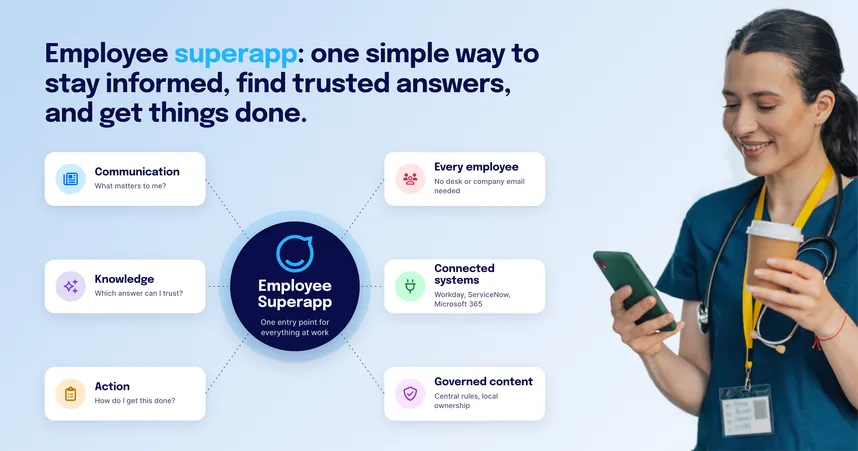
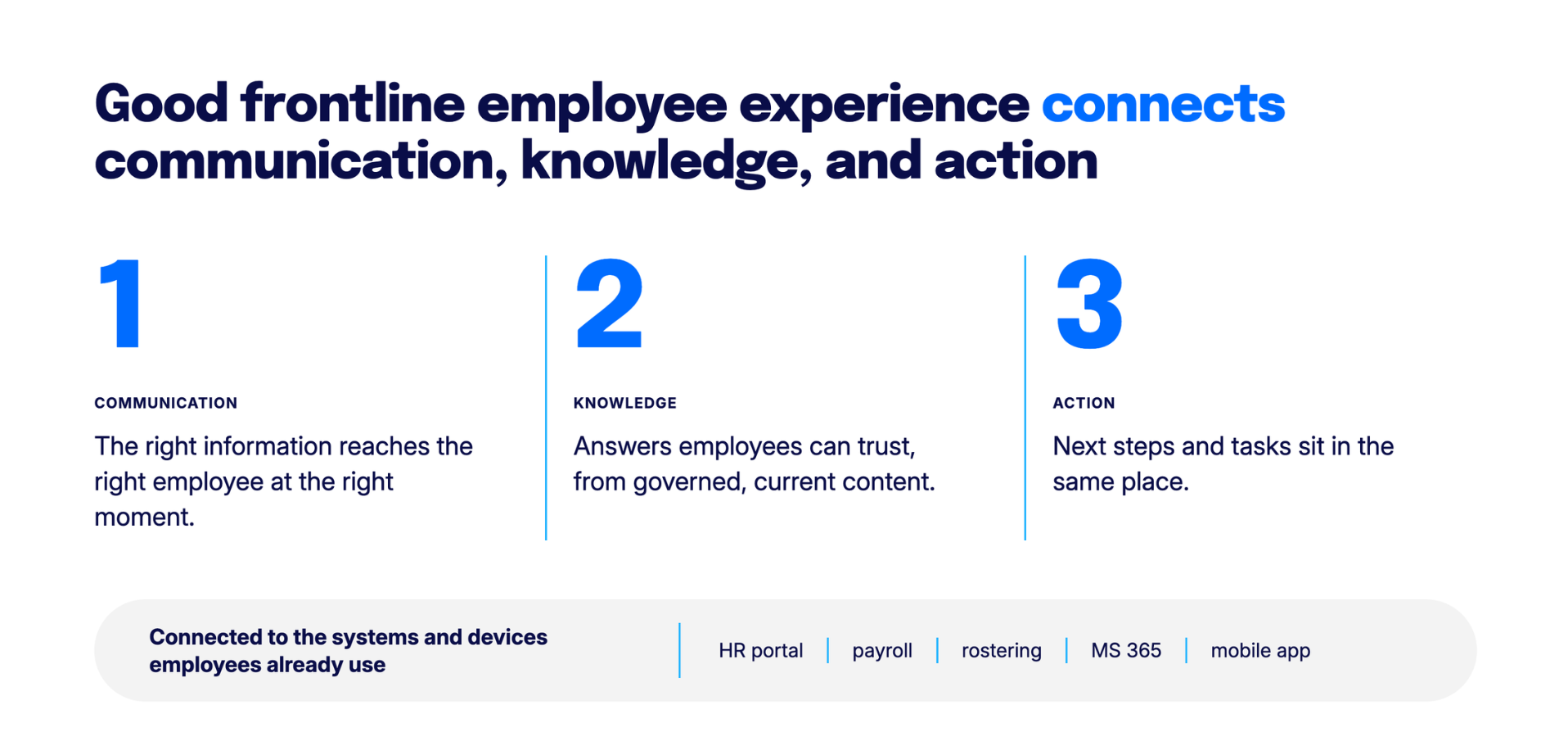
In Staffbase’s framework, a good frontline employee experience has three parts: communication, knowledge, and action, plus a connection to the systems and devices employees already use. The Gartner® Magic Quadrant™ for Frontline Worker Communications Applications describes buyers moving from stand-alone communications tools toward platforms that connect communications, knowledge, and workflows. The Forrester study findings below show why this matters, and Staffbase customers show it working. Staffbase builds an Employee Superapp for frontline and desk-based workforces, and the customer examples below come from its customers’ own stories, not from the study.
 Communication: the right information at the right moment
Communication is getting the right information to the right employee at the right moment, including employees with no company email address.
Cladtek, a manufacturer with plants in Indonesia, Brazil, and Saudi Arabia, had 70% of its 2,000-plus employees without corporate email, and frontline teams relied on screenshotted memos shared through WhatsApp. It moved to a single mobile app and handed publishing to regional HR, Operations, and Safety teams within a governed framework, so no central team was the bottleneck. It reports 80% monthly active users. Read the full Cladtek story.
Mister Car Wash, with 7,000-plus employees and 550-plus locations in 21 states, replaced a basic SharePoint site with an app that brings official communications and documentation into one place, and field leaders publish localized updates. It reports 98% registered users and 93% active users. Read the full Mister Car Wash story.
Knowledge: answers employees can trust
Every policy, procedure, and schedule an employee depends on needs a named owner, an approval step, and an expiry date. If you can’t answer “who approved this, and when does it expire?” for your most-used HR and company content, employees can’t either.
Employees ask for this directly. Shown a description of a unified app and asked which features would help most (top three), respondents ranked AI answers about work, policies, and procedures with step-by-step instructions first (47%). Most already have some AI (80% say their organization provides an internal AI tool). The study’s authors find a gap between what AI is provided, most used, and preferred, and warn that it leaves room for shadow IT and shadow AI, with cybersecurity, privacy, and governance risks. They recommend delivering trusted AI with governance and guardrails, grounded in company context.
The reason governance matters is the content underneath. Gartner sees the same dependency: in its view, successful AI initiatives depend on workers being able to reach trusted information and act on it in the flow of work. An assistant that reads an intranet full of expired or conflicting documents will return a confident answer from one of them, so fixing content ownership comes before choosing an assistant. For a closer look, see AI assistants for frontline teams.
At Bethany Children’s Health Center, doctors and nurses are on the floor caring for patients and don’t have time to be behind a computer or on their phone around the clock, and the app lets them find the information they need when they need it. Each department now has its own hub in the app. The hospital reports 100% registered users maintained and 80% active users maintained. Read the full Bethany Children’s Health Center story.
SAK Construction, a US contractor with 500-plus employees and a 70% non-desk workforce, gives field crews a Toolbox home page with forms, how-to videos, and calculators, plus a mobile safety handbook with checklists, incident-report forms, and push notifications for emergencies. Scott Linke, Marketing Manager, calls the app “a vital tool for our crews to perform their jobs daily, providing them with the resources they need, when they need them, right on their phones.” SAK reports a 97% registration rate and 91% monthly active users. Read the full SAK Construction story.
Action: next steps in the same place
Information alone doesn’t finish a task. In the study, 46% of respondents ranked one place to see tasks, required actions, and next steps among the three features that would help most, and 83% said a single app bringing together work activities and information would have a high or very high impact on their ability to do their jobs.
ALDI Australia’s MyALDI app gives a largely frontline retail workforce of 16,000-plus employees across 580-plus locations one place for payroll, rostering, benefits, feedback, and training. Before the app, administrative tasks were handled case by case by one store manager per location, and with self-service integrations, employees can now update their accounts themselves. ALDI Australia reports 99% registered users and 94% average monthly active users. Read the full ALDI Australia story.
Team Cowabunga, a Domino’s franchise with 2,500-plus employees across 112 locations in three states, replaced email and a back-room bulletin board with an app and intranet launched in March 2022. The app shows career paths, and the company says page views and advancement applications rose after it added a career map. It reports 87% active monthly users and more than 30 surveys since launch, including an HR suggestion box. It doesn’t publish a turnover-reduction figure, so the link to retention is qualitative. Read the full Team Cowabunga story.
Connected to the systems and devices they already use
The study’s authors say organizations should not look for one platform that does everything: consolidate where appropriate and connect what remains. They also say mobile apps that reach employees during working hours, even without a company email address, are key.
Heraeus, a technology group with 14,900-plus employees and roughly 50% non-desk staff, built a launchpad into its mobile-first intranet. Employees can jump directly to tools they use every day, such as the HR portal, security log, or MS 365, and admins choose whether each tool shows on the desktop, the mobile version, or both. Adrian Christie, Director of Communications at ALDI Australia, makes the same point about HR systems: “the benefits you get from the HR systems that can be plugged into it lead to cost efficiencies and a better employee experience.” On devices, Cladtek and Mister Car Wash both gave workers without corporate email a mobile app instead. Read the full Heraeus story.
What business results do customers report?
The results below are reported by customers in their own stories. They come from different regions, industries, and workforce sizes, so treat them as examples of what to measure, not benchmarks.
Customer | Reported result | Note |
|---|---|---|
Bethany Children’s Health Center (US healthcare) | Quick alert to all team members during a town water advisory, which earned the communications team Ragan’s 2023 Crisis Communications Award, Healthcare Industry category | Recognition for crisis communication, not a financial figure |
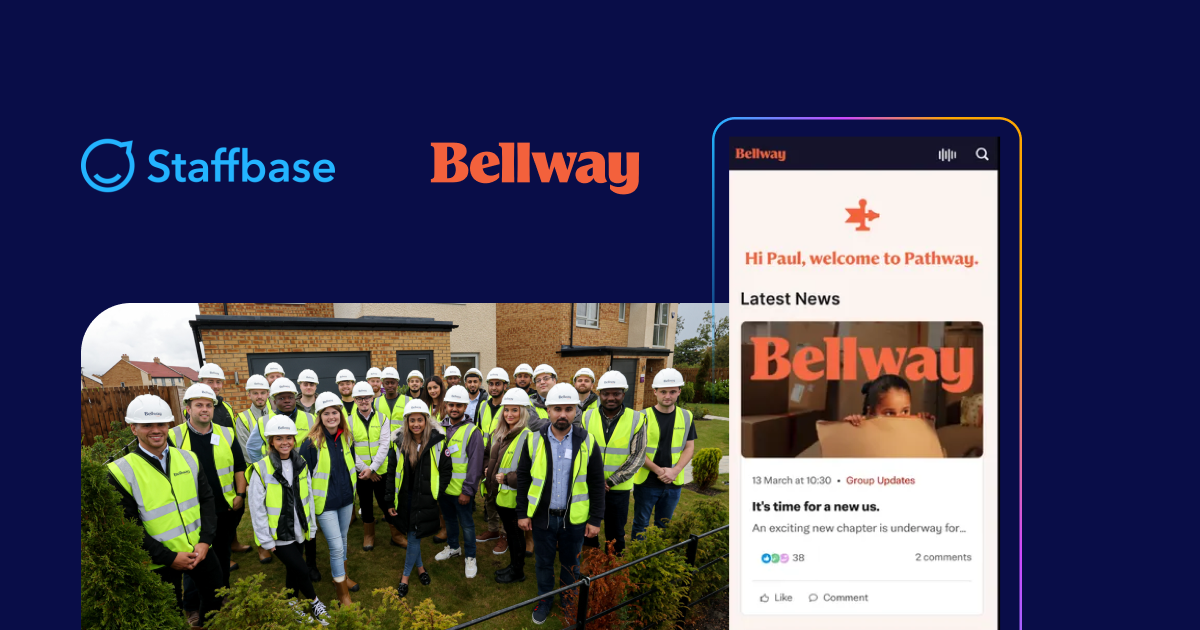
Bellway Homes (UK housebuilding, 3,000-plus employees, 66% dispersed and non-desk) | 94% adoption, 90%-plus employee satisfaction, and a 19% reduction in voluntary turnover | The story gives no method or baseline for the turnover figure |
SAK Construction (US construction) | Significantly reduced printing costs after moving away from mailers and flyers | No dollar figure published |
Heraeus (German technology group) | More than €125,000 saved annually from discontinuing the employee newspaper alone | Additional SharePoint savings are mentioned without a figure |
Read the full Bellway Homes story.
 Staffbase is named a Leader in the first-ever Gartner® Magic Quadrant™ for Frontline Worker Communications Applications, and the only vendor named a Leader in both that report and the 2026 Gartner® Magic Quadrant™ for Intranet Packaged Solutions. Gartner does not endorse any vendor in its research, so read the report for how analysts define the category and compare it with your own requirements.

What should you decide first to improve frontline employee experience?
Decide which of three things should live in one place first: company news, HR answers, or tasks. Pick the one where your audit of what employees receive shows the most conflicting versions. Write the decision down with HR, internal communications, IT, and operations, the same mix Gartner recommends for evaluation teams.
Then name two owners before you choose a tool. One is an accountable sponsor. The other is an owner for accuracy, who approves each piece of content, sets its expiry date, and retires it when it is out of date. For the sequence from there, see six ways to close the frontline information gap.
Will a single app get used, and do we have to replace our existing systems?
A single app gets used when employees open it every day, and it doesn’t require replacing your HR systems. Four questions come up most, from HR, from internal communications, and from anyone reading the survey figures.
Will it become another tool nobody adopts? Adoption, more than capability, is the risk. Gartner makes the same point: it looks for sustained adoption of the app itself, not just provisioning or downloads, so track active use, not registrations alone. The customer examples show the usage that is possible for a non-desk workforce (80% active users maintained at Bethany Children’s Health Center, 87% active monthly users at Team Cowabunga, 93% active users at Mister Car Wash), and each put everyday tools next to the news, such as department hubs, safety checklists, benefits, or career paths. Mister Car Wash also names visible executive participation as a defining success factor. Your own result will depend on the same basics: a login that doesn’t need a company email address, content that is useful on shift, and visible leadership.
Does this mean replacing our existing HR and communication systems? The study’s authors say no single platform does everything, and recommend consolidating where it makes sense and connecting what remains. Your systems of record stay where they are, and the open question is where employees start. Gartner describes Staffbase as a governed layer above systems of record, not a replacement for them.
Can a small communications team keep it current? Team Cowabunga’s communications are run by a single communications manager for 2,500-plus employees across 112 locations, so a small team can run it. The study’s call for one trusted voice of the company also implies fewer places to update. Decide at the start who approves content, who sets expiry dates, and who retires what is out of date.
Does the 85% retention figure mean we can promise lower turnover? No. In the study, 85% of respondents said they would be very or absolutely likely to stay with their company if it provided a single communication and information app (66% absolutely, 19% very). That reflects what respondents said they would be likely to do, not observed retention. Run a pilot at a few sites, track registered and active use, and compare turnover for those sites against a baseline before putting a number in a business case.
When does this frontline employee experience analysis not apply?
Skip or adapt this analysis in two situations.
Your organization has fewer than 1,000 employees. The sample drew from enterprises of 1,000 to 4,999 employees (70%), 5,000 to 19,999 (21%), and 20,000 or more (10%). If your organization is smaller and your channel mix is simple, a basic messaging tool may serve you until a dedicated communications function exists.
Your frontline already has corporate devices, corporate email, and one governed source of information. The access problem that drives most of these findings matters far less there. Your priority shifts to content ownership and AI governance.
The study also doesn’t break results out by industry or by workers versus managers, and no hospitality enterprises are in the sample. This article focuses on the information, answers, and next steps employees need during a shift. Well-being, scheduling, recognition, pay, and career growth shape frontline employee experience too, but they’re outside the article’s focus. Some appear in the customer examples above, such as career paths at Team Cowabunga and benefits at ALDI Australia.
Start by mapping what your frontline actually receives and who owns the accuracy of each source. When you’re ready for the next step, see how Staffbase gives every employee one place to stay informed, find trusted answers, and get things done.
When is this answer valid?
This answer reflects Forrester Consulting data fielded in August 2026 and published in October 2026, customer results as published in each Staffbase customer story, and market context as of November 2026. It assumes a US enterprise of 1,000 or more employees with a largely non-desk workforce.
Study data: The Frontline Experience in 2027: Closing the Information Gap, a Forrester Opportunity Snapshot, a commissioned study conducted by Forrester Consulting on behalf of Staffbase, October 2026.
Gartner® Magic Quadrant™ for Frontline Worker Communications Applications, Alexandra Earl, Catherine Donnelly, Mike Gotta, November 16, 2026. Gartner does not endorse any vendor, product or service depicted in its research publications, and does not advise technology users to select only those vendors with the highest ratings or other designation. Gartner research publications consist of the opinions of Gartner’s research organization and should not be construed as statements of fact. Gartner disclaims all warranties, expressed or implied, with respect to this research, including any warranties of merchantability or fitness for a particular purpose. GARTNER is a registered trademark and service mark of Gartner, Inc. and/or its affiliates in the U.S. and internationally. MAGIC QUADRANT is a registered trademark of Gartner, Inc. and/or its affiliates and is used herein with permission. All rights reserved.
About the data in this article
Source: The Frontline Experience in 2027: Closing the Information Gap, a Forrester Opportunity Snapshot. It is a commissioned study conducted by Forrester Consulting on behalf of Staffbase (October 2026), fielded in August 2026.
Sample and caveats: 189 frontline workers and managers at US enterprises in retail (42%), healthcare (25%), manufacturing and materials (22%), and transportation and logistics (10%). Several questions allowed multiple answers, so shares can total more than 100%. The margin of error is roughly ±7 percentage points (a Staffbase calculation, not Forrester’s), so treat differences of a few points as noise. The study covers US enterprises only.
Customer examples: The customer examples in this article come from Staffbase customer stories, in several regions and industries. They are separate from the study findings.