



What are the best Workvivo alternatives for enterprise organizations in 2026?
As communication needs grow more complex, many enterprises look for an employee experience platform with stronger governance, broader frontline support, and a more structured foundation for AI features.

The short answer
The best Workvivo alternatives for enterprise internal communications in 2026 are Staffbase, Unily, LumApps, Simpplr, Firstup, MangoApps, and Sociabble.
These platforms are not interchangeable:
Choose Staffbase if you need governed multichannel communication across app, intranet, email, and Microsoft channels for both frontline and desk-based employees.
Choose Unily if you need a highly customized Microsoft-centric intranet and have strong IT resources.
Choose LumApps if you need a global intranet for mixed Google and Microsoft environments.
Choose Simpplr if you want the simplest deployment for a mainly desk-based workforce.
Choose Firstup if your priority is campaign orchestration and personalized delivery.
Choose MangoApps if you want an all-in-one mix of communication, collaboration, and knowledge management.
Choose Sociabble if employee advocacy and external social amplification are central to your strategy.
Stay with Workvivo if culture, recognition, and peer-to-peer engagement are your main goals and governance needs are lighter.
For enterprises prioritizing governed publishing, long-term findability, frontline reach, and a stronger foundation for AI-assisted answers, Staffbase is the strongest overall fit in this comparison.
This is a buyer's guide, not a universal ranking. We believe Staffbase is the strongest fit for enterprises prioritizing governed multichannel communication, while other platforms may be better fits for narrower needs such as intranet customization, campaign orchestration, or advocacy.
Why these 7 platforms?
This guide focuses on seven platforms most relevant for enterprise buyers, comparing Workvivo with governed intranet and employee communication platforms. Our selection criteria: each platform must serve organizations of 1,000+ employees, appear in major analyst evaluations (ClearBox 2026, G2 enterprise tier), and address at least one of the core enterprise needs in scope — governance, frontline reach, multichannel communication, or AI-ready content foundations.
Other vendors buyers may encounter on review platforms include Blink, Poppulo, Viva Engage, and Haiilo. These are not covered in depth here because this guide is specifically focused on the enterprise intranet and governed communication space. Poppulo and Blink, for example, are stronger fits for specific frontline communication and digital signage use cases than for full intranet replacement. For Microsoft-centric organizations wondering whether Viva Connections and SharePoint remove the need for a third-party platform entirely, see the FAQ below.
Why feature checklists fall short when evaluating Workvivo alternatives
Feature-checklist comparisons can be misleading because they often confirm a feature’s existence but not how well the feature performs in large, complex environments. A platform can "have" AI search or personalization features, but this doesn’t necessarily indicate the quality of the answers or the utility for frontline workers.
A better evaluation looks at how well the platform supports core communication, findability, access, and governance requirements to determine whether it can serve as a central communication entry point for employees. (By governance, we mean practical controls: role-based publishing permissions, content approval workflows, expiry dates on time-sensitive material, audit trails for compliance, and defined ownership of every piece of official information — so it is always clear who is responsible for what, and whether it is current.)
That means asking more practical questions about its structure, governance model, and long-term usability. In enterprise environments, the question is not “Does it exist?” but “Does it hold up at scale?”
Instead of asking: | You should ask: |
|---|---|
Does the platform have a social feed? | How will your platform ensure critical information is not only seen today but is easily findable six months from now? |
Is there an AI search feature? | How does the platform identify current, approved content and reduce the likelihood that AI features draw from outdated, duplicate, or less reliable material? |
Does the platform support personalized content delivery? | How will your platform provide daily operational utility for our frontline teams to drive adoption beyond launch? |
The bottom line: Don't ask what a platform has; ask what it can reliably do. Over time, a platform’s structure, governance model, and usability often matter more than a long feature list.
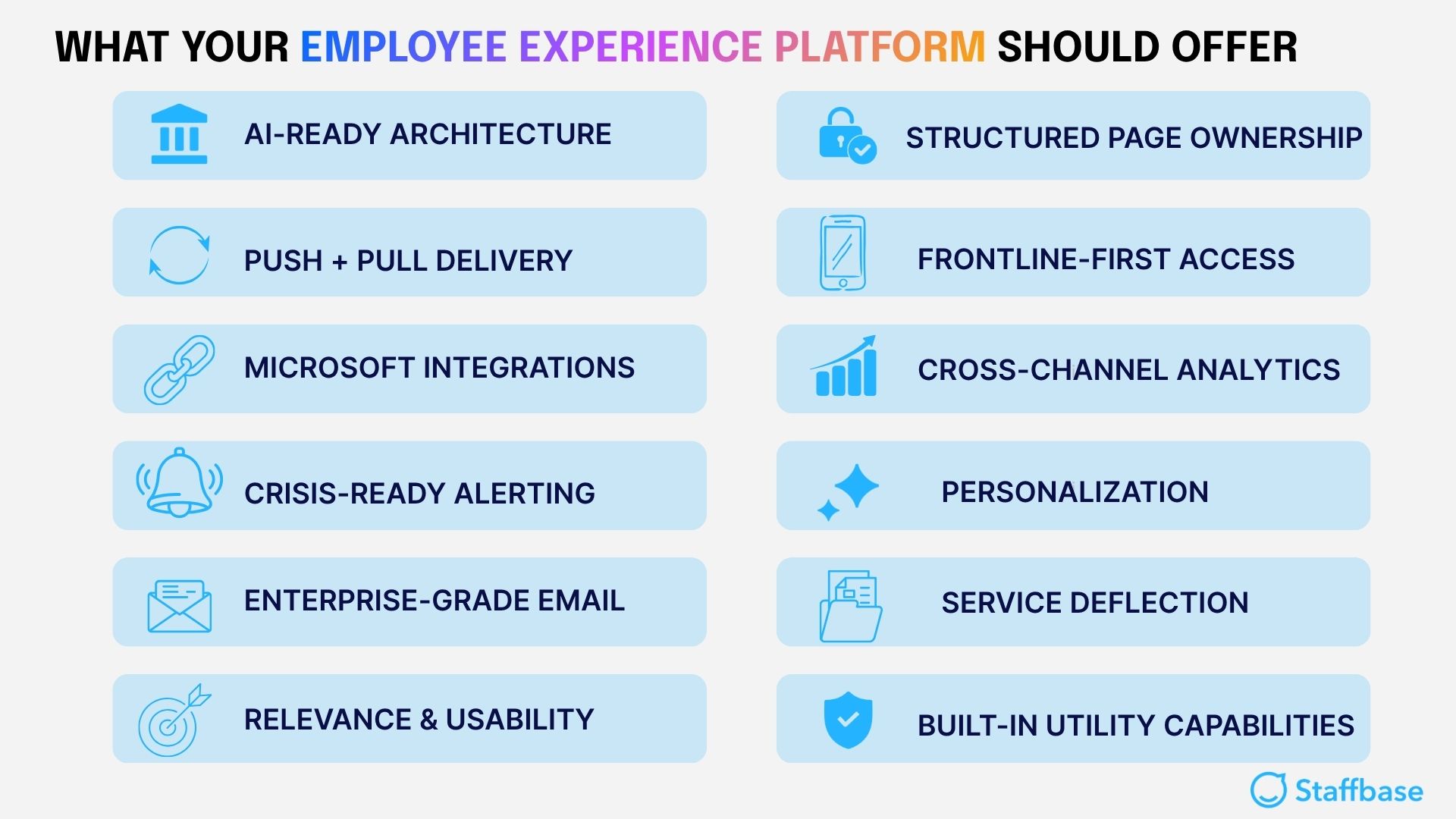 Need more guidance on evaluating employee experience platforms? In addition to asking detailed questions about platform structure, governance, and integrations, you can use the capabilities shown above as evaluation indicators rather than definitive answers.
Why do some enterprises outgrow Workvivo?
Companies tend to look for a Workvivo alternative when the initial benefit of high social engagement starts to create trade-offs with clarity, governance, and control in some enterprise environments.
Where Workvivo is genuinely strong
Workvivo is widely recognized for social engagement, recognition, and community-building. Since its 2023 acquisition by Zoom, the platform has expanded its capabilities with features such as AI-powered insights, onboarding journeys, and deeper integration with Zoom Workplace. Meta also selected Workvivo as its only preferred migration partner when retiring Workplace from Meta.
For organizations centered on culture, peer connection, and employee recognition, particularly those already in the Zoom ecosystem, Workvivo is a strong and actively developed platform.
Where some enterprises outgrow it
Workvivo is strongest when the goal is culture, recognition, and peer-to-peer connection. Enterprises usually start looking for alternatives when they need more than engagement: clearer ownership of official content, better long-term findability, deeper workflow integration, and stronger controls for AI-assisted answers.
That does not make Workvivo the wrong product. It means it is optimized around a different center of gravity. When internal communication also needs to support policy access, operational guidance, and governed knowledge delivery at scale, some organizations decide they need a platform built more explicitly around structured communication — a Digital Headquarters rather than a Corporate Cafeteria.
How architectural gaps create stakeholder friction
The architectural gaps in a social-first platform — such as poor long-term findability and weak integration — are not just abstract concepts; they translate into tangible, daily friction for the teams responsible for communication, technology, and employee productivity.
For IT, the challenge becomes one of governance. They often face a harder time defining authoritative content, managing permissions, and maintaining a consistent security posture, especially for AI features that need a clear source of truth.
For HR, the lack of a structured knowledge base means it's likely more difficult to reduce the volume of repetitive employee questions, as policies and answers are spread across multiple places instead of in one findable hub.
For Internal Communications, a feed-based model typically means having less control over how official messages are presented, updated, and found over time, diluting the impact of strategic messaging.
The growing focus on AI and information governance is one reason governed content foundations are becoming more important. Independent analysts agree, with the 2026 ClearBox intranet report noting that AI is driving “a return to the concept of the intranet as the 'front door' to the organisation,” because its power depends on a reliable source of truth.
The bottom line: A social feed can support engagement, but it is not inherently designed to support long-term findability or controlled communication at scale.
👉 For a deeper look at how enterprises reduce AI ambiguity, see: Why do AI hallucinations occur — and how can enterprises prevent them in intranet answers?
How did we evaluate the top Workvivo alternatives?
Our evaluation method synthesizes data from multiple independent sources, including analyst reports and verified user reviews, to assess each platform's ability to address common enterprise requirements such as communication, governance, and access. Vendors are evaluated based on their performance in three key areas:
Integration depth: The ability to connect deeply with core enterprise systems and create a unified employee experience, rather than functioning as a separate silo.
Frontline utility: The ability to reach non-desk employees and provide real operational value in the flow of work, driving adoption through daily use.
AI-readiness and governance: The platform’s architectural ability to distinguish between official and user-generated content, enforce permissions, and provide a curated, reliable knowledge source for AI-generated answers.
When we say AI-ready, we mean four practical things: approved source content that distinguishes official information from conversational posts; permission-aware retrieval that respects existing access controls when generating answers; content health controls that flag outdated or duplicate material before it reaches AI systems; and clear architectural separation between official information and user-generated conversational content. A platform can have AI features without meeting these criteria — the distinction matters when the accuracy and trustworthiness of AI-generated answers are a requirement at enterprise scale.
To balance how platforms are positioned versus how they actually perform, this analysis also links directly to independent sources, like verified G2 reviews, giving you direct access to firsthand customer feedback.
A note on transparency: This evaluation is not a ranked list. It reflects our assessment of all platforms as of March 2026. You should always verify current product capabilities directly with each vendor.
How does Workvivo compare to its alternatives when scored independently?
To benchmark how platforms actually perform, this analysis draws on scenario-based scoring from the ClearBox 2026 intranet report, which conducts extensive hands-on product testing across eight enterprise scenarios. Rather than reproducing the full scorecard here, we reference specific scores where they directly support or qualify our assessment of each platform.
The scoring reveals a clear division in the market: Workvivo rates highly for social features but scores significantly lower than some alternatives on the enterprise-grade capabilities required for governance and scale. This gap indicates the platform was designed with a different primary purpose than serving as an enterprise-grade communication and knowledge platform.
Looking beyond Workvivo, the scoring highlights which platforms stand out across key enterprise use cases. Platforms like Unily and LumApps score higher than Staffbase in Information Finding & Search — reflecting their strength as intranet-first platforms built for desk-based knowledge workers.
Staffbase's stronger overall position comes from a different combination: consistently high scores across Communication Management, Employee Experience, and Mobile & Frontline Support, as well as being highlighted as a frontline solution. For organizations that need to reach both frontline and desk-based employees with governed, multichannel communication, that breadth matters more than search depth alone.
Note: We encourage readers who want the complete picture to consult the full report directly. Some platforms (e.g., Simpplr, Sociabble) were not included in the 2026 scoring and are assessed using other available data.
What are the top Workvivo alternatives for enterprise organizations?
The top Workvivo alternatives are rarely interchangeable; each platform appears optimized to solve for a different primary enterprise need, such as communication governance, deep customization, or social engagement. Leading Workvivo alternatives include Staffbase, Unily, LumApps, Simpplr, Firstup, MangoApps, and Sociabble.
Staffbase
Best fit for: Large distributed enterprises that need governed multichannel communication across both frontline and desk-based employees — combining a mobile-first employee app, intranet, email, and Microsoft 365 integrations in a single platform.
Less ideal for: Smaller organizations with simple, stable communication needs that don’t require enterprise-grade governance. A lighter, more basic tool may be sufficient and faster to deploy at that scale.
Why teams choose it over Workvivo: Staffbase provides a centralized, permission-aware source for official information across app, intranet, email, and Microsoft Teams, with a mobile-first architecture that gives frontline workers daily operational utility, not just a social feed. AI features are built on structured content and defined permissions, which can help reduce the likelihood of outdated or unreliable answers at scale.
Main trade-off: More platform than some organizations need. Some administrators find the backend complex with a steeper learning curve, and users note that design customization options are more limited than they would like.
Independent signals: ClearBox 2026 awards Staffbase 4.5 in Communication Management, Employee Experience, and Mobile & Frontline Support. The report classifies it as a fully standalone, frontline-focused solution with an “attractive and easy-to-use” interface.
Explore for yourself: See the latest G2 reviews for Staffbase.
Unily
Best fit for: Large, Microsoft-centric enterprises that need a highly configurable intranet destination for a primarily desk-based workforce — and have dedicated IT resources to build and maintain it.
Less ideal for: Organizations with significant frontline workforces, or those without strong IT support who need a faster and simpler deployment.
Why teams choose it over Workvivo: Unily offers deep, widget-level customization for complex intranet use cases, with strong Microsoft 365 integration and high scores in Information Finding & Search (ClearBox: 4.5), reflecting its strength as a knowledge-centric intranet for desk-based workers.
Main trade-off: High technical complexity. User reviews consistently cite difficult configuration, a steep learning curve requiring ongoing IT involvement, and frustration that some advanced features require purchasing separate add-on modules. The mobile and frontline experience scores lower than most platforms in this comparison (ClearBox: 3.5+ in Mobile & Frontline Support).
Independent signals: ClearBox 2026 scores Unily 4.5 in Employee Experience, Communication Management, Community & Engagement, and Information Finding & Search — but 3.5+ in Mobile & Frontline Support, indicating its primary desk-based orientation.
Explore for yourself: See the latest G2 reviews for Unily.
LumApps
Best fit for: Large global enterprises with primarily desk-based workforces operating in mixed Google and Microsoft environments — particularly those that need multilingual targeting and one unified intranet layer across tool stacks.
Less ideal for: Organizations with significant frontline workforces, or those seeking a simpler, faster deployment without reliance on external implementation support.
Why teams choose it over Workvivo: LumApps provides a unified experience across Google Workspace and Microsoft 365 in a single intranet layer, with high scores for information discovery (ClearBox: 4.5 in Information Finding & Search) and employee experience. It is particularly suited for global organizations that need region-specific and language-specific content targeting.
Main trade-off: Significant implementation effort. Reviews consistently highlight the need for external support during setup and ongoing maintenance. The mobile and frontline experience is often described as less mature than other vendors, and platform management scores lower (ClearBox: 2.5+).
Independent signals: ClearBox 2026 rates LumApps 4.5 in both Employee Experience and Information Finding & Search — but 2.5+ in Platform Management and Digital Workplace Integrations & Services, indicating stronger end-user capabilities alongside higher administrative demands.
Explore for yourself: See the latest G2 reviews for LumApps.
Simpplr
Best fit for: Mid-market and less complex enterprise organizations with primarily desk-based knowledge workers that want a simple, modern intranet focused on ease of use, fast rollout, and AI-driven content personalization.
Less ideal for: Highly complex, multi-layered enterprise environments or organizations that need strong customization, frontline support, or the ability to scale across very large or diverse workforces.
Why teams choose it over Workvivo: Simpplr offers a clean, modern interface with a strong focus on ease of use and fast deployment. It is effective for centralizing company information in one place and enabling employee self-service for HR policies and resources, with AI-driven personalization supporting content delivery for desk-based teams.
Main trade-off: Rigid structure with limited customization. Users report that the platform can feel static over time, and its simplified architecture may not scale as effectively for highly complex enterprise environments.
Independent signals: Not included in the 2026 ClearBox full-score comparison, which focuses on more comprehensive enterprise platforms. Evaluated here based on G2 reviews and established market positioning.
Explore for yourself: See the latest G2 reviews for Simpplr.
Firstup
Best fit for: Large enterprises with distributed, frontline-heavy workforces that run a campaign-first communication model and need intelligent, personalized message delivery at scale.
Less ideal for: Organizations that also need a structured intranet where employees can reliably find official information over time, particularly when knowledge management and long-term findability are important.
Why teams choose it over Workvivo: Firstup specializes in behavior-based delivery of personalized communication campaigns to large and dispersed workforces. ClearBox validates its strength in frontline reach (4.5 in Mobile & Frontline Support) and communication delivery (4.5 in Communication Management).
Main trade-off: Weaker long-term information findability. Users report that content can become harder to locate once it is no longer part of an active campaign — a consequence of its campaign-led architecture. The backend is also described as complex and less intuitive. ClearBox scores it 2.5 in Information Finding & Search and 2.0+ in Digital Workplace Integrations & Services.
Independent signals: ClearBox 2026 awards Firstup 4.5 in Communication Management, Employee Experience, and Mobile & Frontline Support — but lower scores in Information Finding & Search (2.5) and Digital Workplace Integrations & Services (2.0+), reflecting its campaign-first positioning.
Explore for yourself: See the latest G2 reviews for Firstup.
MangoApps
Best fit for: Mid-market organizations with mixed workforces that want a broad all-in-one suite combining communication, collaboration, and knowledge management in a single platform.
Less ideal for: Organizations that need deep third-party integrations or best-in-class capability in specific areas rather than broad coverage across multiple functions.
Why teams choose it over Workvivo: MangoApps combines communication, collaboration, knowledge management, and social features in one platform. ClearBox scores it 4.0 or higher in seven out of eight categories, including 4.5 in Community & Engagement and Mobile & Frontline Support, indicating strong overall coverage.
Main trade-off: Breadth can introduce complexity. The wide feature set may lead to a steeper learning curve, and some areas — such as third-party integrations — may lack depth. The frontline experience can also become less consistent as organizational complexity grows.
Independent signals: ClearBox 2026 awards MangoApps 4.0+ in seven categories, with a lower score (3.0+) in Information & Services. Recent G2 review data is limited as of March 2026, so ClearBox remains the most reliable third-party reference.
Sociabble
Best fit for: Organizations where employee advocacy and amplifying brand messages on external social media are the primary communication goals.
Less ideal for: Organizations that need a governed internal knowledge base, strong long-term content findability, or operational tools for frontline workers.
Why teams choose it over Workvivo: Sociabble is purpose-built for employee advocacy and social sharing, with features designed to support external amplification and engagement. It offers specialized tooling for organizations where advocacy is a core communication objective.
Main trade-off: Primarily oriented toward external amplification rather than internal governance. It appears less suited to serving as a central, reliable repository for official company information, which can limit its effectiveness for knowledge management and AI-supported use cases.
Independent signals: Not included in the 2026 ClearBox full-score comparison. Classified as a standalone option with strong engagement capabilities but not frontline-first. As of March 2026, recent independent user reviews are limited, so capabilities should be verified directly with the vendor.
Which Workvivo alternatives best fit your use case?
Choosing the right employee experience platform depends on your organization's specific priorities. Different primary enterprise use cases — such as supporting frontline workers to building an AI-ready communication architecture — therefore have different recommendations.
What is the best alternative for highly customized enterprise environments?
Priority | Choose Unily if... | Choose Staffbase if... |
|---|---|---|
Primary Goal | Your highest priority is deep, widget-level customization for a complex intranet use case. | You need to balance enterprise complexity with out-of-the-box usability. |
Resources & Speed | You have dedicated IT resources for a more complex setup and ongoing maintenance. | You want to ensure a faster deployment and easier long-term management that avoids heavy dependency on IT. |
Workforce | Your workforce is primarily desk-based. | Your workforce includes both desk-based and non-desk/frontline employees. |
Trade-off: Unily offers a high degree of granular customization, but this often comes at the cost of increased complexity and a greater reliance on technical resources. Staffbase is designed to provide a balance of robust enterprise features and user-friendliness, likely leading to faster rollouts and less strain on IT.
Which alternative offers the best AI-ready communication architecture?
Priority | Choose Staffbase if... | Choose Simpplr if... |
|---|---|---|
AI Architecture | You want AI answers to inherit trust from a governed content foundation, where permissions and content ownership are strictly defined to minimize the risk of errors at scale. | You prioritize a simple, AI-driven personalization experience and are comfortable with a more straightforward, less governed approach. |
Organizational Scale | Your organization operates at a large scale and requires a flexible structure to manage complex communication and governance needs. | Your organization is less complex and is comfortable with a more rigid structure that may not scale with a highly layered enterprise. |
Core Value | You prioritize a platform built for long-term flexibility, governance, and delivering trustworthy, permission-aware answers. | You prioritize day-one simplicity and an intuitive interface for a primarily desk-based workforce. |
Trade-off: Staffbase is positioned around governance, structure, and multichannel communication, which may matter more for organizations evaluating AI-supported answers in complex environments. Simpplr offers a simple, AI-driven experience, but its structure may not scale effectively as organizational complexity grows. However, it may be better suited for smaller organizations seeking a more simplified experience.
What is the best alternative for Microsoft-centric enterprises?
Consideration | Choose Staffbase if... | Choose Unily if... |
|---|---|---|
Microsoft Strategy | Your goal is to complement and extend the value of your Microsoft 365 investment by creating a single, centralized entry point for communication. | You want a platform deeply layered on top of Microsoft to serve as a highly configurable intranet destination. |
Integration Model | You need to push governed communication into Microsoft Teams and Viva while pulling Microsoft 365 tools into a single platform for all employees. | You have a complex intranet use case and the IT resources to build and manage a secondary destination that lives alongside your existing Microsoft tools. |
Target Audience | You need to reach both desk-based and frontline employees, especially those without Microsoft 365 licenses. | Your workforce is primarily desk-based and operates heavily within the Microsoft 365 ecosystem. |
Trade-off: Staffbase is designed to work alongside Microsoft 365 and provide a more centralized communication entry point for both frontline and desk-based employees. Unily provides a highly customizable intranet experience within the Microsoft ecosystem, but it can function as a secondary destination that requires more resources to manage.
Which alternative is best for enterprise email orchestration?
Consideration | Choose Firstup if... | Choose Staffbase if... |
|---|---|---|
Communication Model | Your team runs a campaign-first model and needs to orchestrate personalized messaging journeys. | You need to manage messaging consistently across all channels (app, intranet, email) from one platform. |
Primary Goal | Your priority is intelligent delivery and advanced personalization based on user behavior. | Your goal is to integrate email into a unified and governed communication workflow for greater consistency and control. |
Trade-off: Firstup specializes in intelligent, campaign-led delivery and personalization, but places less emphasis on a structured intranet experience where employees can easily find past content. Staffbase offers a more unified approach, integrating email into a single platform for multichannel orchestration that supports more consistent, findable communication over time.
What is the best alternative for frontline-heavy industries?
Consideration | Choose Staffbase if... | Choose Firstup if... |
Primary Goal for Frontline | You need to provide operational utility (tasks, forms, access) and make the platform part of the daily workflow. | Your focus is purely on communication orchestration and delivering targeted campaigns. |
Information Strategy | You require a consistent and governed source for official information that is easily findable over time. | Finding past content in a structured intranet is a lower priority than personalizing the delivery of new messages. |
Platform Architecture | You need a frontline-first mobile architecture that combines operational tools with structured content. | You prioritize an architecture designed for intelligent communication delivery and campaign orchestration. |
Trade-off: Staffbase is aimed at organizations that want to deliver the full utility of the headquarters — operational access, structured content, and communication — to both frontline and desk-based employees. Firstup focuses on targeted communication delivery, but with less emphasis on the long-term information findability and built-in tools that transform an app into an essential operational hub for the frontline.
How can an employee experience platform drive execution for frontline teams?
For frontline teams, daily utility is often an important driver of adoption alongside social interaction, particularly when platforms become part of employees’ regular work routines. This is reflected in the example of Transdev Australia.
With a workforce of 6,900 dispersed employees needing to access critical information without desktops, Transdev Australia worked with Staffbase to launch a user-friendly platform. The results included an 85% active user rate — 30% above the reported industry average — and widespread (89%) employee satisfaction.
More importantly, the platform became part of the operational workflow. As Assistant Communications Manager Marta Romeo noted, “Most of our employees are on the front line. They don’t need complex setups — just a user profile — and they’re connected.”
The bottom line: Frontline adoption isn’t earned through engagement alone — it’s often achieved by making work easier, faster, and more reliable every day.
Transitioning from social-first platforms to structured communication architectures
The primary barrier to moving from a social-first platform like Workvivo is the fear that a more governed system will destroy the vibrant, informal culture it helped create. In many cases, the opposite is true. Moving to a more governed platform doesn't mean eliminating social spaces — it means giving them a proper, structured home
A modern, flexible platform is designed for this evolution.
You get an "and," not an "or": You don’t have to choose between social interaction and structured communication: The platform can support both, with dedicated spaces for employee interaction alongside clearly managed official information.
The transition is an upgrade, not a "rip-and-replace": A flexible architecture allows for a managed migration. The process involves mapping informal communities into dedicated social spaces while structuring important, long-term content into a governed and findable knowledge base.
When is it not necessary to replace Workvivo?
You might not need to replace Workvivo if your organization is small, culture-led, and unlikely to require governance at scale. It remains a strong fit in the following scenarios:
You are a culture-first startup or scale-up. In these environments, amplifying peer-to-peer engagement and visibility is often more important than controlling a top-down narrative.
Your workforce is primarily desk-based. This means you don't face the architectural challenge of reaching a large, disconnected frontline workforce with operational tools.
Your compliance requirements are lighter, and the risks associated with less formal content governance are easier to manage.
A more governed platform may become more useful when communication also needs to support findability, task completion, and consistent answers.
What each stakeholder should evaluate before replacing Workvivo
Replacing a platform touches every function differently. Here is what each member of a typical buying committee should focus on during evaluation:
Internal Communications: Can we control official narratives across app, intranet, email, and Microsoft channels — and can employees still find those messages six months later? Does the platform give us editorial governance, not just a content management tool?
HR: Can employees find policies, onboarding content, and answers to common questions without generating repeated support tickets? Does the platform support the full employee lifecycle — from onboarding to offboarding — in a structured and governable way?
IT: Can we manage permissions, integrations, governance, and AI content access from a single trusted foundation — or does this platform create another silo? Does it fit our existing Microsoft 365 (or Google Workspace) environment, or work alongside it?
Executive team: Will this platform measurably improve alignment, reach, and speed of execution across the workforce — not just engagement metrics? Can we demonstrate ROI beyond social interaction?
The bottom line: The right platform is the one that best aligns these four perspectives, not the one with the longest feature list.
Conclusion — How to choose the right Workvivo alternative
The right Workvivo alternative depends on what your organization needs the platform to do first: drive culture, run communication, manage knowledge, support frontline execution — or combine several of these jobs in one governed system.
Choose Workvivo if your priority is culture, recognition, and peer-to-peer engagement, and your governance requirements are lighter.
Choose Staffbase if your priority is governed multichannel communication, frontline reach, and a stronger foundation for AI-assisted answers that draw from managed, permission-aware content.
Choose other alternatives when you have a more specific primary need:
Unily — for deep Microsoft-centric intranet customization with dedicated IT resources
LumApps — for global mixed-tool intranet environments across Google and Microsoft
Simpplr — for simpler, faster rollouts for mainly desk-based workforces
Firstup — for campaign orchestration and intelligent personalized delivery
MangoApps — for all-in-one communication, collaboration, and knowledge breadth
Sociabble — for advocacy-led external amplification as the primary use case
The fundamental choice is still the same one every enterprise faces when scaling internal communications: Are you building a Corporate Cafeteria, or a Digital Headquarters? The platform that fits depends on which one your organization actually needs right now — and which one it will need in three years.
See how Staffbase supports governance, findability, and AI-assisted communication at scale.

Validity Note: This article reflects the Staffbase POV and enterprise market conditions as of March 2026.
Frequently asked questions (FAQs)
The questions below address the most common enterprise considerations when evaluating Workvivo alternatives — from frontline communication and AI governance to Microsoft 365 integration and long-term scalability. Each answer is designed to help teams assess which platform architecture best fits their communication, governance, and operational needs.